Pediatric resuscitation ventilation and critical care inter-facility transport represent high-stakes clinical domains where physiological fragility, mechanical constraints, and ambient environmental shifts intersect. Whether managing a decompensating infant in the emergency department, stabilizing a post-cardiac arrest child, or executing rotary- or fixed-wing aeromedical transport at cruising altitude, clinical success hinges on rigorous adherence to pediatric cardiopulmonary mechanics, standardized emergency algorithms, and exact physical gas laws.
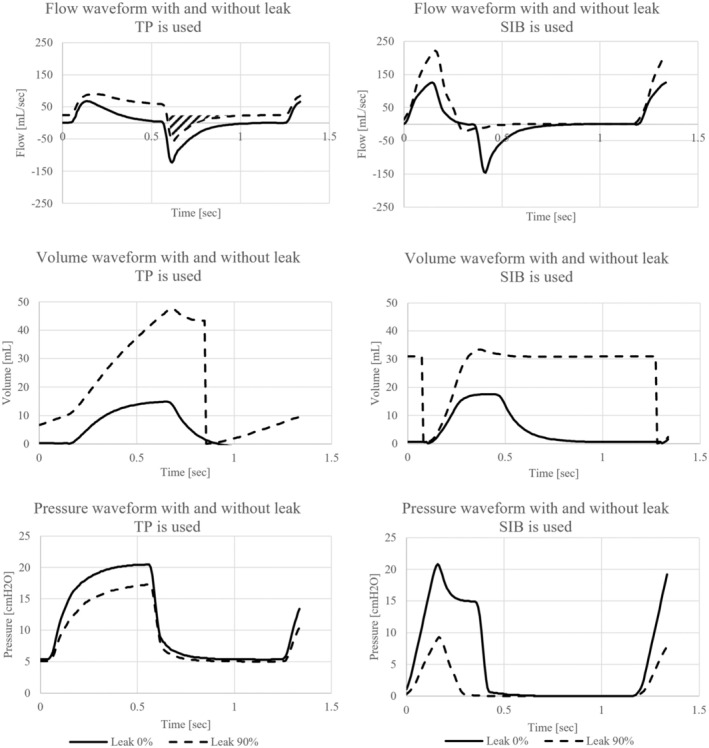 Figure 1: Comparative respiratory mechanics, pressure-time waveforms, and delivered tidal volumes during neonatal and infant positive pressure resuscitation using a T-piece resuscitator (TPR) versus a self-inflating bag (SIB) across baseline (0% leak) and severe mask leak (90% leak) conditions. Note the consistent square-wave inspiratory pressure plateau and stable baseline PEEP ($5\text{ cmH}_2\text{O}$) maintained by the T-piece device, contrasting with the operator-dependent, erratic pressure spikes, lack of baseline PEEP, and severe tidal volume loss characteristic of self-inflating manual resuscitators. Sourced from Takatori et al., Pediatrics International, 2025; DOI:
10.1111/ped.70139
.
Pediatric Resuscitation Ventilation Mechanics
PALS Resuscitation Guidelines: Manual Devices & Interfaces
Manual positive pressure ventilation (PPV) is the primary life-saving intervention in pediatric cardiopulmonary arrest and severe hypoventilation, as primary respiratory failure accounts for over 80% of pediatric arrests. Effective delivery requires an air-tight mask seal, appropriate tidal volume delivery ($6-8\text{ mL/kg}$), and prevention of gastric insufflation and pulmonary barotrauma.
flowchart TD
    A["Pediatric Patient with Inadequate Breathing / Apnea"] --> B{"Patient Age & Weight?"}
    B -->|"Neonate / Infant (< 10 kg)"| C["T-Piece Resuscitator (e.g., Neopuff) Preferred"]
    B -->|"Child / Adolescent (>= 10 kg)"| D["Self-Inflating Bag with PEEP Valve & Reservoir"]

    C --> E["Set Gas Flow 8-10 L/min<br>Preset PIP (20-25 cmH2O)<br>Preset PEEP (5 cmH2O)<br>Preset Pop-Off (35-40 cmH2O)"]
    D --> F["Attach 500 mL / 1000 mL Bag<br>Attach PEEP Valve (Set 5 cmH2O)<br>Verify Pop-Off Override Mechanism"]

    E --> G["Two-Person Technique:<br>Rescuer 1: Two-Handed E-C Clamp<br>Rescuer 2: Occlude PEEP Cap / Squeeze Bag"]
    F --> G

    G --> H{"Target Rate & Chest Rise"}
    H -->|"Arrest (Unintubated, 2 Rescuers)"| I["15:2 Compression-to-Ventilation Ratio"]
    H -->|"Arrest (Intubated Continuous CPR)"| J["1 breath every 2-3 seconds (20-30 bpm)"]
    H -->|"Respiratory Arrest (Pulse Present)"| K["1 breath every 2-3 seconds (20-30 bpm)"]
Bag-Mask Ventilation (BMV) Interface & The Two-Person E-C Clamp
A single-rescuer hand seal frequently fails in infants and young children due to the prominent suboccipital region, large tongue, and compliant subglottic tissues.
- Two-Person E-C Clamp Technique: Rescuer 1 utilizes both hands to position the mask over the nasal bridge and chin. The thumbs and index fingers form a "C" compressing the mask flange downward, while the third, fourth, and fifth fingers form an "E" under the mandibular ramus, lifting the jaw anteriorly without applying pressure to the soft submental triangle (which collapses the lingual airway). Rescuer 2 gently compresses the ventilation bag over a full $1.0\text{ second}$ inspiratory time, visualizing chest rise.
- Sizing of Resuscitation Bags:
- Infant bags ($240-450\text{ mL}$): Indicated for neonates and infants up to $10\text{ kg}$.
- Child/Pediatric bags ($500-750\text{ mL}$): Indicated for children $10-25\text{ kg}$.
- Adult bags ($1000-1600\text{ mL}$): Used only in children $> 25-30\text{ kg}$ or adolescents. Using an adult bag on a toddler easily delivers $30-50\text{ mL/kg}$ per compression, causing alveolar overdistension, barotrauma, and tension pneumothorax.
Pop-Off Valves and Pressure Dynamics
Standard pediatric self-inflating bags are equipped with an inline, spring-loaded pop-off pressure-limiting valve factory-set to release at:
$$P_{\text{pop-off}} = 35 - 40\text{ cmH}_2\text{O}$$- Clinical Caveat: In non-compliant lungs (e.g., severe ARDS, meconium aspiration, acute chest syndrome, pulmonary hemorrhage), airway pressures necessary to overcome decreased chest wall/lung compliance and elevated airway resistance ($R_{\text{aw}}$) may exceed $40\text{ cmH}_2\text{O}$. Rescuers must be prepared to engage the pop-off override clip while continuously monitoring chest wall excursion to prevent under-ventilation.
T-Piece Resuscitators vs. Self-Inflating Bags
T-piece resuscitators (e.g., Neopuff, Fisher & Paykel Healthcare) are flow-controlled, pressure-limited devices that require an external compressed gas source ($5-10\text{ L/min}$).
- Peak Inspiratory Pressure (PIP) and Positive End-Expiratory Pressure (PEEP) are precisely preset via mechanical dial valves.
- Inspiratory Time ($T_i$) Control: The rescuer intermittently occludes the PEEP cap with a finger, delivering a consistent square-wave pressure plateau independent of operator fatigue.
- Comparison: Self-inflating bags generate triangular, operator-variable pressure peaks and rapidly dump PEEP to zero unless fitted with a specialized, spring-loaded expiratory PEEP valve.
| Resuscitation Device | Gas Source Requirement | PEEP Capability | PIP Consistency | Spontaneous CPAP Delivery |
|---|---|---|---|---|
| Self-Inflating Bag (SIB) | Operates without gas flow (room air $FiO_2 = 0.21$) | Only with attached spring-loaded PEEP valve | Highly variable ($20-60\text{ cmH}_2\text{O}$); operator-dependent | No (valves close during spontaneous inhalation) |
| Flow-Inflating Bag (Anesthesia Bag) | Continuous gas flow required ($5-10\text{ L/min}$) | Adjustable via tail bleed valve | Operator-dependent (squeeze depth & flow rate) | Yes (maintains baseline CPAP) |
| T-Piece Resuscitator (Neopuff) | Continuous gas flow required ($5-15\text{ L/min}$) | Stable preset PEEP ($3-10\text{ cmH}_2\text{O}$) | Exact preset square-wave PIP ($15-40\text{ cmH}_2\text{O}$) | Yes (delivers reliable free-flow CPAP) |
Compression-to-Ventilation Ratios and CPR Mechanics
Pediatric Advanced Life Support (PALS) and AHA/ILCOR guidelines specify distinct ventilation strategies based on airway status and rescuer presence:
- Unintubated (Bag-Mask / Supraglottic Airway):
- Single Rescuer: $30:2$ compression-to-ventilation ratio.
- Two or More Rescuers: $15:2$ compression-to-ventilation ratio (pausing compressions for $1\text{ second}$ per breath to deliver 2 gentle inflations).
- Intubated / Advanced Airway in Place:
- Continuous uninterrupted chest compressions at $100-120\text{ compressions/min}$.
- Asynchronous ventilation: 1 breath every $2-3\text{ seconds}$ ($20-30\text{ breaths/min}$).
flowchart LR
    A["Excessive Ventilation Rate / Tidal Volume (> 30 bpm, > 10 mL/kg)"] --> B["Progressive Dynamic Air Trapping & Auto-PEEP"]
    B --> C["Marked Rise in Mean Intrathoracic Pressure (P_IT)"]
    C --> D["Compression of Superior & Inferior Vena Cava"]
    D --> E["Severe Reduction in Venous Return (Preload)"]
    C --> F["Increased Right Ventricular Afterload"]
    E --> G["Catastrophic Drop in Cardiac Output (CO)"]
    F --> G
    G --> H["Collapse of Coronary Perfusion Pressure (CPP)"]
    H --> I["Failure of Resuscitation & ROSC Inability"]
During cardiopulmonary resuscitation, pulmonary blood flow is severely restricted to only $25-33\%$ of normal cardiac output. Consequently, excessive minute ventilation ($> 30\text{ breaths/min}$ or large tidal volumes) generates air trapping, elevated intrathoracic pressure, and mechanical vascular compression. This dramatically lowers Coronary Perfusion Pressure:
$$\text{CPP} = P_{\text{aortic, diastolic}} - P_{\text{right atrial, diastolic}}$$By elevating right atrial diastolic pressure and collapsing venous return, hyperventilation directly abolishes myocardial blood flow, extinguishing the possibility of Return of Spontaneous Circulation (ROSC).
Acute Deterioration on Mechanical Ventilation: The DOPE Algorithm
When a ventilated pediatric patient exhibits sudden bradycardia, profound cyanosis, precipitous hypoxemia ($SpO_2 < 85\%$), or loss of end-tidal $CO_2$ waveform, the clinician must execute the DOPE algorithm immediately and systematically.
flowchart TD
    Start["Acute Deterioration / Severe Desaturation on Ventilator"] --> Step1["1. Disconnect Ventilator from ETT<br>2. Connect Manual Resuscitator with 100% O2 & PEEP<br>3. Assess 'Feel' of the Bag (Compliance & Resistance)"]

    Step1 --> D["D - Displacement"]
    D --> D_Action{"Check ETT Depth Mark at Lip/Gingiva & Waveform EtCO2"}
    D_Action -->|"ETT Dislodged into Pharynx"| D_Pharynx["Extubate, Perform BMV, Reintubate"]
    D_Action -->|"Right Mainstem Intubation"| D_Mainstem["Withdraw ETT 1-2 cm to Carina (Bilateral Breath Sounds)"]
    D_Action -->|"ETT Position Verified"| O["O - Obstruction"]

    O --> O_Action{"Pass Suction Catheter down ETT"}
    O_Action -->|"Catheter Blocks / Obstructed"| O_Clear["Inline Suctioning, Instill 0.5-1 mL Saline, Unkink Tube, or Replace ETT"]
    O_Action -->|"Catheter Passes Freely"| P["P - Pneumothorax"]

    P --> P_Action{"Asymmetric Chest Rise, Absent Breath Sounds, Tracheal Deviation, Hypotension"}
    P_Action -->|"Tension Pneumothorax Present"| P_Decomp["Immediate Needle Decompression (2nd ICS MCL or 4th/5th ICS AAL) followed by Chest Tube"]
    P_Action -->|"No Pneumothorax Detected"| E["E - Equipment Failure"]

    E --> E_Action{"Examine Ventilator, Circuit, Gas Supply"}
    E_Action -->|"Circuit Leak / Disconnection / Gas Outage"| E_Fix["Check Circuit Integrity, Gas Wall Outlets, Power Source, Switch to Bagging"]
Detailed DOPE Component Pathophysiology & Management
1. Displacement ($D$)
- Right Mainstem Bronchial Migration: In infants, the trachea is remarkably short ($4\text{ cm}$ in newborns, $5-7\text{ cm}$ in toddlers). Head flexion advances the ETT up to $1.5-2.0\text{ cm}$ distally into the right mainstem bronchus, resulting in left lung atelectasis and right lung overdistension/volutrauma. Head extension withdraws the tube cephalad into the subglottic space.
- Verification: Auscultate mid-axillary lines bilaterally, confirm symmetric bilateral chest expansion, verify depth mark at the alveolar ridge/incisors using the formula: $$\text{Depth at Lip (cm)} = \text{Internal Diameter (mm)} \times 3 \quad \text{or} \quad \frac{\text{Age (years)}}{2} + 12$$
2. Obstruction ($O$)
- Etiology: Secretion plugging, blood clot aspiration, ETT kinking at the oral bite-block, or herniation of the cuff over the Murphy eye/distal orifice.
- Diagnostic/Therapeutic Maneuver: Attempt immediate passage of an appropriately sized, end-hole suction catheter ($2 \times \text{ETT ID in mm}$ French size). Inability to pass the suction catheter past the distal tip confirms complete obstruction, necessitating immediate extubation and bag-mask resuscitation.
3. Pneumothorax ($P$)
- Tension Pneumothorax: Progressive positive pressure drives air into the pleural space via alveolar-pleural fistulas, creating a one-way ball-valve mechanism. Intrapleural pressure exceeds atmospheric pressure, causing mediastinal shift, contralateral lung compression, and inferior vena cava kinking with rapid cardiovascular collapse.
- Emergency Decompression:
- Needle Thoracostomy: Insert an 18–14 gauge over-the-needle catheter into the 2nd intercostal space in the mid-clavicular line or 4th/5th intercostal space anterior to the mid-axillary line, directly over the superior rib margin to avoid the neurovascular bundle.
- Finger Thoracostomy / Pigtail Chest Tube: Immediate definitive tube thoracostomy with underwater seal.
4. Equipment Failure ($E$)
- Mechanisms: Expiratory valve malfunction, breathing circuit disconnection, humidifier water-trap saturation with condensate occlusion, internal battery exhaustion, or depletion of transport oxygen cylinders.
- Action: Maintain manual ventilation with 100% oxygen using a stand-alone bag-valve resuscitator while systematically inspecting the ventilator power, gas supply pressures, and circuit integrity.
When acute deterioration occurs on mechanical ventilation:
- Disconnect immediately: Eliminate ventilator failure from the differential; assess manual lung compliance directly.
- Hand-bag with $100\% \text{ FiO}_2$: Feel for stiff lungs (pneumothorax/asthma) vs. zero resistance (disconnection/extubation).
- Pass a suction catheter: Clear mucus plugs; check tube patency to the full length.
- Decompress pleural space: If breath sounds are unilaterally absent with shock, needle decompress without awaiting radiography.
Pediatric Inter-Facility Transport Ventilation
Transporting critically ill neonates, infants, and children between institutions requires converting a mobile vehicle (ground ambulance, rotorcraft, or fixed-wing aircraft) into a fully functional intensive care unit.
flowchart TD
    subgraph PreTransport ["1. Pre-Transport Stabilization"]
        A1["Secure ETT: Note Depth Mark at Teeth/Gingiva"]
        A2["Convert to Cuffed ETT if Significant Leak"]
        A3["Place Nasogastric/Orogastric Tube to Low Suction"]
        A4["Calibrate Transport Ventilator to PICU Baseline Settings"]
    end

    subgraph TransportExecution ["2. En-Route Monitoring & Management"]
        B1["Continuous Real-Time Waveform EtCO2 Capnography"]
        B2["Monitor Cylinder Gas Remaining: P_cyl * Cyl_Factor / V_dot_E"]
        B3["Maintain Active/Passive Humidification (HME/HMEF)"]
        B4["Thermal Protection: Incubator / Space Blanket / Fluid Warmer"]
    end

    subgraph AeromedicalFlight ["3. Aeromedical Altitude Physics"]
        C1["Boyle's Law: P1 * V1 = P2 * V2"]
        C2["Decompress Trapped Gas (Air Splints, Pneumothorax, Bowel)"]
        C3["Replace ETT Cuff Air with Sterile Water or Titrate Pilot Pressure"]
        C4["Account for Barometric Hypoxia (Adjust FiO2 as PaO2 Shifts)"]
    end

    PreTransport --> TransportExecution
    TransportExecution --> AeromedicalFlight
Transport Ventilator Technology: Pneumatic vs. Turbine-Driven
Dedicated critical care transport ventilators must deliver exact tidal volumes down to $20-50\text{ mL}$ with active flow triggering and pressure-limited safety features.
+-----------------------------------------------------------------------------------+
|                        CRITICAL CARE TRANSPORT VENTILATOR                         |
+-----------------------------------------------------------------------------------+
|  [Pneumatic Venturi / Gas-Driven]            [Turbine / Blower-Driven]            |
|  - Consumes high-pressure O2 for operation   - Generates inspiratory flow via fan |
|  - Depletes cylinders rapidly                - Conserves O2 (O2 only for FiO2)    |
|  - Lightweight, no compressor needed         - Higher electrical battery burden   |
+-----------------------------------------------------------------------------------+
- Pneumatic (Gas-Driven) Ventilators:
- Rely on high-pressure ($50\text{ psi}$) gas sources to power internal fluidic timing and pneumatic pistons.
- Severe Limitation: Consume significant quantities of oxygen simply to operate the internal mechanics (driving gas), rapidly exhausting cylinder reserves.
- Turbine / Blower-Driven Ventilators (e.g., Hamilton-T1, Zoll Z-Vent, Medtronic PB560):
- Generate inspiratory flow utilizing an internal ambient-air turbine compressor.
- High-pressure or low-pressure oxygen is added solely to achieve the target $FiO_2$, dramatically extending cylinder longevity.
- Feature advanced modes: Adaptive Support Ventilation (ASV), PRVC, non-invasive ventilation (NIV), and inline continuous waveform capnography.
Transport Gas Consumption Mathematical Derivations
Calculating required oxygen reserves is critical to avoid in-transit depletion. The total gas consumption per minute ($\dot{V}_{\text{gas, total}}$) encompasses the patient's minute ventilation, the ventilator's internal bias flow (for flow-triggering), and pneumatic consumption.
flowchart LR
    A["Cylinder Pressure (P_psi) - Residual Safety Margin (200 psi)"] --> B["Usable Pressure (psi)"]
    B --> C["Multiply by Cylinder Conversion Factor (k_cyl)"]
    C --> D["Total Usable Gas Volume (Liters)"]
    D --> E["Divide by Total Gas Consumption per Minute (L/min)"]
    E --> F["Total Transport Oxygen Duration (Minutes)"]
The usable duration of a compressed medical gas cylinder is derived from:
$$T_{\text{remaining (min)}} = \frac{\left(P_{\text{gauge}} - P_{\text{safe}}\right) \times k_{\text{cyl}}}{\dot{V}_{\text{total}}}$$Where:
- $P_{\text{gauge}} = \text{Current cylinder pressure in pounds per square inch (psi)}$.
- $P_{\text{safe}} = \text{Minimum residual safety margin (typically } 200\text{ psi)}$.
- $k_{\text{cyl}} = \text{Cylinder tank conversion factor (Liters per psi)}$.
- D cylinder: $k = 0.16\text{ L/psi}$ ($350-400\text{ L}$ total)
- E cylinder: $k = 0.28\text{ L/psi}$ ($660\text{ L}$ total)
- M cylinder: $k = 1.56\text{ L/psi}$ ($3450\text{ L}$ total)
- $\dot{V}_{\text{total}} = (\dot{V}_E \times \text{fractional } O_2 \text{ demand}) + \text{Ventilator Bias Flow } (\text{L/min})$.
The $2\times$ Safety Margin Rule
Inter-facility transport logistics must always account for unforeseen transit delays (traffic congestion, mechanical failure, adverse weather diversion). Transport teams must carry at least twice ($2.0\times$) the calculated oxygen requirement for the planned journey duration.
| Patient Age / Weight | Minute Ventilation ($\dot{V}_E$) | FiO2 | Bias Flow | Total O2 Draw ($\dot{V}_{\text{O2}}$) | E-Cylinder Duration ($2000\text{ psi}$) |
|---|---|---|---|---|---|
| Infant ($5\text{ kg}$) | $1.2\text{ L/min}$ | $0.40$ | $2.0\text{ L/min}$ | $2.5\text{ L/min}$ | $\approx 200\text{ minutes}$ ($3.3\text{ hrs}$) |
| Child ($20\text{ kg}$) | $4.0\text{ L/min}$ | $0.60$ | $2.0\text{ L/min}$ | $4.4\text{ L/min}$ | $\approx 114\text{ minutes}$ ($1.9\text{ hrs}$) |
| Adolescent ($60\text{ kg}$) | $8.5\text{ L/min}$ | $1.00$ | $2.0\text{ L/min}$ | $10.5\text{ L/min}$ | $\approx 48\text{ minutes}$ ($0.8\text{ hrs}$) |
Altitude Physiology in Aeromedical Transport
Fixed-wing air ambulances and rotorcraft encounter significant barometric pressure drops with increasing altitude. Commercial aircraft and fixed-wing air ambulances typically maintain a pressurized cabin altitude of $6,000 - 8,000\text{ feet}$ ($1,800 - 2,400\text{ meters}$), where atmospheric pressure ($P_B$) falls from $760\text{ mmHg}$ at sea level to $565\text{ mmHg}$. Unpressurized rotary-wing helicopters operate at true ambient pressure.
flowchart TD
    subgraph BoylesLawPhysiology ["Boyle's Law Mechanics: P1 * V1 = P2 * V2"]
        Alt["Ascent to Altitude (Atmospheric Pressure PB Drops)"] --> GasExp["Trapped Gas Expands Proportionally (Volume V2 Increases)"]
        GasExp --> ETT_Cuff["ETT Cuff Expansion -> Tracheal Mucosal Ischemia & Necrosis"]
        GasExp --> Pleural["Occult Pneumothorax -> Tension Pneumothorax"]
        GasExp --> Bowel["Gastric / Intestinal Gas -> Diaphragmatic Splinting & Restriction"]
        GasExp --> MiddleEar["Tympanic Membrane / Sinus Pressure -> Barotrauma & Pain"]
    end

    subgraph Mitigations ["Clinical Countermeasures"]
        ETT_Cuff --> M1["Fill Cuff with Sterile Water/Saline OR Continuous Manometer Titration"]
        Pleural --> M2["Place Chest Tube Before Flight for Any Known Pneumothorax"]
        Bowel --> M3["Decompress Stomach with Large-Bore NG/OG Tube on Continuous Venting"]
    end
At constant temperature, the volume of a given mass of dry gas is inversely proportional to its pressure:
$$P_1 V_1 = P_2 V_2 \implies V_2 = V_1 \left(\frac{P_1}{P_2}\right)$$As altitude increases and ambient barometric pressure ($P_2$) decreases, any enclosed, non-vented gas pocket ($V_1$) expands in volume ($V_2$).
| Altitude (Feet / Meters) | Barometric Pressure ($P_B$, mmHg) | Gas Expansion Ratio ($V_2 / V_1$) | Clinical Implication |
|---|---|---|---|
| Sea Level ($0\text{ m}$) | $760\text{ mmHg}$ | $1.00$ | Baseline volume |
| $5,000\text{ ft}$ ($1,524\text{ m}$) | $632\text{ mmHg}$ | $1.20$ ($+20\%$) | ETT cuff pressure exceeds $30\text{ cmH}_2\text{O}$ |
| $8,000\text{ ft}$ ($2,438\text{ m}$) | $565\text{ mmHg}$ | $1.35$ ($+35\%$) | Standard cabin altitude; stomach & pneumothorax expansion |
| $10,000\text{ ft}$ ($3,048\text{ m}$) | $523\text{ mmHg}$ | $1.45$ ($+45\%$) | Unpressurized rotorcraft; critical mucosal ischemia risk |
Endotracheal Tube Cuff Management at Altitude
- Air within an ETT cuff expands by $30-45\%$ during ascent to cruising altitude, elevating cuff pressure well above the microvascular perfusion pressure of the pediatric tracheal mucosa ($25-30\text{ cmH}_2\text{O}$), risking circumferential ischemic necrosis, tracheomalacia, and post-extubation subglottic stenosis.
- Management Protocol:
- Sterile Water / Saline Filling: Replace air in the ETT cuff with sterile liquid, as liquids are non-compressible and do not expand according to Boyle's law.
- Continuous In-Flight Manometer Monitoring: Use a handheld aneroid manometer to continuously adjust cuff pressures to $20-25\text{ cmH}_2\text{O}$ during ascent and descent phases.
Trapped Gas Decompression
- Pneumothoraces: Any known or suspected pneumothorax must be treated with a functioning tube thoracostomy before take-off.
- Gastrointestinal Gas: Place an orogastric or nasogastric tube open to air/drainage to prevent trapped gas from pushing the diaphragm cephalad, which would decrease functional residual capacity (FRC) and worsen compliance.
Environmental and In-Flight Monitoring Mandates
Continuous Waveform Capnography ($EtCO_2$)
Continuous end-tidal $CO_2$ waveform monitoring is an absolute standard of care in transport medicine:
- Instantaneous ETT Confirmation: Immediate recognition of accidental extubation during vehicle vibration or patient transfer.
- Ventilation Optimization: Prevents both hypercapnic acidosis and hypocapnic cerebral vasoconstriction (critical in traumatic brain injury).
- Early Shock / Perfusion Warning: A sudden drop in $EtCO_2$ with stable ventilation reflects a sharp decrease in pulmonary perfusion, signaling hemorrhagic shock, massive pulmonary embolism, or cardiopulmonary arrest.
Thermal Regulation and Humidification
- Thermoregulation: Hypothermia increases oxygen consumption ($VO_2$), induces pulmonary vasoconstriction, worsens metabolic acidosis, and impairs coagulation. Transport requires closed transport incubators for neonates, thermal blankets, warmed intravenous fluids, and cabin ambient temperature control.
- Humidification: Cold, dry compressed cylinder gas rapidly desiccates pediatric airway secretions, leading to acute mucus plugging. An age-appropriate Heat and Moisture Exchanger with Filter (HME / HMEF) must be placed in-line at the ETT connector (ensuring added apparatus dead space does not exceed $1-2\text{ mL/kg}$ in small infants).
Comprehensive Summary Matrix: Resuscitation & Transport Ventilation
| Parameter / Protocol | Neonate / Infant ($< 10\text{ kg}$) | Child ($10 - 30\text{ kg}$) | Adolescent ($> 30\text{ kg}$) |
|---|---|---|---|
| Primary Manual Device | T-Piece Resuscitator (Neopuff) | Self-Inflating Bag ($500\text{ mL}$) with PEEP | Self-Inflating Bag ($1000-1500\text{ mL}$) |
| Preset Resuscitation PEEP | $5\text{ cmH}_2\text{O}$ | $5\text{ cmH}_2\text{O}$ | $5\text{ cmH}_2\text{O}$ |
| Preset Resuscitation PIP | $20-25\text{ cmH}_2\text{O}$ (Pop-off $35-40$) | Controlled by hand squeeze & pop-off | Controlled by hand squeeze |
| CPR Rate (Advanced Airway) | $20-30\text{ breaths/min}$ ($1\text{ q } 2-3\text{ s}$) | $20-30\text{ breaths/min}$ ($1\text{ q } 2-3\text{ s}$) | $20-30\text{ breaths/min}$ ($1\text{ q } 2-3\text{ s}$) |
| CPR Rate (Unintubated 2-Rescuer) | $15:2$ compression-to-ventilation | $15:2$ compression-to-ventilation | $15:2$ (or $30:2$ if single rescuer) |
| ETT Depth Formula | $\text{ID} \times 3$ or gestational weight rules | $\text{Age}/2 + 12\text{ cm}$ at lip | $\text{Age}/2 + 12\text{ cm}$ at teeth |
| Transport Ventilator Type | Turbine-driven or neonatal pneumatic | Turbine-driven critical care vent | Turbine-driven critical care vent |
| Altitude ETT Cuff Protection | Liquid fill / continuous manometer | Liquid fill / continuous manometer | Liquid fill / continuous manometer |
| Minimum Oxygen Reserve | $2.0 \times$ calculated travel time | $2.0 \times$ calculated travel time | $2.0 \times$ calculated travel time |