Pediatric sepsis and septic shock represent a systemic dysregulated host response to infection characterized by profound microvascular dysfunction, cellular metabolic failure, myocardial depression, and severe distributive/hypovolemic shock. Respiratory failure frequently coexists—either as the primary septic nidus (e.g., severe bacterial or viral pneumonia) or as a secondary manifestation of systemic endothelial barrier breakdown resulting in Pediatric Acute Respiratory Distress Syndrome (PARDS). In critically ill infants and children with septic shock, invasive mechanical ventilation is not merely a supportive measure for gas exchange failure, but a powerful hemodynamic resuscitation tool that unloads the exhausted respiratory musculature and redistributes limited cardiac output to vital organ beds.
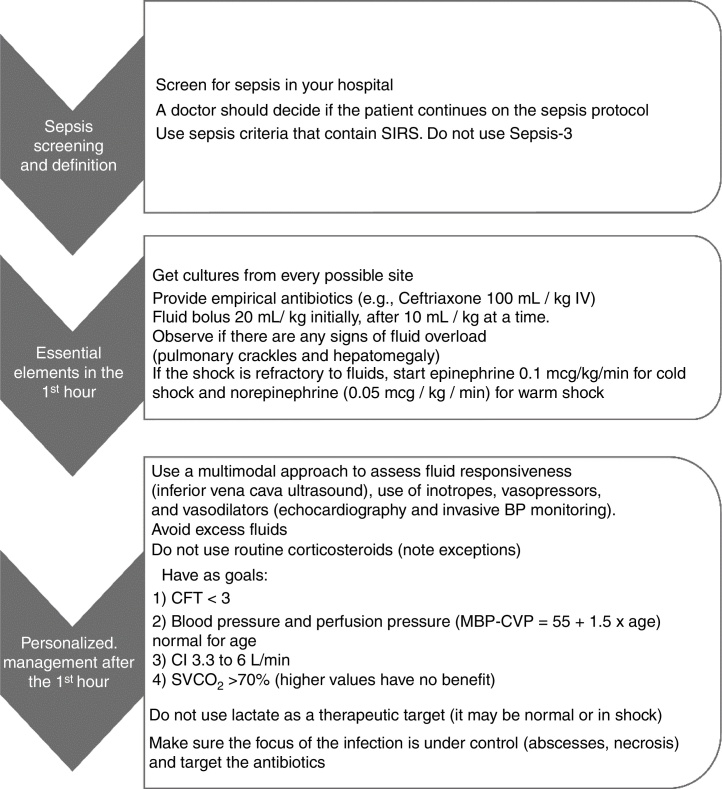 Figure 1: Stepwise pharmacological and clinical resuscitation algorithm for pediatric sepsis and septic shock, outlining the progression from rapid screening and initial 1-hour fluid titration ($10-20\text{ mL/kg}$) to early vasoactive support (epinephrine for cold shock phenotypes vs. norepinephrine for warm shock phenotypes) and personalized physiological goal-directed management. Sourced from Garcia et al., Jornal de Pediatria 2020; DOI: 10.1016/j.jped.2019.10.007 (PMC9432279).
flowchart TD
    subgraph Sepsis_Cascade["Systemic Septic Cascade"]
        Pathogen["Invasive Infection (PAMPs / DAMPs)"] --> Inflam["Systemic Cytokine Release (TNF-alpha, IL-1beta, IL-6)"]
        Inflam --> Glycocalyx["Endothelial Glycocalyx Degradation & Capillary Leak"]
        Inflam --> Vaso["Nitric Oxide Overproduction & Vasoplegia"]
        Inflam --> Myo["Myocardial Depression (Cytokine-Induced Beta-Receptor Desensitization)"]
    end

    subgraph Respiratory_Consequences["Cardiopulmonary Crosstalk & Work of Breathing"]
        Glycocalyx --> PARDS["Alveolar-Capillary Barrier Disruption & Protein-Rich Edema (PARDS)"]
        PARDS --> LossFRC["Micro-Atelectasis, V/Q Mismatch, & Severe Reduction in Lung Compliance"]
        LossFRC --> WOB["Massive Increase in Work of Breathing (WOB)"]
        WOB --> Steal["Diaphragm Steal: 40–50% Cardiac Output Diverted to Respiratory Muscles"]
        Steal --> OrganHypo["Systemic Malperfusion: Renal, Cerebral, & Mesenteric Hypoxia"]
    end

    subgraph MV_Intervention["Therapeutic Unloading via Invasive Mechanical Ventilation"]
        MV["Invasive Positive Pressure Ventilation + Neuromuscular Blockade"]
        MV --> Unload["Abolishes Diaphragmatic Work (WOB -> 0)"]
        Unload --> PerfusionRestored["Recaptures 40–50% Cardiac Output -> Restores Vital Organ Perfusion"]
        MV --> AlveolarRecruit["PEEP & P_plat Control -> Reverses Micro-Atelectasis & Restores FRC"]
    end

    Steal -.->|Critical Indication for Support| MV
Pathophysiological Crosstalk Between Sepsis, Shock, and Lung Injury
The intersection of septic shock and acute lung injury in pediatric patients is governed by systemic immune activation, severe endothelial permeability alterations, and acute metabolic resource reallocation.
Endothelial Barrier Breakdown, Glycocalyx Shedding, and PARDS
During invasive sepsis, circulating pathogen-associated molecular patterns (PAMPs, such as lipopolysaccharide and peptidoglycan) and damage-associated molecular patterns (DAMPs, including high-mobility group box 1 [HMGB1] and mitochondrial DNA) bind Toll-like receptors (TLRs) on pulmonary endothelial and alveolar epithelial cells:
- Glycocalyx Degradation: Endothelial activation stimulates neutrophil elastase, matrix metalloproteinases, and heparanase, cleaving the endothelial glycocalyx (syndecan-1 and hyaluronic acid shedding). This disrupts the endothelial surface layer that normally restricts macromolecular transit.
- Capillary Leak Syndrome: Loss of vascular integrity promotes hydrostatic and oncotic fluid extravasation into the pulmonary interstitial and alveolar spaces, flooding alveoli with proteinaceous exudate and cellular debris.
- Surfactant Inactivation and Alveolar Instability: Fibrinogen, albumin, and inflammatory cytokines directly inactivate pulmonary surfactant. Alveolar surface tension rises precipitously according to the Young-Laplace relationship: $$\Delta P = \frac{2\gamma}{r}$$ where elevated surface tension ($\gamma$) in small-radius alveoli ($r$) induces widespread diffuse micro-atelectasis, severe ventilation-perfusion ($V/Q$) mismatch, intrapulmonary right-to-left shunting, and a dramatic drop in static respiratory system compliance ($C_{rs}$).
graph LR
    PAMP["PAMPs / DAMPs (TLR4 Activation)"] --> Neutro["Neutrophil Extravasation & NETosis"]
    Neutro --> Protease["Protease & ROS Release"]
    Protease --> GlycoLoss["Syndecan-1 & Glycocalyx Cleavage"]
    GlycoLoss --> JunctionBreak["VE-Cadherin Disruption & Gap Formation"]
    JunctionBreak --> Exudate["Proteinaceous Alveolar Inundation"]
    Exudate --> SurfInact["Surfactant Inactivation & Alveolar Collapse"]
Diaphragm Perfusion Steal and the Metabolic Cost of Breathing
In healthy children at rest, the metabolic cost of breathing consumes less than $2-5\%$ of total whole-body oxygen consumption ($\dot{V}O_2$) and a matching fraction of cardiac output ($CO$). In severe sepsis and secondary PARDS, the work of breathing increases exponentially due to:
- Markedly reduced lung compliance requiring enormous transpulmonary pressure swings ($\Delta P_L > 20-30\text{ cmH}_2\text{O}$).
- Increased airway resistance from inflammatory secretions and peribronchial cuffing.
- Severe tachypnea driven by central metabolic acidemia (lactic acidosis) demanding compensatory alveolar hyperventilation to eliminate carbon dioxide.
Under these pathological conditions, diaphragmatic and intercostal muscle oxygen demands surge. The respiratory musculature can divert up to $40-50\%$ of total cardiac output to maintain ventilation:
$$\dot{V}O_{2,\text{total}} = \dot{V}O_{2,\text{systemic}} + \dot{V}O_{2,\text{respiratory}}$$$$CO = CO_{\text{vital organs}} + CO_{\text{respiratory muscles}}$$When the cardiovascular system is already compromised by septic myocardial depression and hypovolemia, this "diaphragmatic steal phenomenon" leaves remaining visceral beds (cerebral, coronary, renal, and splanchnic) underperfused.
Systemic arterial oxygen delivery ($DO_2$) is the mathematical product of cardiac output ($CO$) and arterial oxygen content ($CaO_2$):
$$DO_2 = CO \times CaO_2 = CO \times \left(1.34 \times [\text{Hb}] \times S_aO_2 + 0.0031 \times P_aO_2\right)$$In severe pediatric septic shock, if $45\%$ of $CO$ is consumed by the diaphragm, the effective oxygen delivery to vital visceral organs ($DO_{2,\text{visceral}}$) is halved:
$$DO_{2,\text{visceral}} = (0.55 \times CO) \times CaO_2$$Endotracheal intubation, controlled mechanical ventilation, and therapeutic neuromuscular blockade eliminate the active work of breathing ($\text{WOB} \approx 0\text{ J/L}$), instantly liberating up to $50\%$ of systemic blood flow to re-perfuse ischemic kidneys, liver, gut, and brain.
Hemodynamics of Intubation in Pediatric Septic Shock
Endotracheal intubation in pediatric septic shock is one of the highest-risk resuscitation procedures in critical care medicine. Without rigorous physiological pre-optimization, induction and positive pressure initiation frequently trigger catastrophic cardiovascular collapse and peri-intubation cardiac arrest.
flowchart TD
    subgraph High_Risk_State["Decompensated Septic Shock (Baseline)"]
        S1["Profound Hypovolemia & Vasoplegia"]
        S2["Endogenous Catecholamine Surge (Tachycardia + Vasoconstriction)"]
        S3["Spontaneous Negative Intrathoracic Pressure (Aids Venous Return)"]
        S4["Septic Myocardial Dysfunction (Depressed LVEF / RVEF)"]
    end

    subgraph Induction_Effects["Induction & Intubation Insults"]
        I1["Sedative Induction Agents -> Abolish Sympathetic Adrenergic Drive"]
        I2["Neuromuscular Blockade -> Loss of Muscle Pump & Thoracic Tone"]
        I3["Positive Pressure Ventilation (PEEP + PIP) -> Elevated Mean Airway Pressure"]
    end

    subgraph Hemodynamic_Collapse["Pathophysiological Downstream Cascade"]
        I1 & I2 --> Vasodilation["Abrupt Vasodilation & Venodilation (Unstressed Volume Increases)"]
        I3 --> Intrathoracic["Elevated Intrathoracic Pressure -> Caval Collapse & Severe Drop in Venous Return"]
        Vasodilation & Intrathoracic --> PreloadDrop["Precipitous Drop in RV End-Diastolic Volume"]
        I3 --> RVAfterload["Alveolar Overdistension -> Elevated Pulmonary Vascular Resistance (RV Afterload)"]
        PreloadDrop & RVAfterload & S4 --> AcuteLVDrop["Acute Fall in LV Stroke Volume & Cardiac Output"]
        AcuteLVDrop --> Arrest["Severe Post-Intubation Hypotension / PEA Cardiac Arrest"]
    end

    High_Risk_State --> Induction_Effects
    Induction_Effects --> Hemodynamic_Collapse
Lethal Mechanisms of Post-Intubation Circulatory Collapse
- Abolition of Endogenous Adrenergic Tone: Patients in septic shock maintain marginal perfusion pressures via extreme endogenous catecholamine secretion. Standard induction sedatives (even moderate doses of midazolam or fentanyl) instantly blunt this sympathetic compensation, resulting in profound vasodilation and loss of systemic vascular resistance ($SVR$).
- Shift to Positive Intrathoracic Pressure and Preload Elimination: Spontaneous breathing generates negative intrathoracic pressure swings during inspiration, augmenting the pressure gradient for venous return from the extrathoracic systemic veins (mean systemic filling pressure, $P_{msf}$) to the right atrium ($P_{ra}$): $$Q_{vr} = \frac{P_{msf} - P_{ra}}{R_{vr}}$$ Transitioning to positive pressure ventilation elevates mean intrathoracic pressure and $P_{ra}$. In an underfilled septic circulation with depleted unstressed and stressed vascular volumes, $P_{ra}$ easily exceeds $P_{msf}$, causing immediate caval collapse and catastrophic reduction in venous return ($Q_{vr} \to 0$).
- Right Ventricular Afterload Surge: Positive airway pressures applied to heterogeneously collapsed or overdistended lung units compress intra-alveolar capillaries, increasing pulmonary vascular resistance ($PVR$) and precipitating acute right ventricular strain or right-to-left interventricular septal flattening (reversed Bernheim phenomenon).
- Direct Myocardial Depression: Sepsis-induced cardiomyopathy (driven by circulating myocardial depressant factors like IL-6, TNF-$\alpha$, and NO-induced mitochondrial uncoupling) renders the heart intolerant of acute alterations in loading conditions.
Attempting emergency endotracheal intubation in an under-resuscitated child with septic shock before restoring circulating intravascular volume and initiating vasoactive infusions carries a high risk of pulseless electrical activity (PEA) or asystolic cardiac arrest within 1 to 5 minutes of induction. Intubation must be conceptualized as an advanced hemodynamic intervention requiring pre-emptive vascular stabilization.
Hemodynamic Resuscitation-First Protocol
Prior to the administration of any induction agent, the resuscitation team must execute a structured stabilization bundle:
flowchart TD
    Step1["Step 1: Rapid Vascular Access & Resuscitation Boluses
(IO / Peripheral IV: 10–20 mL/kg Balanced Crystalloid over 10–15 min)"] --> Step2
    Step2["Step 2: Pre-Emptive Vasoactive Infusion Running
(Epinephrine 0.05–0.2 mcg/kg/min or Norepinephrine 0.05–0.2 mcg/kg/min)"] --> Step3
    Step3["Step 3: Push-Dose Vasopressor Drawn and In-Line
(Epinephrine 1 mcg/kg or Phenylephrine 1–2 mcg/kg ready at bedside)"] --> Step4
    Step4["Step 4: Denitrogenation & Pre-Oxygenation
(High-flow nasal cannula or CPAP with 100% FiO2; Avoid excessive bag-mask peak pressures)"] --> Step5
    Step5["Step 5: Hemodynamically Neutral Induction & Rapid Sequence Airway Placement"]
Stepwise Pre-Intubation Bundle
- Intravascular Volume Expansion: Administer $10-20\text{ mL/kg}$ of balanced isotonic crystalloids (e.g., Plasmalyte or Ringer's Lactate; avoid large-volume $0.9\%$ saline to prevent hyperchloremic metabolic acidosis) titrated against signs of fluid responsiveness.
- Early Vasoactive Support: Do not wait for central venous access. Initiate peripheral or intraosseous (IO) continuous vasoactive infusions before induction:
- Cold Shock (Poor perfusion, delayed CRT $> 3\text{ s}$, low CO, elevated SVR): Epinephrine infusion ($0.05-0.2\text{ mcg/kg/min}$).
- Warm Shock (Flash CRT $< 1\text{ s}$, bounding pulses, wide pulse pressure, low SVR): Norepinephrine infusion ($0.05-0.2\text{ mcg/kg/min}$).
- Push-Dose Vasopressors at Bedside: Dedicated push-dose epinephrine ($1\text{ mcg/kg/dose} = 0.1\text{ mL/kg}$ of $1:100,000$ solution [$10\text{ mcg/mL}$]) must be connected and ready for immediate bolus administration upon induction if mean arterial pressure (MAP) declines.
Induction Agent Pharmacology in Septic Shock
The selection and dosing of induction and neuromuscular blocking agents must prioritize hemodynamic stability.
| Drug | Recommended Dosing in Septic Shock | Hemodynamic Mechanism & Impact | Advantages & Clinical Pearls | Major Pitfalls & Contraindications |
|---|---|---|---|---|
| Ketamine | $1.0-2.0\text{ mg/kg}$ IV/IO | Centrally stimulates sympathetic catecholamine release; preserves vascular tone and SVR. | Bronchodilator; preserves functional residual capacity and pharyngeal reflexes; maintains MAP in most patients. | In catecholamine-depleted, critically moribund shock states, intrinsic direct negative inotropic effects may unmask acute hypotension. |
| Etomidate | $0.2-0.3\text{ mg/kg}$ IV/IO | Minimal alteration of myocardial contractility, heart rate, or SVR. | Hemodynamically neutral; excellent cerebral perfusion pressure preservation. | Adrenal suppression via transient reversible inhibition of $11\beta$-hydroxylase; controversy in sepsis regarding refractory hypotension. |
| Rocuronium | $1.0-1.2\text{ mg/kg}$ IV/IO | Non-depolarizing steroidal NMBA; competitive acetylcholine antagonist. | Rapid onset ($45-60\text{ s}$ at RSI dose); zero histamine release; excellent intubating conditions. | Reversal agent Sugammadex must be readily dosed if 'cannot intubate, cannot oxygenate' crisis occurs. |
| Succinylcholine | $1.5-2.0\text{ mg/kg}$ IV/IO | Depolarizing NMBA; activates motor endplate nicotinic receptors. | Ultra-rapid onset ($30-45\text{ s}$) and short duration of action ($5-10\text{ min}$). | Lethal hyperkalemia risk in patients with sepsis-induced denervation, crush injury, or prolonged immobilization; muscarinic bradycardia. |
| Propofol | AVOID | Profound arterial and venous dilation; direct negative inotrope. | Rapid emergence; potent anticonvulsant. | High risk of cardiac arrest in septic shock due to massive drop in $P_{msf}$ and SVR. |
| Midazolam | AVOID high dose ($< 0.05\text{ mg/kg}$ if used) | Potentiates GABA; systemic venodilation and blunting of sympathetic tone. | Anterograde amnesia. | Substantial vasodilation and unpredictable myocardial depression in underfilled patients. |
In the vast majority of pediatric septic shock cases requiring emergency intubation:
- First-Line Induction: Ketamine ($1-2\text{ mg/kg}$ IV/IO) + Rocuronium ($1.2\text{ mg/kg}$ IV/IO).
- Alternative: Etomidate ($0.2\text{ mg/kg}$ IV/IO) if ketamine is contraindicated.
- Maintain continuous vasoactive drug flow throughout the entire laryngoscopy sequence.
Lung-Protective Mechanical Ventilation in Sepsis (PALICC-2 Standards)
Following successful airway placement, ventilator management must adhere strictly to pediatric lung-protective ventilation guidelines (Second Pediatric Acute Lung Injury Consensus Conference, PALICC-2). Sepsis-induced lung injury is inherently heterogeneous; unprotective ventilation rapidly accelerates biotrauma and secondary multi-organ failure.
graph TD
    subgraph Ventilator_Prescription["Lung-Protective Ventilator Framework (PALICC-2)"]
        VT["Low Tidal Volume (V_T: 5–7 mL/kg PBW)"]
        DP["Driving Pressure Limitation (Delta P = P_plat - PEEP <= 14 cmH2O)"]
        PEEP["Optimal PEEP Titration (8–12 cmH2O for Capillary Leak)"]
        FiO2["Targeted Oxygenation (SpO2: 92–97% for Mild, 88–92% for Moderate-Severe)"]
        pH["Permissive Hypercapnia (pH 7.20–7.30, PaCO2 50–65 mmHg)"]
    end

    subgraph Protective_Targets["Pathophysiological Protection Targets"]
        VT & DP --> VoluStrain["Abolishes Volutrauma & Excessive Alveolar Strain"]
        PEEP --> AtelecShear["Prevents Cyclic Alveolar Collapse (Atelectrauma)"]
        pH --> BaroSafe["Avoids Injurious Peak Pressures & Reduces Mechanical Power"]
    end

    subgraph Clinical_Outcome["Systemic Impact"]
        VoluStrain & AtelecShear & BaroSafe --> BioTrauma["Reduced Cytokine Translocation into Systemic Circulation (Biotrauma)"]
        BioTrauma --> OrganProtection["Mitigates Sepsis-Induced Secondary AKI, Hepatic & MOF"]
    end
Initial Modes and Protective Parameters
- Ventilator Mode: Pressure-Controlled Synchronized Intermittent Mandatory Ventilation (PC-SIMV) with Pressure Support or Pressure-Controlled Continuous Mandatory Ventilation (PC-CMV). Pressure-controlled modalities allow strict limitation of peak inspiratory pressures ($PIP$) and continuous decelerating flow patterns that improve alveolar recruitment in heterogeneous lung units.
- Tidal Volume ($V_T$): Target $5-7\text{ mL/kg}$ of Predicted Body Weight (PBW) (or $3-6\text{ mL/kg}$ in severe PARDS with markedly reduced compliance). Avoid calculating $V_T$ based on actual body weight in fluid-overloaded or obese children.
- Driving Pressure ($\Delta P$): $$\Delta P = P_{\text{plat}} - \text{PEEP} = \frac{V_T}{C_{rs}}$$ Maintain $\Delta P \le 14\text{ cmH}_2\text{O}$ (and ideally $< 12\text{ cmH}_2\text{O}$). Elevated driving pressure reflects excessive cyclic strain on the surviving "baby lung" and directly correlates with mortality in pediatric sepsis.
- Plateau Pressure ($P_{\text{plat}}$): Restrict $P_{\text{plat}} \le 28\text{ cmH}_2\text{O}$ (or $\le 30-32\text{ cmH}_2\text{O}$ in patients with markedly reduced chest wall compliance from abdominal compartment syndrome or severe anasarca).
- Positive End-Expiratory Pressure (PEEP):
- Initiate moderate-to-high PEEP: $8-12\text{ cmH}_2\text{O}$ (escalating up to $14-16\text{ cmH}_2\text{O}$ in severe PARDS).
- Rationale: Systemic capillary leak reduces alveolar compliance and surfactant concentration. Inadequate PEEP ($< 6\text{ cmH}_2\text{O}$) causes end-expiratory alveolar derecruitment, cyclical reopening shear injury (atelectrauma), and worsening right-to-left shunting.
- Permissive Hypercapnia:
- Accept respiratory acidosis with arterial pH $7.20-7.30$ ($P_aCO_2$ $50-65\text{ mmHg}$) provided the patient has no concurrent severe pulmonary hypertension, intracranial hypertension, or life-threatening uncorrected metabolic acidosis.
Hemodynamic Phenotypes and Mechanical Ventilation Strategies
| Hemodynamic Phenotype | Core Pathophysiological Derangement | Clinical Bedside Presentation | Primary Vasoactive Agent of Choice | Ventilator Strategy & Cautions |
|---|---|---|---|---|
| Hyperdynamic / Warm Shock (Low SVR, High CO) | Systemic vasoplegia, endothelial NO overproduction, low effective circulating volume. | Bounding peripheral pulses, flash CRT ($< 1\text{ s}$), wide pulse pressure, warm flushed extremities. | Norepinephrine ($0.05-0.5\text{ mcg/kg/min}$) $\pm$ Vasopressin ($0.0003-0.002\text{ U/kg/min}$). | Maintain adequate intravascular volume; PEEP will lower SVR further if venous return falls; monitor dynamic compliance and MAP carefully. |
| Cardiogenic / Cold Shock (Low CO, High SVR) | Sepsis-induced myocardial depression, poor contractility, high compensatory SVR. | Weak thready pulses, delayed CRT ($> 3\text{ s}$), cool mottled extremities, narrow pulse pressure. | Epinephrine ($0.05-0.3\text{ mcg/kg/min}$) $\pm$ Milrinone ($0.25-0.75\text{ mcg/kg/min}$) once volume replete. | Avoid excessive PEEP which increases RV afterload and drops LV preload; keep driving pressure low to minimize mechanical power. |
| Septic PARDS with Acute Cor Pulmonale (ACP) | High PVR from alveolar hypoxia, hypercapnia, microvascular thrombosis, and high $P_{\text{mean}}$. | RV dilation, D-shaped LV on echo, systemic hypotension, elevated CVP, refractory hypoxemia. | Epinephrine or Norepinephrine + Inhaled Nitric Oxide (iNO, $10-20\text{ ppm}$). | Optimize PEEP at point of minimal PVR (FRC); strictly avoid hypercapnia (target pH $> 7.30$); keep $P_{\text{plat}} \le 28\text{ cmH}_2\text{O}$. |
Fluid Stewardship, Sepsis AKI, and Ventilator Liberation
Fluid management in pediatric septic shock follows a strict biphasic paradigm: aggressive initial resuscitation followed by active de-resuscitation and fluid restriction.
stateDiagram-v2
    direction LR
    [*] --> Resuscitation: Sepsis Recognition (0–6 Hours)

    state Resuscitation {
        [*] --> Bolus: 10–20 mL/kg Titration
        Bolus --> Vasoactive: Fluid Refractory Shock
        Vasoactive --> Intubation: Unload Diaphragm & Secure Airway
    }

    Resuscitation --> Optimization: Shock Stabilization (6–24 Hours)

    state Optimization {
        [*] --> StopBoluses: Discontinue Maintenance Boluses
        StopBoluses --> RestrictiveFluid: Match Insensible Losses + Output
        RestrictiveFluid --> MonitorFO: Calculate Cumulative % Fluid Overload
    }

    Optimization --> DeResuscitation: Stabilization to Liberation (> 24–48 Hours)

    state DeResuscitation {
        [*] --> Diuresis: Loop Diuretics (Furosemide +/- Chlorothiazide)
        Diuresis --> CRRT_Threshold: If Fluid Overload > 10–15% or Anuric AKI
        CRRT_Threshold --> ExtubationReadiness: Resolved Edema & Restored Compliance
    }

    DeResuscitation --> [*]: Successful Liberation
The Fluid Accumulation Penalty in Pediatric Sepsis
While early fluid resuscitation ($10-20\text{ mL/kg}$ aliquots up to $40-60\text{ mL/kg}$ in the first hours) is life-saving to restore effective circulating volume, uncontrolled continued fluid administration after shock resolution is highly deleterious. Capillary leak ensures that $> 80-90\%$ of crystalloid infusions rapidly escape the intravascular compartment into the lung interstitium and peripheral tissues.
$$\text{Percentage Fluid Overload (\% FO)} = \left[ \frac{\text{Cumulative Fluid In (L)} - \text{Cumulative Fluid Out (L)}}{\text{Admission Weight (kg)}} \right] \times 100\%$$Extensive pediatric literature confirms that a $\% \text{FO} > 10-15\%$ is independently associated with:
- Doubling of mortality in pediatric septic shock and PARDS.
- Significant prolongation of mechanical ventilation duration (delayed extubation).
- Exacerbation of Sepsis-Induced Acute Kidney Injury (AKI) due to renal venous congestion (renal compartment syndrome).
- Impairment of alveolar gas exchange ($P_aO_2/F_iO_2$ decline) requiring escalated PEEP and airway pressures.
flowchart LR
    ExcessFluid["Excessive Fluid Administration (> 10–15% FO)"] --> CapExtravasation["Fluid Extravasation across Leaky Endothelium"]
    CapExtravasation --> LungEdema["Pulmonary Interstitial & Alveolar Edema"]
    CapExtravasation --> RenalEdema["Renal Subcapsular Edema & Venous Congestion"]
    CapExtravasation --> AbdoEdema["Intra-Abdominal Hypertension (IAH)"]

    LungEdema --> ↓C_rs["Reduced Lung Compliance & Elevated Oxygenation Index (OI)"]
    RenalEdema --> ↓GFR["Reduced Glomerular Filtration Gradient & Sepsis AKI"]
    AbdoEdema --> ↑Diaphragm["Cephalad Diaphragm Elevation & Basal Atelectasis"]

    ↓C_rs & ↓GFR & ↑Diaphragm --> ProlongedVent["Prolonged Mechanical Ventilation & Multi-Organ Dysfunction"]
De-Resuscitation Strategy and Continuous Renal Replacement Therapy (CRRT)
- Phase 1: Active Fluid Resuscitation ($0-6\text{ hours}$): Goal-directed restoration of perfusion pressure ($\text{MAP} - \text{CVP} \ge \text{target for age}$).
- Phase 2: Fluid Maintenance and Restriction ($6-24\text{ hours}$): Discontinue unguided fluid boluses; concentrate vasoactive and antimicrobial infusions; restrict total maintenance fluid intake to $60-80\%$ of normal maintenance.
- Phase 3: Active De-Resuscitation ($> 24-48\text{ hours}$): Initiate negative fluid balance protocols once vasoactive support is stabilizing or weaning:
- Pharmacological Diuresis: Continuous infusion furosemide ($0.1-0.4\text{ mg/kg/h}$) combined with distal tubule blockade (chlorothiazide $5-10\text{ mg/kg/dose}$).
- Early CRRT Initiation: If urine output remains $< 0.5\text{ mL/kg/h}$ despite diuretic challenge and fluid overload approaches $10-15\%$, initiate Continuous Veno-Venous Hemofiltration/Hemodialysis (CVVH/CVVHD) promptly. Do not delay CRRT until fluid overload exceeds $20\%$. Active fluid removal on CRRT accelerates lung de-congestion, improves thoracic compliance, and reduces mechanical ventilation days.
Pulmonary Vascular Resistance (PVR) Surges and Right Ventricular Protection
Septic shock frequently triggers acute surges in pulmonary vascular resistance ($PVR$) through widespread microvascular thrombosis, complement activation, hypoxemia, and acidosis. The fragile pediatric right ventricle is highly afterload-sensitive and prone to acute dilation and failure.
The following ventilatory pitfalls dramatically increase RV afterload and must be rigorously avoided:
- Alveolar Overdistension: Transalveolar pressures $> 28-30\text{ cmH}_2\text{O}$ compress intra-alveolar capillaries, driving $PVR$ exponentially higher.
- Alveolar Atelectasis: PEEP below closing volume allows extra-alveolar vessel collapse and hypoxic pulmonary vasoconstriction (HPV).
- Acidemia and Hypercapnia: Severe uncompensated respiratory or metabolic acidosis ($\text{pH} < 7.20$, $P_aCO_2 > 65\text{ mmHg}$) acts as a potent pulmonary vasoconstrictor.
- Hypoxemia: Alveolar $P_AO_2 < 60\text{ mmHg}$ activates acute HPV.
PVR is minimized at Functional Residual Capacity (FRC) where the sum of alveolar and extra-alveolar vascular resistances is lowest.
graph TD
    subgraph PVR_Curve["U-Shaped Pulmonary Vascular Resistance Curve"]
        Atelectasis["Low Lung Volume (< FRC)
Extra-Alveolar Vessel Compression & HPV"] --> MinPVR["Minimal PVR at Normal FRC
(Optimal PEEP: 8–12 cmH2O)"]
        Overdistension["High Lung Volume (> FRC)
Intra-Alveolar Capillary Compression (P_plat > 28 cmH2O)"] --> MinPVR
    end

    subgraph Therapeutic_Control["Bedside Management Protocol"]
        MinPVR --> Target1["1. Titrate PEEP to Restore FRC without Hyperinflation"]
        MinPVR --> Target2["2. Correct Acidemia (Target pH 7.25–7.35)"]
        MinPVR --> Target3["3. Prevent Hypoxic Episodes (SpO2 92–97%)"]
        MinPVR --> Target4["4. Rescue Pulmonary Vasodilation: Inhaled Nitric Oxide (iNO 10–20 ppm)"]
    end
Comprehensive Bedside Checklist: Sepsis Intubation & Ventilation
Phase 1: Pre-Intubation Hemodynamic Optimization
- Two functional vascular access points established (peripheral IV or IO).
- Balanced isotonic crystalloid bolus ($10-20\text{ mL/kg}$) delivered under pressure.
- Vasoactive infusion running (Epinephrine for cold shock; Norepinephrine for warm shock).
- Push-dose epinephrine ($1\text{ mcg/kg}$) connected to the patient line.
- Pre-oxygenation with $100\% \text{ FiO}_2$ via high-flow or CPAP.
- Induction with Ketamine ($1-2\text{ mg/kg}$) + Rocuronium ($1.2\text{ mg/kg}$); avoid propofol.
Phase 2: Post-Intubation Lung-Protective Setup
- Mode: PC-SIMV or PC-CMV.
- Tidal Volume: Target $5-7\text{ mL/kg}$ PBW ($3-6\text{ mL/kg}$ for severe PARDS).
- PEEP: Initial $8-10\text{ cmH}_2\text{O}$ (titrate up to $12-14\text{ cmH}_2\text{O}$ for severe capillary leak).
- Driving Pressure: Ensure $\Delta P = P_{\text{plat}} - \text{PEEP} \le 14\text{ cmH}_2\text{O}$.
- Plateau Pressure: Verify $P_{\text{plat}} \le 28\text{ cmH}_2\text{O}$.
- Target Oxygenation: $S_pO_2$ $92-97\%$ (mild PARDS) or $88-92\%$ (moderate-severe PARDS).
Phase 3: Post-Stabilization Fluid Stewardship & Weaning
- Restrict maintenance fluids to $60-80\%$ of normal baseline by 12–24 hours post-shock.
- Track cumulative $\% \text{FO}$; initiate furosemide diuresis once shock stabilizes.
- Escalate to CRRT if $\% \text{FO} \ge 10-15\%$ with persistent oliguria.
- Daily readiness testing: Screen for spontaneous breathing trials once sepsis resolves and inotropes are low.