Inhaled pulmonary vasodilators represent a cornerstone of precision pharmacotherapy in pediatric critical care, providing selective pulmonary vasorelaxation and optimizing ventilation-perfusion ($V_A/Q$) matching without provoking the systemic hypotension, loss of cerebral perfusion, and cardiovascular collapse characteristic of non-selective intravenous vasodilators. In neonatal and pediatric intensive care units, Inhaled Nitric Oxide (iNO) and Inhaled Prostacyclins—predominantly nebulized epoprostenol ($PGI_2$), iloprost, and treprostinil—are deployed for acute hypoxic respiratory failure, Persistent Pulmonary Hypertension of the Newborn (PPHN), severe Pediatric Acute Respiratory Distress Syndrome (PARDS), acute right ventricular failure following congenital cardiac surgery, and post-repair Congenital Diaphragmatic Hernia (CDH).
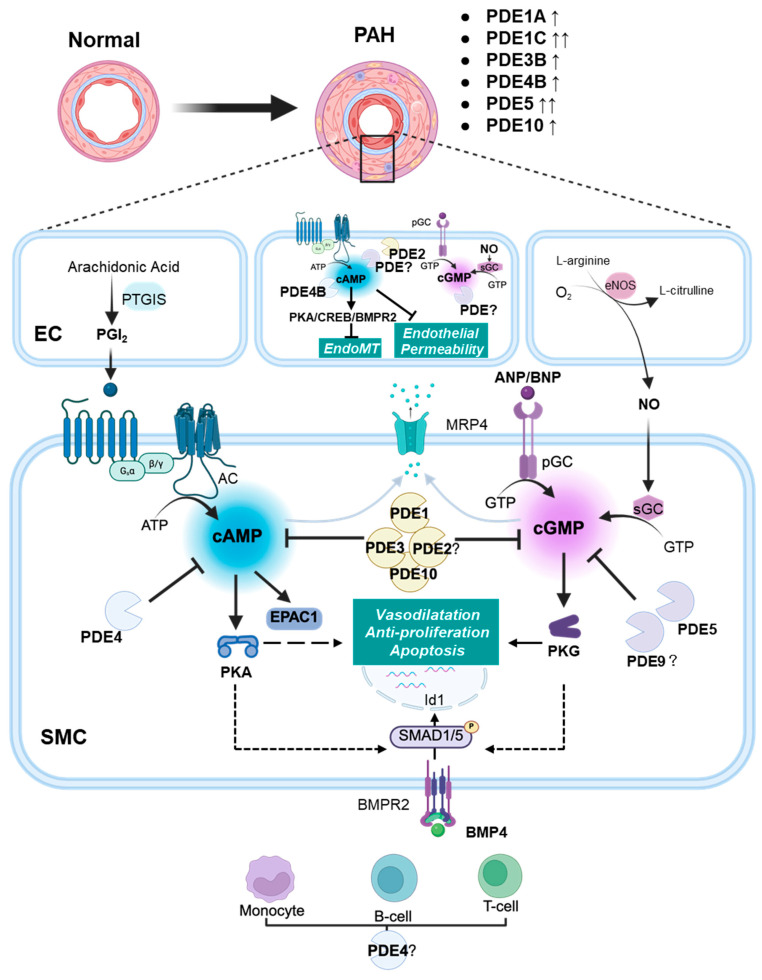 Figure 1: Intracellular signaling pathways of inhaled nitric oxide (iNO) and prostacyclins (epoprostenol, iloprost, treprostinil) in pulmonary artery smooth muscle cells (PASMCs) and vascular endothelial cells. Inhaled NO diffuses into PASMCs to stimulate soluble guanylyl cyclase (sGC), converting GTP to cyclic GMP ($cGMP$), which activates Protein Kinase G ($PKG$) to promote vascular smooth muscle relaxation, suppress pathological remodeling, and induce apoptosis. Inhaled prostacyclins bind G-protein coupled $IP$ receptors to activate adenylyl cyclase ($AC$), synthesizing cyclic AMP ($cAMP$) and activating Protein Kinase A ($PKA$). Cyclic nucleotide phosphodiesterases ($PDE5$ and $PDE3/4$) regulate intracellular second-messenger degradation. (Source: Wang et al., Cells 2025; 14(21):1670. DOI:
10.3390/cells14211670
. CC BY 4.0).
Pharmacology and Intracellular Signaling Mechanisms
The therapeutic selectivity of inhaled vasodilators relies upon their route of delivery: aerosolized or gaseous agents are preferentially delivered to well-ventilated alveolar units, selectively dilating the adjacent pulmonary capillary beds while leaving non-ventilated (atelectatic or consolidated) zones unexposed. This micro-selective vasodilation redirects blood flow away from shunt regions toward functional lung parenchyma, attenuating intrapulmonary shunt fraction ($Q_s/Q_t$) and reducing right ventricular (RV) afterload.
graph TD
    subgraph "Alveolar Delivery & Gas Exchange"
        Vent["Ventilated Alveolus"] -->|"Diffusion across Alveolar-Capillary Membrane"| EC["Endothelial Cell"]
        Vent -->|"Transcellular Diffusion"| SMC["Pulmonary Artery Smooth Muscle Cell (PASMC)"]
    end

    subgraph "Inhaled Nitric Oxide (iNO) Pathway"
        iNO["Inhaled Nitric Oxide (iNO)"] -->|"Binds Heme Moiety"| sGC["Soluble Guanylyl Cyclase (sGC)"]
        GTP["GTP"] -->|"sGC Catalysis"| cGMP["Cyclic GMP (cGMP)"]
        cGMP -->|"Activates"| PKG["Protein Kinase G (PKG)"]
        PKG -->|"Phosphorylation of Phospholamban & IP3R"| Ca_Efflux["Ca2+ Efflux & Sarcoplasmic Uptake"]
        PKG -->|"Activates"| MLCP["Myosin Light Chain Phosphatase (MLCP)"]
        MLCP --> VasoRelax["Smooth Muscle Dephosphorylation & Vasodilation"]
        cGMP -->|"Degradation"| PDE5["Phosphodiesterase-5 (PDE5)"]
        PDE5 -->|"Hydrolysis"| GMP["5'-GMP (Inactive)"]
    end

    subgraph "Inhaled Prostacyclin (PGI2) Pathway"
        PGI2["Inhaled Epoprostenol / Iloprost"] -->|"Binds IP Prostanoid Receptor"| IP_Rec["Gs-Protein Coupled IP Receptor"]
        IP_Rec -->|"Activates"| AC["Adenylyl Cyclase (AC)"]
        ATP["ATP"] -->|"AC Catalysis"| cAMP["Cyclic AMP (cAMP)"]
        cAMP -->|"Activates"| PKA["Protein Kinase A (PKA)"]
        PKA -->|"Inhibits MLCK & Promotes K+ Channel Opening"| VasoRelax
        cAMP -->|"Degradation"| PDE3["PDE3 / PDE4"]
        PDE3 -->|"Hydrolysis"| AMP["5'-AMP (Inactive)"]
    end

    subgraph "Intravascular Inactivation"
        iNO_Cap["iNO Entering Pulmonary Capillary Lumen"] -->|"Ultra-rapid Reaction (t1/2 < 5 ms)"| HbO2["Oxyhemoglobin (Hb-Fe2+)"]
        HbO2 --> MetHb["Methemoglobin (Hb-Fe3+) + Nitrate (NO3-)"]
    end
Inhaled Nitric Oxide (iNO) Cascade
Nitric oxide is an uncharged, low-molecular-weight ($30.01\text{ g/mol}$), lipophilic free radical gas synthesized endogenously from $\text{L-arginine}$ and molecular oxygen by endothelial nitric oxide synthase ($\text{eNOS / NOS3}$).
- Diffusion & Guanylyl Cyclase Activation: Upon inhalation, exogenous NO rapidly diffuses across the alveolar-capillary barrier into subjacent vascular smooth muscle cells. NO binds with high affinity to the prosthetic ferrous heme moiety ($\text{Fe}^{2+}$) of soluble guanylyl cyclase ($\text{sGC}$), inducing a conformational transition that accelerates enzymatic velocity by >200-fold.
- Cyclic GMP Generation: Activated $\text{sGC}$ converts intracellular guanosine triphosphate ($\text{GTP}$) to cyclic guanosine-$3',5'$-monophosphate ($\text{cGMP}$): $$\text{GTP} \xrightarrow{\text{sGC (NO-activated)}} \text{cGMP} + \text{PP}_\text{i}$$
- Protein Kinase G ($\text{PKG}$) Activation: Elevated $\text{cGMP}$ allosterically activates $\text{cGMP}$-dependent Protein Kinase G (specifically $\text{PKG-I}\alpha$). Activated $\text{PKG}$ orchestrates smooth muscle relaxation via multiple coordinated mechanisms:
- Phosphorylation and activation of Myosin Light Chain Phosphatase ($\text{MLCP}$), dephosphorylating the $20\text{ kDa}$ regulatory myosin light chain ($\text{MLC}_{20}$) and uncoupling actin-myosin cross-bridges.
- Phosphorylation of Phospholamban, accelerating intracellular $\text{Ca}^{2+}$ sequestration into the sarcoplasmic reticulum via the $\text{SERCA2a}$ pump.
- Phosphorylation of the Inositol $1,4,5$-trisphosphate receptor ($\text{IP}_3\text{R}$) and inhibition of voltage-gated L-type $\text{Ca}^{2+}$ channels ($\text{Cav}1.2$), abolishing cytosolic $\text{Ca}^{2+}$ influx.
- Activation of large-conductance $\text{Ca}^{2+}$-activated potassium channels ($\text{BK}_{\text{Ca}}$), driving membrane hyperpolarization.
- Intravascular Inactivation and Methemoglobin Formation: Unlike intravenous vasodilators, NO entering the capillary bloodstream is instantaneously scavenged by intraerythrocytic hemoglobin ($\text{Hb}$) with a reaction rate constant of $k \approx 3-5 \times 10^7\text{ M}^{-1}\text{s}^{-1}$ (biological half-life $t_{1/2} < 5\text{ milliseconds}$). In the presence of oxyhemoglobin ($\text{HbFe}^{2+}\text{O}_2$), NO is oxidized to nitrate ($\text{NO}_3^-$) and methemoglobin ($\text{HbFe}^{3+}$): $$\text{HbFe}^{2+}\text{O}_2 + \text{NO} \rightarrow \text{HbFe}^{3+} (\text{MetHb}) + \text{NO}_3^-$$ This near-instantaneous intravascular clearance confines vasodilation strictly to the pulmonary circuit, preventing systemic arterial hypotension.
Inhaled Prostacyclins Cascade
Epoprostenol is a synthetic salt of prostacyclin ($\text{PGI}_2$), an endogenous eicosanoid synthesized from arachidonic acid by cyclooxygenase ($\text{COX-1/COX-2}$) and prostacyclin synthase ($\text{PTGIS}$).
- Receptor Activation: Inhaled $\text{PGI}_2$ (epoprostenol), iloprost (a carbacyclin $\text{PGI}_2$ analogue), or treprostinil (a tricyclic benzindene analogue) bind to high-affinity cell-surface prostacyclin ($\text{IP}$) receptors on pulmonary artery smooth muscle cells.
- Adenylyl Cyclase Activation: The $\text{IP}$ receptor couples to stimulatory heterotrimeric G-proteins ($\text{G}\alpha_s$), stimulating transmembrane adenylyl cyclase ($\text{AC}$) to hydrolyze intracellular $\text{ATP}$ into cyclic adenosine-$3',5'$-monophosphate ($\text{cAMP}$): $$\text{ATP} \xrightarrow{\text{Adenylyl Cyclase}} \text{cAMP} + \text{PP}_\text{i}$$
- Protein Kinase A ($\text{PKA}$) Activation: $\text{cAMP}$ binds regulatory subunits of Protein Kinase A ($\text{PKA}$), releasing active catalytic subunits that:
- Inhibit Myosin Light Chain Kinase ($\text{MLCK}$), suppressing contractile tone.
- Phosphorylate phospholamban and open $\text{BK}_{\text{Ca}}$ potassium channels, driving cytosolic calcium depletion.
- Activate Exchange Protein Directly Activated by cAMP 1 ($\text{EPAC1}$), strengthening endothelial junctional integrity and attenuating endothelial-to-mesenchymal transition ($\text{EndoMT}$).
- Cross-Talk and Clearance: Inhaled prostacyclins undergo spontaneous chemical hydrolysis at neutral $\text{pH}$ to $6\text{-keto-PGF}_{1\alpha}$ ($t_{1/2} \approx 3-6\text{ minutes}$ for epoprostenol; $t_{1/2} \approx 20-30\text{ minutes}$ for iloprost; $t_{1/2} \approx 4\text{ hours}$ for treprostinil).
Comparative Pharmacological Matrix
| Pharmacological Characteristic | Inhaled Nitric Oxide (iNO) | Inhaled Epoprostenol ($\text{PGI}_2$) | Inhaled Iloprost | Inhaled Treprostinil |
|---|---|---|---|---|
| Active Molecule | Nitric Oxide Gas ($\text{NO}$) | Epoprostenol Sodium | Synthetic Carbacyclin | Synthetic Tricyclic Benzindene |
| Intracellular Second Messenger | $\text{cGMP}$ (via $\text{sGC}$) | $\text{cAMP}$ (via $\text{AC}$) | $\text{cAMP}$ (via $\text{AC}$) | $\text{cAMP}$ (via $\text{AC}$) |
| Effector Kinase | Protein Kinase G ($\text{PKG}$) | Protein Kinase A ($\text{PKA}$) | Protein Kinase A ($\text{PKA}$) | Protein Kinase A ($\text{PKA}$) |
| Inactivation Mechanism | Hemoglobin binding to $\text{MetHb} + \text{NO}_3^-$ | Spontaneous hydrolysis to $6\text{-keto-PGF}_{1\alpha}$ | Beta-oxidation and hepatic metabolism | Hepatic clearance ($\text{CYP2C8}$) |
| Biological Half-life ($t_{1/2}$) | $< 5\text{ milliseconds}$ | $3-6\text{ minutes}$ | $20-30\text{ minutes}$ | $4\text{ hours}$ |
| Delivery Modality | Dedicated synchronized injector into dry inspiratory limb | Continuous vibrating mesh nebulizer (Aeroneb) | Ultrasonic / jet nebulizer intermittent breaths | Ultrasonic pulsed inhaler |
| Standard Pediatric Dose | $10-20\text{ ppm}$ (Max $20\text{ ppm}$) | $10-50\text{ ng/kg/min}$ | $1-2\text{ mcg/kg/dose}$ (q2-4h) | $1.25-2.5\text{ mcg/kg/dose}$ (q6h) |
| Primary Toxicities / Pitfalls | $\text{MetHb}$, $\text{NO}_2$ gas, platelet inhibition | Expired filter occlusion, sticky valve seats, cough | Bronchospasm, flushing | Cough, pharyngeal irritation |
Clinical Indications in Pediatric Critical Care
graph TD
    Patient["Critically Ill Infant / Child with Hypoxemia or PH"] --> Assessment{"Clinical Phenotype & Mechanics"}

    Assessment -->|"Term/Near-Term >= 34 wk with PPHN"| PPHN_Arm["Persistent Pulmonary Hypertension of Newborn"]
    Assessment -->|"Severe PARDS (OI >= 16 or OSI >= 12.3)"| PARDS_Arm["Pediatric ARDS Refractory Hypoxemia"]
    Assessment -->|"Post-Cardiac Surgery / High PVR"| Cardiac_Arm["Post-Op Cardiac RV Failure / PH Crisis"]
    Assessment -->|"CDH Post-Repair with Severe PH"| CDH_Arm["Congenital Diaphragmatic Hernia (CDH)"]

    PPHN_Arm -->|"Oxygenation Index (OI) >= 20-25"| iNO_PPHN["Initiate iNO at 20 ppm<br>(FDA Approved; Reduces ECMO Need)"]
    PARDS_Arm -->|"Rescue Oxygenation Bridge"| iNO_PARDS["Trial iNO 10-20 ppm or Epoprostenol 20-50 ng/kg/min<br>(Bridge to Lung Recruitment / ECMO)"]
    Cardiac_Arm -->|"Elevated mPAP / RV Squeeze Loss"| iNO_Cardiac["iNO 20 ppm or Inhaled Prostacyclin<br>(Decreases RV Afterload, Preserves MAP)"]
    CDH_Arm -->|"Suprasystemic PA Pressures"| iNO_CDH["iNO 20 ppm + Maintain Pre-ductal SpO2 > 85%<br>(Beware Left Ventricular Hypoplasia/Dysfunction)"]
1. Persistent Pulmonary Hypertension of the Newborn (PPHN)
- Population: Term and near-term infants ($\ge 34\text{ weeks}$ gestation) presenting within the first days of life with suprasystemic pulmonary vascular resistance ($\text{PVR}$), right-to-left extrapulmonary shunting across the patent ductus arteriosus ($\text{PDA}$) or patent foramen ovale ($\text{PFO}$), and critical hypoxemia.
- Evidence & Approval: Inhaled Nitric Oxide is FDA-approved for term/near-term neonates with hypoxic respiratory failure associated with clinical or echocardiographic evidence of PPHN. Multicenter randomized trials demonstrated that iNO significantly decreases the requirement for Extracorporeal Membrane Oxygenation (ECMO) from $\sim 64\%$ to $\sim 38\%$ ($p < 0.001$), though it does not affect overall mortality.
- Threshold for Initiation:
- Oxygenation Index ($\text{OI}$) $\ge 15-20$ on two consecutive blood gases despite optimized lung recruitment and lung-protective ventilation: $$\text{OI} = \frac{\text{MAP} \times \text{FiO}_2 \times 100}{\text{PaO}_2} \ge 20$$
- Oxygen Saturation Index ($\text{OSI}$) $\ge 10-12$: $$\text{OSI} = \frac{\text{MAP} \times \text{FiO}_2 \times 100}{\text{SpO}_2} \ge 10$$
- Significant pre-post ductal oxygen saturation gradient ($> 10\%$ differential between right upper extremity and lower extremities) confirming right-to-left ductal shunting.
In neonates $\ge 34\text{ weeks}$, iNO must be initiated promptly when $\text{OI} \ge 20$ or $\text{OSI} \ge 12.3$. An acute positive response is defined as an increase in $\text{PaO}_2 > 20\text{ mmHg}$ or a reduction in $\text{OI} > 20\%$ within $30-60\text{ minutes}$ of starting $20\text{ ppm}$ iNO. Non-responders ($\sim 30-40\%$) must be evaluated immediately for ECMO candidacy, left ventricular dysfunction, pulmonary venous hypertension, or alveolar capillary dysplasia.
2. Severe Pediatric Acute Respiratory Distress Syndrome (PARDS)
- Clinical Role: In PARDS governed by PALICC-2 (Pediatric Acute Lung Injury Consensus Conference-2) guidelines, routine empirical use of iNO or inhaled prostacyclins is not recommended. However, both agents are strongly endorsed as rescue therapies for severe PARDS with refractory hypoxemia: $$\text{OI} \ge 16 \quad \text{or} \quad \text{OSI} \ge 12.3$$
- Physiological Objective: In severe PARDS characterized by consolidated and atelectatic dorsal lung units, inhaled vasodilators selectively redistribute pulmonary perfusion to ventral, ventilated alveoli, improving $V_A/Q$ matching and buying critical time while lung-protective ventilation, prone positioning, neuromuscular blockade, or ECMO cannulation are deployed.
- Response Assessment: If an improvement in $\text{PaO}_2/\text{FiO}_2$ ratio ($> 20\%$) or $\text{OI}$ is not demonstrated within $60-120\text{ minutes}$, the inhaled vasodilator should be weaned and discontinued to avoid unnecessary expense and drug toxicity.
3. Post-Cardiac Surgery Pulmonary Hypertension and RV Failure
- Clinical Pathophysiology: Cardiopulmonary bypass ($\text{CPB}$), surgical manipulation, and protamine administration provoke intense pulmonary endothelial dysfunction, depleting endogenous eNOS and triggering acute pulmonary hypertensive crises.
- Hemodynamic Impact: High pulmonary arterial pressure increases RV wall tension, induces RV ischemia, flattens the interventricular septum into the left ventricle (reversed Bernheim effect), and precipitates low cardiac output syndrome.
- Therapeutic Benefit: iNO ($10-20\text{ ppm}$) or nebulized epoprostenol ($20-50\text{ ng/kg/min}$) selectively decreases pulmonary vascular resistance index ($\text{PVRI}$) and pulmonary artery systolic pressure without lowering mean arterial pressure ($\text{MAP}$), preserving RV coronary perfusion gradient: $$\text{Perfusion Gradient}_{\text{RV}} = \text{MAP} - \text{Peak RV Pressure}$$
4. Congenital Diaphragmatic Hernia (CDH)
- Phenotype: CDH infants suffer from marked pulmonary hypoplasia, adventitial and medial arterial wall muscularization, and variable left ventricular hypoplasia.
- Cautionary Rule: While iNO ($20\text{ ppm}$) is frequently trialed in CDH with suprasystemic right-to-left ductal shunting, echocardiography must verify adequate left ventricular systolic function. In patients with severe left-sided hypoplasia or LV diastolic dysfunction, selective pulmonary vasodilation increases pulmonary venous return to a stiff LV, precipitating acute left atrial hypertension, pulmonary venous congestion, and catastrophic pulmonary edema.
Delivery Systems, Monitoring, and Safety Protocols
Inhaled Nitric Oxide (iNO) Delivery and Chemistry
flowchart LR
    subgraph "iNO Delivery Architecture"
        Cylinder["iNO Gas Cylinder (800 ppm NO in N2)"] --> Injector["Microprocessor Delivery System (INOmax / INOvent)"]
        Vent["Mechanical Ventilator"] -->|"Inspiratory Flow Sensor"| Injector
        Injector -->|"Synchronized Proportional Injection"| InspLimb["Dry Inspiratory Limb (Before Humidifier)"]
        InspLimb --> Humidifier["Heated Humidifier"] --> Wye["Patient Wye & ETT"]
        Wye --> SampleLine["Sample Line (5 cm from Wye)"] --> CoOxAnalyzer["Continuous NO / NO2 / O2 Electrochemical Analyzer"]
    end
- Initial Dosing and Plateau Dynamics: The standard starting dose for pediatric patients is $20\text{ ppm}$. Dose-response curves demonstrate that pulmonary vasodilation and $\text{PaO}_2$ elevation plateau at $20\text{ ppm}$; escalating doses to $40-80\text{ ppm}$ provide no additional pulmonary vasodilation but exponentially accelerate toxic by-product formation.
- Toxic Byproduct Generation:
- Nitrogen Dioxide ($\text{NO}_2$) Formation: In the ventilator circuit, $\text{NO}$ reacts with inspired oxygen ($\text{O}_2$) to form cytotoxic $\text{NO}_2$:
$$2\text{NO} + \text{O}_2 \rightarrow 2\text{NO}_2$$
- The rate of $\text{NO}_2$ production is proportional to $[\text{NO}]^2$, $[\text{O}_2]$, and the residence time ($\tau$) inside the circuit: $$\frac{d[\text{NO}_2]}{dt} = k \cdot [\text{NO}]^2 \cdot [\text{O}_2] \cdot \tau$$
- Clinical Target: Maintain continuous monitored $\text{NO}_2 < 0.5\text{ ppm}$ (maximum allowable limit $< 1.0\text{ ppm}$). Exposure above $2.0\text{ ppm}$ causes surfactant inactivation, alveolar capillary permeability, acute bronchiolitis obliterans, and pulmonary edema.
- Methemoglobinemia ($\text{MetHb}$):
- Normal baseline $\text{MetHb}$ is $< 1.0\%$.
- Monitor blood co-oximetry at baseline, $2-4\text{ hours}$ after initiation, and at least every $12-24\text{ hours}$ thereafter.
- Action Levels:
- $\text{MetHb} < 2.5-3.0\%$: Acceptable, maintain dose.
- $\text{MetHb} \ge 3.0-5.0\%$: Decrease iNO dose by $50\%$ (e.g., from $20\text{ ppm}$ to $10\text{ ppm}$).
- $\text{MetHb} > 5.0\%$: Discontinue or aggressively wean iNO; check underlying cytochrome-$b_5$ reductase activity.
- $\text{MetHb} > 7.0\%$ or symptomatic tissue hypoxia: Administer intravenous Methylene Blue ($1-2\text{ mg/kg}$ IV over 5 minutes; note contraindication in G6PD deficiency).
- Nitrogen Dioxide ($\text{NO}_2$) Formation: In the ventilator circuit, $\text{NO}$ reacts with inspired oxygen ($\text{O}_2$) to form cytotoxic $\text{NO}_2$:
$$2\text{NO} + \text{O}_2 \rightarrow 2\text{NO}_2$$
Premature infants and neonates possess lower levels of erythrocyte NADH-methemoglobin reductase (cytochrome-$b_5$ reductase, $\sim 50-60\%$ of adult levels) and fetal hemoglobin ($\text{HbF}$) is more readily oxidized to $\text{MetHb}$ than adult hemoglobin ($\text{HbA}$). Routine co-oximetry is mandatory. Never operate an iNO delivery circuit without dedicated inline electrochemical analyzers sampling gas within $5-10\text{ cm}$ of the patient wye.
Inhaled Epoprostenol Delivery Mechanics and Equipment Safety
- Delivery System: Continuous aerosolization requires an inline vibrating mesh nebulizer (e.g., Aeroneb Pro/Solo) positioned in the inspiratory limb before the humidifier or close to the patient wye. Jet nebulizers must be avoided due to unpredictable flow additions and variable drug concentrations.
- Expiratory Filter Occlusion Hazard:
- Epoprostenol solutions are formulated with an alkaline glycine buffer ($\text{pH } 10.2-10.8$) to ensure molecular stability.
- Upon continuous nebulization, the alkaline solvent crystallizes upon cooling and humidification, generating sticky micro-precipitates.
- These deposits aggregate on the expiratory bacteriological filter and within the ventilator's expiratory valve assembly, causing:
- Progressive expiratory resistance and elevated auto-PEEP.
- Inadvertent breath-stacking and barotrauma / pneumothorax.
- Expiratory flow sensor failure and false ventilator alarms.
- Mandatory Safety Mitigation:
- Install a dual-chamber HEPA filter with an active expiratory water trap.
- Change the expiratory filter routinely every $2-4\text{ hours}$ (or immediately if peak expiratory pressure increases or auto-PEEP emerges).
- Use active heating collars around expiratory filters where available.
graph TD
    subgraph "Continuous Inhaled Epoprostenol Monitoring"
        Neb["Vibrating Mesh Nebulizer (Aeroneb)"] -->|"Inspiratory Line"| Patient["Patient Airway (ETT)"]
        Patient -->|"Exhaled Gas"| ExpLine["Expiratory Circuit Limb"]
        ExpLine --> Filter["Expiratory Filter & Water Trap"]
        Filter --> ExpValve["Ventilator Expiratory Valve"]

        Filter -->|"Glycine Buffer Crystallization"| Clog{"Filter Clogging Risk"}
        Clog -->|"Every 2-4 Hours"| Change["Mandatory Filter Exchange"]
        Clog -->|"Monitored Pressure Rise"| AutoPEEP["Auto-PEEP / High Baseline Pexp Alert"]
        AutoPEEP --> ImmediateChange["Emergency Filter Swap & Suction"]
    end
Stepwise Titration and Decremental Weaning Protocol
flowchart TD
    Start["Initiate iNO at 20 ppm"] --> ResponseCheck{"Response at 30-60 min?<br>(PaO2 rise > 20 mmHg or OI drop > 20%)"}

    ResponseCheck -- "No" --> NonResponder["Non-Responder Protocol:<br>Re-evaluate Echo (LV Function, CHD)<br>Consider Escalation to ECMO / Prostacyclins<br>Wean & Stop iNO over 2-4 hours"]
    ResponseCheck -- "Yes" --> Stabilize["Maintain 20 ppm for 4-12 hours<br>Optimize PEEP, Acid-Base, & Hemodynamics"]

    Stabilize --> Phase1{"Clinical Stability Criteria Met:<br>FiO2 < 0.60 and MAP Stable<br>Pre-ductal SpO2 > 92-95%"}

    Phase1 -- "No" --> Maintain["Continue Current iNO Dose<br>Monitor MetHb & NO2 q12h"]
    Phase1 -- "Yes" --> Wean1["Stepwise Decrement:<br>Reduce 20 -> 10 -> 5 ppm<br>(Hold 2-4 hours per step)"]

    Wean1 --> Phase2{"Low Dose Stability:<br>iNO at 5 ppm with FiO2 <= 0.40"}

    Phase2 -- "Yes" --> Wean2["Ultra-Low Dose Titration:<br>5 ppm -> 4 -> 3 -> 2 -> 1 ppm<br>(Hold 1-2 hours per step)"]
    Phase2 -- "No" --> StepBack1["Step Back to Prior Tolerated Dose"]

    Wean2 --> Phase3{"Stability at 1 ppm for >= 1-2 hours"}
    Phase3 -- "Yes" --> Discontinue["Discontinue iNO<br>Monitor SpO2 & PA Pressures for Rebound"]
    Phase3 -- "No" --> StepBack2["Return to 2-3 ppm; Re-evaluate in 12-24 hours"]

    Discontinue --> ReboundCheck{"Rebound PH / Hypoxemia within 1-2 hrs?"}
    ReboundCheck -- "Yes" --> Rescue["Emergency Rescue:<br>Resume iNO at 5-10 ppm<br>Escalate FiO2 immediately<br>Initiate Oral Sildenafil Bridge"]
    ReboundCheck -- "No" --> Success["Successful Liberation"]
The Biology of Rebound Pulmonary Hypertension
Abrupt cessation of iNO or inhaled prostacyclin can trigger life-threatening rebound pulmonary hypertension, acute right ventricular failure, and cardiovascular collapse.
Molecular Mechanism:
- Prolonged inhalation of exogenous NO suppresses endogenous endothelial NOS (eNOS / NOS3) expression and enzymatic activity through negative feedback.
- Chronic high intracellular cGMP upregulates Phosphodiesterase-5 (PDE5A) transcription and catalytic activity.
- Sudden withdrawal of exogenous NO removes the substrate for cGMP production while upregulated PDE5 rapidly destroys residual cGMP, resulting in profound vasoconstrictor spasm exceeding pre-treatment baseline.
Stepwise Decremental Weaning Rules
- Prerequisites for Weaning:
- $\text{FiO}_2 < 0.60$ with satisfactory oxygenation ($\text{PaO}_2 > 60-80\text{ mmHg}$ or $\text{SpO}_2 > 92-95\%$).
- Hemodynamic stability without escalating vasoactive support.
- Mean airway pressure ($\text{MAP}$) optimized.
- Phase I (High-Dose Wean):
- Wean from $20\text{ ppm} \rightarrow 10\text{ ppm} \rightarrow 5\text{ ppm}$ in increments of $5\text{ ppm}$ every $2-4\text{ hours}$.
- Phase II (Ultra-Low-Dose Titration):
- Once at $5\text{ ppm}$, wean slowly by $1\text{ ppm}$ steps: $5 \rightarrow 4 \rightarrow 3 \rightarrow 2 \rightarrow 1\text{ ppm}$, holding at each step for $1-2\text{ hours}$.
- Never discontinue directly from $\ge 5\text{ ppm}$.
- Phase III (Discontinuation and Bridge):
- Discontinue from $1\text{ ppm}$.
- Increase $\text{FiO}_2$ preemptively by $0.10-0.15$ for $15-30\text{ minutes}$ during discontinuation to counter transient hypoxia.
- In patients experiencing recurrent rebound during weaning, initiate oral/IV Sildenafil ($0.5-2.0\text{ mg/kg/dose}$ enterally q6-8h, a selective PDE5 inhibitor) or Enteral Bosentan ($1-2\text{ mg/kg/dose}$ BID, an endothelin receptor antagonist) $12-24\text{ hours}$ prior to final weaning as an exit bridge.
Bedside Troubleshooting and Red Flags
- Acute Desaturation on iNO:
- Check delivery system injector alarms (cylinder empty, injector disconnected).
- Verify mechanical ventilator inspiratory flow sensor signal.
- Inspect sampling line for condensate/water entry.
- Check blood co-oximetry for acute $\text{MetHb} > 5-10\%$.
- Perform urgent bedside echocardiogram to rule out new LV dysfunction or tension pneumothorax.
- Sudden Increase in Peak Inspiratory Pressure / Auto-PEEP during Nebulized Epoprostenol:
- Immediately disconnect and replace the expiratory bacterial filter.
- Check for expiratory valve sticking/crystallization.
- Auscultate for acute bronchospasm (prostacyclins can induce airway hyperreactivity in reactive airways disease).
Summary and Key Takeaways
- Micro-Selective Action: Inhaled NO and nebulized prostacyclins dilate pulmonary vessels solely in ventilated lung regions, optimizing $V_A/Q$ matching and unloading the right ventricle without inducing systemic hypotension.
- Intracellular Pathways: iNO activates the $\text{sGC} \rightarrow \text{cGMP} \rightarrow \text{PKG}$ pathway; prostacyclins activate the $\text{IP-receptor} \rightarrow \text{cAMP} \rightarrow \text{PKA}$ cascade.
- Dosing Ceiling: iNO dosing peaks in therapeutic efficacy at $20\text{ ppm}$. Higher doses do not improve oxygenation and exponentially elevate toxic $\text{NO}_2$ gas and methemoglobinemia.
- Mandatory Safety Monitoring: Continuously monitor $\text{NO}_2$ gas ($< 0.5-1.0\text{ ppm}$) and blood $\text{MetHb}$ levels ($< 2.5-3.0\%$). When using nebulized epoprostenol, replace expiratory limb filters every $2-4\text{ hours}$ to prevent lethal valve crystallization and circuit occlusion.
- Slow Weaning Protocol: Prevent lethal rebound pulmonary hypertension by avoiding abrupt withdrawal; wean in decremental steps ($20 \rightarrow 10 \rightarrow 5 \rightarrow 4 \rightarrow 3 \rightarrow 2 \rightarrow 1\text{ ppm}$) and consider oral sildenafil bridging for difficult-to-wean patients.