Non-invasive respiratory support (NIRS) encompasses a continuum of positive-pressure and high-velocity gas delivery modalities designed to support gas exchange, recruit collapsed pulmonary parenchyma, and mitigate excessive work of breathing ($WOB$) while preserving upper airway anatomy and avoiding invasive endotracheal intubation. In pediatric intensive care, non-invasive modalities—specifically High-Flow Nasal Cannula (HFNC), Continuous Positive Airway Pressure (CPAP), and Non-Invasive Positive Pressure Ventilation / Bi-level Positive Airway Pressure (BiPAP / NIPPV)—serve as frontline interventions for acute hypoxemic, hypercapnic, and mixed respiratory failure.
flowchart TD
    A["Pediatric Acute Respiratory Distress / Hypoxemia"] --> B{"Primary Pathophysiological Defect"}

    B -->|"Upper Airway / Mild Parenchymal / $V_{D,ana}$ Rebreathing (e.g., Bronchiolitis, Mild Viral Pneumonia)"| C["High-Flow Nasal Cannula (HFNC)"]
    C --> C1["Flow: 2.0 L/kg/min (first 10 kg) + 0.5 L/kg/min<br>Gas Conditioning: 37°C, 44 mg/L H2O"]

    B -->|"Alveolar Collapse / Microatelectasis / Refractory Hypoxemia (e.g., Mild-Moderate PARDS, Atelectasis)"| D["Continuous Positive Airway Pressure (CPAP)"]
    D --> D1["CPAP: 5 - 10 cmH2O<br>Constant Distending Pressure (FRC Restoration)"]

    B -->|"Severe Work of Breathing / Dynamic Hyperinflation / Hypercapnia / Diaphragmatic Fatigue (e.g., Asthma, Neuromuscular)"| E["Bi-level Positive Airway Pressure (BiPAP / NIPPV)"]
    E --> E1["EPAP: 5 - 8 cmH2O | IPAP: 10 - 18 cmH2O<br>Delta PS = IPAP - EPAP (Tidal Volume Augmentation)"]

    C1 --> F{"Serial Bedside Reassessment (1 - 2 Hours)"}
    D1 --> F
    E1 --> F

    F -->|"ROX Index Favorable / Reduced RR / Retractions Abated"| G["Weaning & De-escalation Protocol"]
    F -->|"ROX < Threshold / Persistent Acidosis / Thoracoabdominal Paradox"| H["Immediate Invasive Endotracheal Intubation"]
Modality Taxonomy and Biophysical Principles
High-Flow Nasal Cannula
High-Flow Nasal Cannula (HFNC) delivers heated, fully humidified medical gas mixtures ($\text{FiO}_2\ 0.21\text{ to }1.00$) at flow rates that equal or exceed the patient's spontaneous peak inspiratory flow rate ($\dot{V}_{I,\text{peak}}$).
Spontaneous Peak Inspiratory Demand:
$$\dot{V}_{I,\text{peak}} \approx 3 \times \text{Minute Ventilation } (\dot{V}_E) = 3 \times (V_T \times RR)$$
The therapeutic efficacy of HFNC rests on four physiological mechanisms:
flowchart LR
    subgraph HFNC_Mechanics["Physiological Mechanisms of HFNC"]
        M1["1. Anatomical Dead Space Washout<br>Continuous flush of nasopharynx ($V_{D,ana}$) -> Purges end-expiratory CO2"]
        M2["2. Dynamic Distending Pressure<br>Generates ~1 cmH2O PEEP per 10 L/min flow (or 0.5-1 cmH2O per 1 L/kg/min)"]
        M3["3. Gas Conditioning & Energetic Sparing<br>37°C, 100% RH, 44 mg/L H2O -> Prevents metabolic calorie loss & bronchospasm"]
        M4["4. Eliminating Entrainment Dilution<br>Delivered flow >= Peak inspiratory flow -> Stable, uncompromised FiO2"]
    end
1. Nasopharyngeal Dead Space Washout ($V_{D,\text{ana}}$)
In healthy pediatric patients, the upper airway accounts for up to $30-50\%$ of the total anatomical dead space ($V_{D,\text{ana}}$). During spontaneous exhalation, this compartment is filled with end-expiratory gas high in carbon dioxide ($\text{PCO}_2 \approx 40\text{ mmHg}$) and depleted of oxygen. Upon subsequent inspiration, the child must rebreathe this alveolar dead-space volume before fresh atmospheric gas enters the alveoli.
HFNC provides a continuous high-velocity flow of conditioned gas into the nasopharynx during the end-expiratory pause, sweeping away the stagnant $\text{CO}_2$-rich reservoir. Consequently, the effective alveolar ventilation ($\dot{V}_A$) increases without necessitating an increase in spontaneous tidal volume ($V_T$):
$$\dot{V}_A = (V_T - V_D) \times RR$$Where:
- $\dot{V}_A$ is alveolar minute ventilation ($\text{mL/min}$)
- $V_T$ is inspired tidal volume ($\text{mL}$)
- $V_D$ is total dead space ($V_{D,\text{ana}} + V_{D,\text{alv}}$)
- $RR$ is respiratory rate ($\text{breaths/min}$)
2. Generation of Dynamic Positive End-Expiratory Pressure
HFNC generates dynamic, unsealed positive airway pressure by creating an expiratory resistance as the patient breathes out against the incoming continuous jet of gas. In infants and young children, delivered flows of $1.5\text{ to }2.0\text{ L/kg/min}$ generate mean airway distending pressures between $2\text{ and }6\text{ cmH}_2\text{O}$, provided the cannula prongs do not fully occlude the nares (optimal prong outer diameter $\le 50\%$ of internal nares diameter).
Empirical airway pressure generation follows the clinical rule:
- Infants/Toddlers: $\approx 0.5 - 1.0\text{ cmH}_2\text{O}$ per $1.0\text{ L/kg/min}$ of flow (mouth closed)
- Older Children/Adolescents: $\approx 1.0\text{ cmH}_2\text{O}$ per $10\text{ L/min}$ increase in flow
HFNC does not contain an expiratory pop-off valve or sealed circuit; therefore, measured pharyngeal pressure drops by $50-75\%$ whenever the child cries or breathes through an open mouth. HFNC cannot deliver a fixed, guaranteed PEEP.
3. Active Gas Conditioning & Metabolic Work Conservation
Standard medical gases are cold and dry (relative humidity $<5\%$). Delivering unconditioned gas at flows $>2\text{ L/min}$ rapidly desicates the upper airway respiratory epithelium, induces reactive bronchoconstriction, impairs ciliary beat frequency, and thickens mucosal secretions.
HFNC utilizes pass-over heated humidifiers with heated-wire breathing circuits to deliver gas conditioned to core body temperature:
- Temperature: $37^\circ\text{C}$
- Relative Humidity ($RH$): $100\%$
- Absolute Humidity ($AH$): $44\text{ mg } \text{H}_2\text{O}/\text{L}$
This eliminates the insensible heat and water loss normally expended by the pediatric nasopharynx to condition gas, conserving systemic metabolic energy ($400-500\text{ cal/L}$ of conditioned gas).
Continuous Positive Airway Pressure
Continuous Positive Airway Pressure (CPAP) provides a constant, continuous distending pressure throughout the entire spontaneous respiratory cycle (both inspiration and expiration) via an airtight or low-leak patient-interface circuit.
flowchart TD
    CPAP_App["Application of CPAP (5 - 10 cmH2O)"] --> FRC_Inc["Increases End-Expiratory Transpulmonary Pressure ($P_{L,ee} = P_{ao} - P_{pl}$)"]
    FRC_Inc --> Alv_Rec["Alveolar Recruitment & Prevention of End-Expiratory Derecruitment"]
    Alv_Rec --> Compliance["Shifts Lung Mechanics from Lower Flat Region to Steep Linear Portion of P-V Curve"]
    Compliance --> Mech_Benefit["1. Improved Static Compliance ($C_{stat}$)<br>2. Decreased Elastic Work of Breathing ($W_{elastic}$)<br>3. Correction of Intrapulmonary Shunt ($Q_s/Q_t$)"]
Alveolar Recruitment and Transpulmonary Mechanics
The fundamental physical determinant of alveolar stability is transpulmonary pressure ($P_L$):
$$P_L = P_{ao} - P_{pl}$$Where:
- $P_L$ is transpulmonary pressure ($\text{cmH}_2\text{O}$)
- $P_{ao}$ is airway opening pressure ($\text{cmH}_2\text{O}$)
- $P_{pl}$ is pleural pressure ($\text{cmH}_2\text{O}$)
In infants with surfactant deficiency, bronchiolitis, or acute lung injury, Functional Residual Capacity (FRC) falls below the closing capacity ($CC$), precipitating cyclic microatelectasis and intrapulmonary right-to-left shunt ($Q_s/Q_t$). Setting a CPAP of $5-10\text{ cmH}_2\text{O}$ maintains $P_L > 0$ at end-expiration, elevating FRC above $CC$, expanding collapsed gas-exchange units, and shifting the lung onto the compliant linear portion of its static pressure-volume curve.
LaPlace Law of Alveolar Stability:
$$\Delta P = \frac{2\gamma}{r}$$
By maintaining end-expiratory radius ($r$), CPAP prevents critical closing pressure collapse and reduces the opening pressure required for subsequent tidal inflation.
Bi-level Positive Airway Pressure
Bi-level Positive Airway Pressure (BiPAP) or Non-Invasive Positive Pressure Ventilation (NIPPV) provides two distinct levels of positive pressure synchronized to the patient's spontaneous respiratory efforts:
- Inspiratory Positive Airway Pressure (IPAP): Delivered upon patient trigger to augment spontaneous tidal volume and offload inspiratory muscles.
- Expiratory Positive Airway Pressure (EPAP): Maintained during expiration to preserve FRC and prevent alveolar collapse (equivalent to PEEP).
flowchart LR
    subgraph BiPAP_Pressure_Split["Pressure Architecture of BiPAP"]
        EPAP["EPAP (5 - 8 cmH2O)<br>Maintains FRC & Oxygenation"]
        IPAP["IPAP (10 - 18 cmH2O)<br>Augments Tidal Volume"]
        DeltaPS["Delta Pressure Support ($\Delta PS = IPAP - EPAP$)<br>Unloads Diaphragm & Clears CO2"]
        EPAP --> DeltaPS
        IPAP --> DeltaPS
    end
The net inspiratory assistance is governed by the Driving Pressure Support ($\Delta PS$):
$$\Delta PS = IPAP - EPAP$$Work of Breathing Offloading
The equation of motion of the respiratory system defines the total pressure required for inspiration:
$$P_{total}(t) = P_{mus}(t) + P_{vent}(t) = \frac{V(t)}{C_{rs}} + \dot{V}(t) \times R_{aw} + PEEP_{tot}$$By providing $P_{vent}(t) = \Delta PS$ during inspiration, BiPAP reduces the neural and muscular effort ($P_{mus}$) generated by the diaphragm and intercostal muscles. This reduces diaphragmatic oxygen consumption ($\dot{V}\text{O}_{2,\text{diaphragm}}$), averts muscular fatigue, and expands tidal volume ($V_T \propto \Delta PS \times C_{rs}$).
Comparative Modality Matrix & Parameter Titration
| Modality | Primary Mechanism | Pressure Control | Humidification | Typical Pediatric Settings | Primary Clinical Indications |
|---|---|---|---|---|---|
| HFNC | $V_{D,\text{ana}}$ washout, unsealed dynamic PEEP, inspiratory flow support | Variable ($0.5-1\text{ cmH}_2\text{O}$ / $1\text{ L/kg/min}$) | Active ($37^\circ\text{C}$, $44\text{ mg/L}$) | $2.0\text{ L/kg/min}$ (first 10 kg) + $0.5\text{ L/kg/min}$ thereafter (max 50 L/min) | Acute viral bronchiolitis, mild hypoxemic respiratory failure, post-extubation (low risk) |
| CPAP | Constant distending pressure, FRC recruitment, $V/Q$ optimization | Fixed ($5 - 10\text{ cmH}_2\text{O}$) | Active or pass-over heated | $5 - 8\text{ cmH}_2\text{O}$ (titrate to max $10\text{ cmH}_2\text{O}$) | Moderate PARDS, diffuse alveolar atelectasis, tracheobronchomalacia, cardiogenic pulmonary edema |
| BiPAP / NIPPV | Pressure support ($\Delta PS$) + PEEP (EPAP), ventilatory muscle offloading | Fixed IPAP & EPAP | Active heated | EPAP: $5-8\text{ cmH}_2\text{O}$ IPAP: $10-18\text{ cmH}_2\text{O}$ ($\Delta PS: 5-10\text{ cmH}_2\text{O}$) | Status asthmaticus, acute hypercapnic respiratory failure, neuromuscular weakness, severe chest wall distortion |
Clinical Indications and Failure Prediction
flowchart TD
    subgraph Indications_Domain["Pediatric NIV Indications"]
        I1["Viral Bronchiolitis<br>(RSV, Rhinovirus, hMPV)"]
        I2["Community-Acquired Pneumonia & Mild-Moderate PARDS"]
        I3["Acute Severe Asthma / Status Asthmaticus"]
        I4["Extubation Prophylaxis in High-Risk Infants"]
        I5["Neuromuscular Crisis & Chest Wall Deformity"]
    end
The Pediatric ROX Index Formulation
The ROX index (Ratio of Oxygen Saturation) is a bedside physiological score developed to monitor hypoxemic patients on HFNC and identify those failing therapy before catastrophic exhaustion occurs.
The standard ROX Index is calculated as the ratio of pulse oximetry oxygen saturation ($\text{SpO}_2$, in percent, $80-100\%$) to the fraction of inspired oxygen ($\text{FiO}_2$, expressed as a decimal, $0.21-1.00$), divided by the respiratory rate ($RR$, breaths per minute):
$$\text{ROX Index} = \frac{\text{SpO}_2 / \text{FiO}_2}{RR}$$In pediatrics, because baseline physiological respiratory rate varies dramatically with age, the modified ROX-HR Index incorporates heart rate ($HR$, beats per minute) to normalize autonomic sympathetic arousal:
$$\text{ROX-HR Index} = \left[ \frac{(\text{SpO}_2 / \text{FiO}_2) / RR}{HR} \right] \times 100$$Example Calculation:
A 10-month-old infant with RSV bronchiolitis on HFNC (FiO2 0.50) has SpO2 92%, RR 60 bpm, and HR 160 bpm:
$$\text{SpO}_2 / \text{FiO}_2 = \frac{92}{0.50} = 184$$
$$\text{ROX} = \frac{184}{60} = 3.07$$
$$\text{ROX-HR} = \left( \frac{3.07}{160} \right) \times 100 = 1.92$$
Interpretation: ROX < 3.5 at 2 hours indicates a high risk of HFNC failure and warrants immediate preparation for escalation.
Age-Adjusted Pediatric ROX Failure Thresholds
Unlike adults (where $\text{ROX} < 3.85$ at 12 hours predicts failure), pediatric thresholds must be evaluated against age-specific norms:
| Patient Age Group | Normal Resting RR | High Risk of Failure (1-2 Hours) | Intermediate / Indeterminate (6 Hours) | Favorable / Success Predictor (12 Hours) |
|---|---|---|---|---|
| < 12 Months (Infants) | $30 - 50\text{ bpm}$ | $\text{ROX} < 3.00$ ($\text{ROX-HR} < 2.0$) | $\text{ROX } 3.00 - 3.80$ | $\text{ROX} > 4.20$ |
| 1 - 5 Years (Young Children) | $22 - 35\text{ bpm}$ | $\text{ROX} < 3.40$ ($\text{ROX-HR} < 2.5$) | $\text{ROX } 3.40 - 4.50$ | $\text{ROX} > 5.00$ |
| 6 - 12 Years (School-Age) | $18 - 25\text{ bpm}$ | $\text{ROX} < 4.00$ ($\text{ROX-HR} < 3.0$) | $\text{ROX } 4.00 - 5.50$ | $\text{ROX} > 6.20$ |
| > 12 Years (Adolescents) | $12 - 20\text{ bpm}$ | $\text{ROX} < 3.85$ (Adult criteria) | $\text{ROX } 3.85 - 4.88$ | $\text{ROX} > 4.88$ |
Failure Prediction and Clinical Deterioration
flowchart TD
    A["Pediatric Patient on HFNC / CPAP / BiPAP"] --> B["Serial Assessment at 30 min, 1 hr, 2 hr, 6 hr"]

    B --> C{"Check Core Failure Indicators"}
    C -->|"1. Respiratory Mechanics"| D["Severe subcostal / sternal retractions, grunting, thoracoabdominal paradox"]
    C -->|"2. Gas Exchange Trends"| E["Rising FiO2 (>0.60 to maintain SpO2 >92%), worsening respiratory acidosis (pH <7.25, PaCO2 >55)"]
    C -->|"3. Physiological Scoring"| F["ROX < Age Threshold at 2-6 hrs, Pediatric HACOR Score >= 5"]
    C -->|"4. Neurological & Hemodynamic"| G["Agitation, lethargy, encephalopathy, hemodynamic instability"]

    D --> H{"Any Red Flags Present?"}
    E --> H
    F --> H
    G --> H

    H -->|"Yes (Lack of improvement within 1-2 hours)"| I["Do NOT Delay Intubation! Escalate to Endotracheal Intubation (RSI)"]
    H -->|"No (Progressive normalization of RR, HR, Retractions)"| J["Maintain Therapy & Initiate Gradual Weaning"]
Persevering with failing non-invasive respiratory support in the face of progressive hypercapnia, diaphragmatic exhaustion, and deteriorating ROX indices dramatically increases emergency intubation morbidity. Delayed intubation is independently associated with severe peri-intubation cardiac arrest, profound hypoxemia ($\text{SpO}_2 < 70\%$), difficult laryngoscopy, and prolonged PICU length of stay. Re-evaluate within 60 to 120 minutes of initiation.
Clinical Protocol & Evidence-Based Workflow
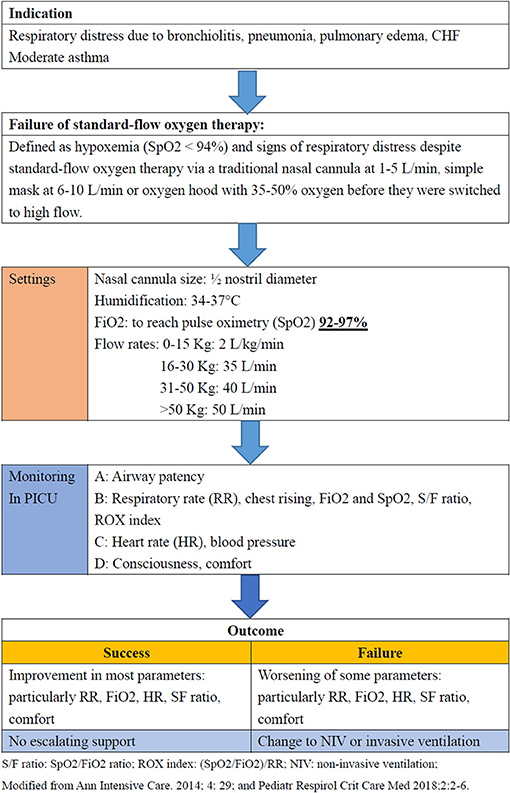 Figure 1: Protocol for high-flow nasal cannula (HFNC) initiation, weight-tiered flow titration ($2\text{ L/kg/min}$ for $\le 15\text{ kg}$ up to $50\text{ L/min}$ for $>50\text{ kg}$), active heated humidification ($34-37^\circ\text{C}$), continuous multi-modal PICU monitoring (airway patency, respiratory rate, $\text{FiO}_2/\text{SpO}_2$, S/F ratio, pediatric ROX index, and hemodynamic stability), and definitive criteria for clinical success versus treatment failure prompting timely escalation to CPAP/BiPAP or invasive mechanical ventilation. Adapted from Chang et al., Frontiers in Pediatrics, 2021; doi:10.3389/fped.2021.664180.
Interface Selection, Fit Engineering, and Complications
Optimal interface selection is the primary technical determinant of pediatric NIV success. Anatomical mismatches introduce massive air leaks, trigger dyssynchrony, cause pressure necrosis, or precipitate claustrophobia.
flowchart LR
    subgraph Interfaces["Pediatric NIV Interfaces"]
        N1["Nasal Prongs / Cannula<br>(Low dead space, high comfort, mouth-leak sensitive)"]
        N2["Nasal Mask<br>(Covers nose only, allows oral suctioning, requires chin strap if mouth leaks)"]
        N3["Oronasal Full-Face Mask<br>(Covers mouth & nose, eliminates mouth leak, higher dead space & asphyxia risk)"]
        N4["Total Face Mask<br>(Covers entire facial profile, distributes pressure evenly, reduces nasal bridge breakdown)"]
        N5["RAM Cannula<br>(Simplified infant prong interface, significant resistance at high flows)"]
    end
Interface Comparison Matrix
| Interface Type | Recommended Age / Weight | Anatomical Contact Points | Internal Dead Space | Advantages | Key Drawbacks & Risks |
|---|---|---|---|---|---|
| Nasal Prongs (HFNC) | Neonates to Adolescents | Nares ($\le 50\%$ diameter) | Minimal | High tolerance, allows feeding and speech, no skin breakdown on bridge | Pressure loss with mouth opening, mucosal dryout if unheated |
| RAM Cannula (NIV/CPAP) | Neonates and Infants $< 10\text{ kg}$ | Nares (60–80% fill) | Minimal | Easy fixation, infant comfort | High circuit resistance; delivered pressure is significantly lower than machine set pressure |
| Nasal Mask (Triangular) | Children $> 1\text{ year}$ | Nasal bridge, maxilla, upper lip | Low | Allows oral expectoration and suction, low asphyxiation risk | Massive pressure leaks if child opens mouth; requires chin strap |
| Oronasal (Full Face) | Children $> 2\text{ years}$ | Nasal bridge, cheeks, mental crease | Moderate | Controls mouth leaks, effective in mouth breathers | Risk of aspiration of emesis, pressure necrosis over nasal bridge, rebreathing risk |
| Total Face Mask | Children $> 5\text{ years}$ and Adolescents | Outer facial perimeter (forehead, lateral cheeks, chin) | High (requires high bias flow) | Completely offloads fragile nasal bridge, minimal skin breakdown, clear field of vision | Claustrophobia, requires anti-asphyxia valve, higher dead space |
Complications and Mitigation Strategies
flowchart TD
    A["NIV / HFNC Complications"] --> B["1. Skin Breakdown & Pressure Ulcers"]
    A --> C["2. Unintentional Air Leaks"]
    A --> D["3. Gastric Insufflation & Distension"]
    A --> E["4. Pulmonary Barotrauma / Air Leaks"]

    B --> B1["Apply prophylactic hydrocolloid dressings over nasal bridge; rotate interfaces every 12 hours"]
    C --> C1["Refit mask sizing; apply gentle headgear tension (allow 1-2 fingers under straps); add chin strap"]
    D --> D1["Insert decompressive orogastric/nasogastric tube; keep IPAP < 20 cmH2O (esophageal opening threshold)"]
    E --> E1["Avoid excessive CPAP/EPAP > 10-12 cmH2O; maintain continuous monitoring for pneumothorax/pneumomediastinum"]
Overtightening headgear straps does not resolve air leaks caused by an incorrectly sized mask; it merely accelerates ischemic pressure necrosis over the pediatric nasal bridge. If the harness cannot accommodate one to two examiner fingers beneath the straps, the mask is overtightened. Switch mask geometry or size immediately.
Key Takeaways
- Dead Space Washout vs. Distending Pressure: HFNC primarily unloads respiratory work by sweeping $\text{CO}_2$ from the anatomical dead space ($V_{D,\text{ana}}$) and reducing inspiratory resistance with fully conditioned gas ($37^\circ\text{C}, 44\text{ mg/L } \text{H}_2\text{O}$); CPAP and BiPAP provide sealed, guaranteed distending and driving pressures.
- Pediatric ROX Dynamics: Use age-adjusted ROX thresholds and the ROX-HR index. An infant with $\text{ROX} < 3.0$ or $\text{ROX-HR} < 2.0$ at 2 hours post-HFNC initiation is failing therapy and mandates urgent escalation.
- Driving Pressure Support Calculation: In BiPAP/NIPPV, alveolar ventilation and diaphragmatic offloading are governed by $\Delta PS = IPAP - EPAP$. Always titrate IPAP and EPAP independently to achieve target oxygenation ($FRC$) and ventilation ($V_T$).
- Avoid Delayed Intubation: Clinical deterioration, severe thoracoabdominal paradox, lack of respiratory rate reduction within 1–2 hours, or worsening respiratory acidosis are clear signals of NIV failure requiring prompt endotracheal intubation.