Regionalised perinatal care depends on moving the sickest infants safely. Extremely preterm newborns and those with surgical anomalies, severe respiratory failure or pulmonary hypertension are often born, or first deteriorate, outside a tertiary centre, and must be stabilised and transferred. For a ventilator-dependent neonate, intensive care is then delivered not in a controlled room but in a moving vehicle or aircraft, where noise, vibration, acceleration, temperature gradients, confined space and finite gas and power reserves all apply. The newborn's reserve is small, the margin between adequate and injurious ventilation is narrow, and expert help may be an hour away.
Transport ventilation is applied physiology under unusual constraints: every choice of ventilator, mode, oxygen fraction and gas supply is a compromise between the infant's needs and the platform's limits. This chapter covers those demands, ventilator limitations, stabilisation before departure, ventilation in transit, device selection, and the team that holds the system together.
The Physiology and Logistics of the Moving Intensive Care Unit
Thermoregulation
Cold stress is the commonest avoidable insult of transport. Neonates have a high surface-area-to-mass ratio, little insulating fat and depend on non-shivering thermogenesis, so cold raises oxygen consumption, depletes glucose, increases pulmonary vascular resistance, impairs surfactant function and worsens acidosis. Target a core (axillary) temperature of about $36.5$–$37.5\ ^\circ\text{C}$ with a pre-warmed servo-controlled incubator, hat and warmed mattress, and keep the incubator closed.
Glucose Homeostasis
Fasting, cold, sepsis and the stress response dysregulate glucose. Preterm and growth-restricted infants have minimal glycogen and become hypoglycaemic readily, while stress and over-infusion cause hyperglycaemia. Hypoglycaemia causes seizures and neuronal injury and depresses respiratory drive; marked hyperglycaemia causes osmotic diuresis. Maintain a dextrose infusion undisturbed throughout and correct glucose before departure.
Cardiovascular Stability
The neonatal circulation tolerates hypovolaemia, cold, hypoxia and acidosis poorly. Avoid aortocaval compression, secure two access points, and assess perfusion, blood pressure and lactate. Correct shock with volume and inotropes before moving, and avoid the hypoxaemia, hypercarbia and acidosis that destabilise ductal shunting and pulmonary hypertension.
The Constrained Environment
A cabin is cramped, poorly lit, often above $80\ \text{dB}$ so alarms are masked and auscultation impossible, and subject to vibration, acceleration, temperature change and, in flight, altitude. Power and oxygen are finite, so procedures that can be done at the bedside are never deferred to the road.
The Transport Ventilator and Its Limitations
Modes and the Missing High-Frequency Option
Most transport ventilators are time-cycled and pressure-limited, offering IMV or SIMV and increasingly volume-targeted (volume-guarantee) ventilation. Triggering is slower than on an intensive care device, and motion can cause missed breaths or auto-triggering. High-frequency oscillatory and jet ventilation are usually unavailable: a conventional device cannot generate the required frequency, amplitude and mean airway pressure, and oscillation in transit needs a purpose-built platform and an experienced team. Advanced synchrony and full waveform graphics are likewise absent, so support must be reproducible with conventional modes before departure.
Flow, Pressure and Gas Consumption
Transport ventilators deliver lower flows and driving pressures than intensive care devices. Some are turbine-driven and consume no cylinder gas, but most neonatal transport ventilators are pneumatic and consume blended gas continuously for bias flow and drive, so total consumption of $6$–$10\ \text{L}\cdot\text{min}^{-1}$ is common. This determines cylinder duration and limits added-flow therapy such as free-flow oxygen, nebulisation or suction. Peak pressures to about $50$–$60\ \text{cmH}_2\text{O}$ are usually available, but flow limitation appears with large leaks or very low compliance.
Humidification, Battery and Oxygen Supply
Heat-and-moisture exchangers need no power but add dead space and resistance — significant in a $500\ \text{g}$ infant — and can obstruct. Heated humidifiers condition gas better but consume battery and water. Battery life is typically one to four hours, so a charged spare is carried, and oxygen is calculated for the whole route with a reserve and a spare cylinder.
Comparison with a Neonatal Intensive Care Ventilator
| Domain | Neonatal intensive care ventilator | Typical transport ventilator |
|---|---|---|
| Modes | Pressure and volume control, volume guarantee, PSV, NAVA, oscillation and jet | Time-cycled pressure-limited, SIMV and PC-CMV, some volume guarantee; high frequency rarely available |
| Gas source | Wall pipeline with blender | Cylinders with blender; consumption-limited |
| Flow and pressure | High, servo-controlled | Lower; blower- or turbine-limited; leak-sensitive |
| Humidification and power | Servo heated humidifier; mains with internal battery | HME or low-output humidifier; battery-first, one to four hours |
| Monitoring | Integrated graphics, loops and trending | Limited display; capnography and oximetry added separately |
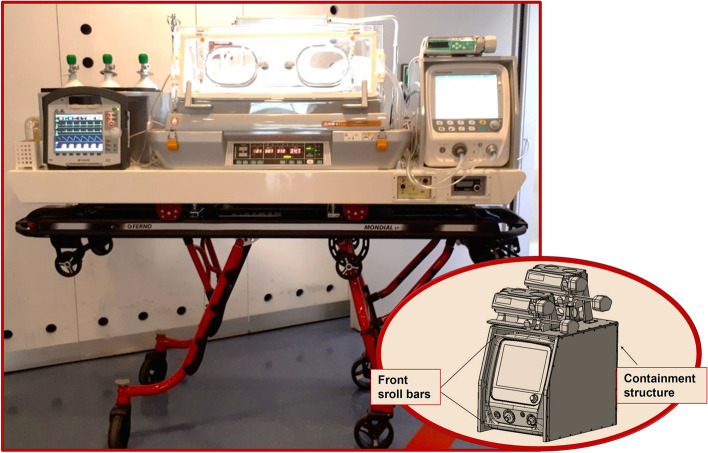 Figure 1: The physical reality of transport ventilation — a transport module with the ventilator and its gas supply accommodated on a dedicated platform, illustrating the confined space, weight and power limits that shape every ventilator decision. (Source: Belli G, Dovadola I, Berti E, et al. BMC Pediatrics 2022. DOI: 10.1186/s12887-022-03393-0).
Stabilise, Then Transport
The Case Against Premature Transport
The physiological state at departure, not the speed of the journey, determines outcome. Moving an unstable infant transfers a controlled problem in a well-equipped unit into an uncontrolled one in a confined, moving space with fewer hands and less equipment. Hypothermia, hypoglycaemia, hypoxaemia, acidosis and hypotension all worsen with movement and are correctable beforehand. If an infant deteriorates despite maximal therapy at the referring unit, bring the tertiary team to the bedside rather than expedite the journey.
Departure before the airway is secure, gas exchange stable, circulation adequate and normothermia and normoglycaemia established is a reversible error that becomes irreversible in transit. Time spent stabilising is the highest-yield intervention of the episode.
A Structured Pre-Transport Approach
- Airway — tube size, depth and fixation documented; position confirmed; suction and spare tubes ready.
- Breathing — blood gas and chest radiograph reviewed; pneumothorax excluded; settings recorded; ventilation confirmed achievable on the transport device.
- Circulation — two access points; perfusion, blood pressure and lactate assessed; shock corrected.
- Disability and drugs — analgesia, sedation, muscle relaxation if indicated; surfactant, antibiotics, dextrose and anticonvulsants prepared.
- Exposure and environment — normothermia, normoglycaemia, secured lines and tubes, monitoring attached.
Two secure access points; a secured and confirmed airway; a blood gas within the last hour; temperature $36.5$–$37.5\ ^\circ\text{C}$; glucose in range; adequate perfusion; functioning capnography and pulse oximetry; and oxygen calculated for the route with a reserve.
Pre-Transport Stabilisation and Ventilator-Selection Algorithm
graph TD
    A["Ventilated neonate: decision to transfer"] --> B["Stabilise: ABCDE at the referring unit"]
    B --> C["Airway: secure and confirm tube"]
    C --> D["Breathing: gas exchange, exclude air leak"]
    D --> E["Circulation: access, perfusion, glucose"]
    E --> F["Drugs and environment: analgesia, normothermia"]
    F --> G{"Stable on current support?"}
    G -->|"No"| H["Correct reversible causes"]
    H --> G
    G -->|"Yes"| I{"Support required?"}
    I -->|"CPAP or non-invasive"| J["T-piece resuscitator or transport CPAP"]
    I -->|"Invasive"| K{"Volume-targeted mode available?"}
    K -->|"Yes"| L["Volume-guarantee pressure-controlled ventilation"]
    K -->|"No"| M["Pressure-limited time-cycled ventilation"]
    J --> N["Check battery, oxygen, circuit and alarms"]
    L --> N
    M --> N
    N --> O["Depart; monitor capnography and SpO2; structured handover"]
Ventilation During Transit
Preserving the Pre-Transport Settings
The safest strategy is usually the one already working. Changing mode, PEEP or target volume at the moment of greatest instability adds a variable and removes a known reference point. Where the transport device cannot reproduce the intensive care mode, use the nearest equivalent and record achieved tidal volume, pressures and blood gas; volume-targeted modes compensate automatically when compliance changes with position, secretions or altitude.
Altitude, Partial Pressures and Oxygen Delivery
The partial pressure of oxygen in dry inspired gas is the product of the fractional concentration and the ambient barometric pressure:
$$P_{i}O_2 = F_{i}O_2 \times P_{B}$$After humidification to body temperature, the water-vapour pressure $P_{H_2O} \approx 6.3\ \text{kPa}$ at $37\ ^\circ\text{C}$ displaces part of the total, and at the alveolus carbon dioxide further dilutes the mixture:
$$P_{A}O_2 = F_{i}O_2 \left(P_{B} - P_{H_2O}\right) - \frac{P_{a}CO_2}{R}$$where $P_{B}$ = barometric pressure ($\text{kPa}$), $F_{i}O_2$ = inspired oxygen fraction (dimensionless), $P_{a}CO_2$ = arterial carbon dioxide tension ($\text{kPa}$), and $R$ = respiratory exchange ratio ($\approx 0.8$, dimensionless).
At sea level $P_{B} \approx 101.3\ \text{kPa}$, whereas a commercial aircraft cabin is equivalent to roughly $2{,}400\ \text{m}$, at which $P_{B} \approx 75\ \text{kPa}$. A blender holds the fraction constant, so $F_{i}O_2$ does not fall; the partial pressure falls, in proportion to barometric pressure. On room air $P_{i}O_2$ drops from about $21.3$ to $15.8\ \text{kPa}$, and alveolar oxygen tension falls by roughly $5.5\ \text{kPa}$ — enough to desaturate an infant with marginal reserve. Restoring the sea-level inspired partial pressure at $P_{B} = 75\ \text{kPa}$ requires $F_{i}O_2 \approx 0.28$, so the fraction is titrated upward using pulse oximetry and blood or transcutaneous gases.
Calculating Oxygen Cylinder Duration
For an isothermal ideal gas the volume a fixed mass occupies is inversely proportional to pressure, so the volume available at ambient pressure from a cylinder of internal water capacity $V_{c}$ is
$$V_{\text{usable}} = \frac{P_{g}\,V_{c}}{P_{\text{atm}}}$$and the time that this volume sustains a total consumption $Q$ is
$$t = \frac{P_{g}\,V_{c}}{Q\,P_{\text{atm}}}$$where $P_{g}$ = cylinder gauge pressure ($\text{bar}$), $V_{c}$ = internal water capacity ($\text{L}$), $P_{\text{atm}}$ = ambient pressure at the point of use ($\text{bar}$), $Q$ = total blended-gas consumption ($\text{L}\cdot\text{min}^{-1}$), and $t$ = duration ($\text{min}$). At sea level $P_{\text{atm}} \approx 1\ \text{bar}$.
An E-cylinder with $V_{c} \approx 4.7\ \text{L}$ at $P_{g} = 137\ \text{bar}$ supplying a ventilator at $Q = 10\ \text{L}\cdot\text{min}^{-1}$ gives $V_{\text{usable}} = 137 \times 4.7 \approx 644\ \text{L}$, hence $t \approx 64\ \text{min}$. The calculation ignores residual pressure and assumes no leak, so carry a reserve of at least half the expected journey and a spare cylinder.
Omitting bias flow, leak, suction or nebulisation from the consumption estimate is a common, preventable cause of intra-transport oxygen failure. Calculate for the whole route, add a reserve, carry a spare cylinder and monitor its pressure in transit.
Disconnection, Over- and Under-Inflation, and Vibration
An unrecognised disconnection or extubation is the most dangerous event in transport ventilation, because noise and restricted access make it easy to miss. Secure every connection, use one continuous circuit, and rely on waveform capnography, whose loss proves disconnection or tube displacement before desaturation occurs. Over-inflation follows an excessive pressure limit or inexpert use of a flow-inflating bag, while under-inflation follows leak, disconnection or a blocked tube. Vibration and acceleration alter delivered tidal volume and can cause sensors to misread, so fix tube and circuit securely and favour motion-tolerant sensing.
Continuous Monitoring
Capnography confirms tube position and patency, detects disconnection immediately and trends carbon dioxide to guide ventilation. Add motion-tolerant pulse oximetry, electrocardiography, blood pressure, temperature and glucose. Alarms must be audible above ambient noise and observations documented at intervals.
Device Selection and Manual Ventilation
Self-Inflating Bags
A self-inflating bag refills from its own reservoir and works even if the gas supply fails. It cannot deliver CPAP or free-flow oxygen, and its inspired oxygen fraction is uncontrolled: about $21\%$ without a reservoir and variable, rarely $100\%$, with one. Peak pressure depends on how the bag is squeezed, and the pressure-release valve can be defeated. A $150$–$250\ \text{mL}$ bag suits a neonate; it is adequate for resuscitation but poor for sustained preterm support.
Flow-Inflating Bags
A flow-inflating bag requires continuous gas flow and a tight seal, delivers CPAP and free-flow oxygen, and can provide up to $100\%$ oxygen. Its weakness is operator-dependence: pressure is set by the combination of seal and squeeze, so dangerously high pressures are readily generated when the seal is occluded. It needs a gas source and a trained operator.
T-Piece Resuscitators
A T-piece resuscitator requires a gas source and a set flow, usually $8$–$10\ \text{L}\cdot\text{min}^{-1}$, and delivers a repeatable preselected peak and end-expiratory pressure, plus CPAP. It is the most controlled manual device and the preferred choice for preterm infants and transport stabilisation. Its limitations are high gas consumption, which enters the cylinder calculation, dependence on a good seal, and inability to deliver a sigh.
Choosing Between Them
The self-inflating bag is most robust for resuscitation or a lost gas supply; the T-piece resuscitator gives the most reproducible pressures for preterm stabilisation and transport; the flow-inflating bag is reserved for frequent users.
Team Composition, Communication and Handover
The Team and the Pre-Brief
Team composition is set by acuity: typically a nurse with neonatal intensive care expertise, a respiratory therapist or equivalently trained practitioner, and a physician or advanced practitioner competent in neonatal airway management and intensive care, with additional expertise for high-acuity transfers. A trained emergency driver and a reliable communication link complete the team. A structured pre-brief covers the patient summary, likely problems, contingency plans for difficult airway, pneumothorax, extubation or power failure, role allocation, and contact with both units.
Handover and Documentation
Handover is a clinical intervention, not an administrative formality. A reproducible structure covers identity, gestation and weight, diagnosis, antenatal and birth history, current support and settings, blood gas and trends, vascular access and drugs, investigations, family communication and the onward plan. A written transport log of times, observations, interventions, ventilator settings and adverse events supports governance and audit, and the receiving unit must get both a verbal handover on arrival and the written record.
Read back, name the task and confirm the receiver. Ambiguity in transport communication is a latent hazard, and a structured handover with explicit confirmation is the cheapest safety intervention available.
Key Takeaways
- Transport is intensive care under constraint: cold stress, glucose instability, cardiovascular fragility and a cramped, noisy cabin with finite oxygen and power, so thermoregulation, glucose and cardiovascular stability must all be secured before departure.
- Transport ventilators provide conventional pressure-limited and some volume-targeted modes, but high-frequency ventilation, jet ventilation and advanced synchrony are rarely available.
- Gas consumption, humidification, battery life and cylinder duration are the hard limits; $6$–$10\ \text{L}\cdot\text{min}^{-1}$ of total consumption sets how long the oxygen lasts.
- "Stabilise, then transport": safety depends on the physiological state at departure, not speed, so an unstable infant is stabilised or the tertiary team brought to the bedside.
- Cylinder duration follows Boyle's law, $t = P_{g}V_{c}/(Q\,P_{\text{atm}})$, and altitude lowers the partial pressure of oxygen even when the inspired fraction is unchanged, so $F_{i}O_2$ is titrated upward in flight.
- Device selection, waveform capnography, secure fixation, a trained team, closed-loop communication and documentation turn a hazardous journey into controlled intensive care.