Bronchopulmonary dysplasia (BPD) is the most common chronic respiratory morbidity of extreme prematurity and the leading reason a preterm infant is discharged on supplemental oxygen. It is not a single disease but a final common pathway: an immature lung exposed to antenatal inflammation, invasive ventilation, hyperoxia and postnatal infection undergoes an injury–repair response that distorts alveolar and vascular growth rather than simply scarring the parenchyma.
For the ventilated neonate, BPD is both the disease being prevented and the chronic condition that governs every later ventilator decision. Its heterogeneous, prolonged time constants and collapsible airways make the lung behave less like a stiff, surfactant-deficient lung than like a chronic obstructive airway. This chapter covers diagnosis, pathogenesis, prevention, management and the pulmonary vascular consequences that dominate outcome.
Definitions and the Evolution of Diagnostic Criteria
From Northway to the first consensus
Northway and colleagues described BPD in 1967 in relatively mature preterm infants who survived severe respiratory distress syndrome after prolonged ventilation and high inspired oxygen. Their phenotype was fibroproliferative and emphysematous, with airway metaplasia and dense interstitial scarring at autopsy. Diagnosis then required mechanical ventilation, oxygen dependency beyond 28 days and characteristic radiographs.
As progressively more immature infants survived, this definition became unworkable. The 2001 NIH consensus — a joint workshop of the National Heart, Lung, and Blood Institute (NHLBI) and the National Institute of Child Health and Human Development (NICHD) — anchored diagnosis to a functional endpoint: oxygen dependency for at least 28 days, with severity graded at 36 weeks' postmenstrual age (PMA) as mild, moderate or severe by the oxygen and positive pressure required. BPD became defined by ongoing need for support, not by radiography alone.
The 2018–2019 NICHD revision
A 2018 NICHD workshop proposed the graded definition below, which a 2019 multicentre validation tested against 18–24-month outcomes. Rather than a dichotomy, it assigns grades I–III by both the interface and the $F_{iO_2}$ required, and adds a category for the sickest infants who die before assessment. It is the current postgraduate standard.
NICHD 2018 severity grades at 36 weeks' PMA An infant born before 32 weeks' gestation has BPD if persistent parenchymal lung disease (radiographically confirmed) requires one of the $F_{iO_2}$ thresholds below for $\geq 3$ consecutive days to keep $S_{pO_2}$ at 90–95%. Grade rises with the invasiveness of support and the oxygen requirement: invasive ventilation at $F_{iO_2}$ 0.21 is grade II, whereas any invasive ventilation above 0.21 is grade III. Grade III(A) captures early death from respiratory failure.
| Grade | Invasive IPPV | N-CPAP/NIPPV or NC $\geq 3$ L/min | NC 1–$<3$ L/min | Hood O$_2$ | NC $<1$ L/min |
|---|---|---|---|---|---|
| I | — | 0.21 | 0.22–0.29 | 0.22–0.29 | 0.22–0.70 |
| II | 0.21 | 0.22–0.29 | $\geq 0.30$ | $\geq 0.30$ | $>0.70$ |
| III | $>0.21$ | $\geq 0.30$ | — | — | — |
| III(A) | Early death between 14 days and 36 weeks' PMA from persistent parenchymal lung disease and respiratory failure not attributable to other morbidity |
Values are the $F_{iO_2}$ required for $\geq 3$ consecutive days to maintain $S_{pO_2}$ 90–95%; NC = nasal cannula. Adapted from the NICHD 2018 workshop proposal.
Why the definition remains contested
Room air at altitude is not equivalent to room air at sea level, so oxygen-dependency criteria are altitude-sensitive, and "non-invasive support" conceals wide variation in delivered pressure. A fixed 36-week PMA threshold also underestimates BPD in infants born at 24–26 weeks, whose lungs are less mature at that milestone. These ambiguities inflate or deflate incidence and hamper comparison between units, which is why a physiological definition — an oxygen-reduction test at 36 weeks — has been proposed but not universally adopted.
Epidemiological consequences Because incidence depends on definition, saturation targets, altitude and local use of non-invasive support, rates of BPD are not comparable between centres. State the definition, assessment age and population when citing a rate.
The "New BPD" of the Surfactant Era
Since antenatal corticosteroids and surfactant transformed the survival of extremely low birth weight infants, the autopsy phenotype has shifted. The dominant lesion is now alveolar simplification: fewer, larger alveoli with reduced secondary septation and a diminished surface area, plus a dysmorphic, rarefied capillary bed and variable fibroproliferation and airway injury. Frank fibrosis is far less prominent than in Northway's era.
Alveolarisation is quantified by the mean linear intercept ($L_m$), the average distance between alveolar walls on a section:
$$L_m = \frac{4 V_L}{S_A}$$where $V_L$ is lung volume (mL), $S_A$ the internal alveolar surface area (cm$^2$), and $L_m$ is in $\mu$m. In new BPD, $L_m$ rises and $S_A$ falls because the same volume is subdivided into fewer, larger airspaces; stereological alveolar number is likewise reduced.
From fibrosis to arrested development
BPD reflects a deviation from the normal developmental trajectory, not merely damage. Injury during the canalicular and saccular stages — roughly 23 to 30 weeks' gestation, when septation should be accelerating — arrests alveolar and vascular growth. Depending on timing and intensity, the outcome ranges from early developmental arrest (new BPD) to structural destruction of a relatively immature lung (old BPD). This is why an infant can develop chronic oxygen dependency with only modest fibrosis.
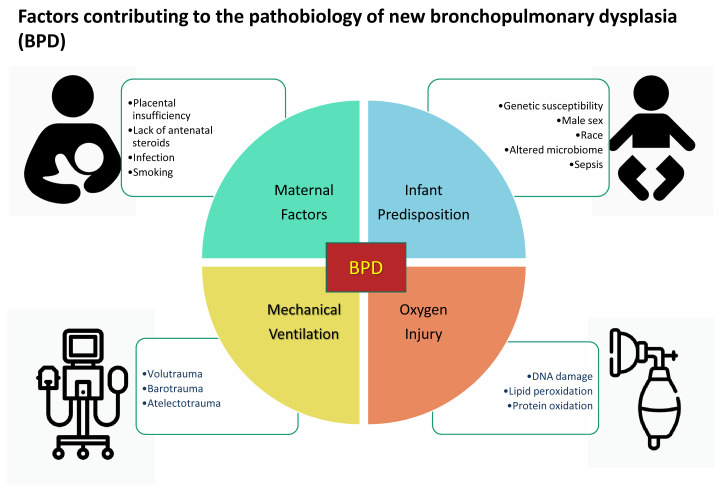 Figure 1: Premature infants with antenatal and postnatal risk factors develop "new BPD" when exposed to invasive mechanical ventilation and hyperoxia, producing arrested alveolar and vascular growth rather than classical fibrosis. (Source: Sahni M, Bhandari V. F1000Research 2020. DOI: 10.12688/f1000research.25338.1).
Pathogenesis: A Multifactorial Injury–Repair Disorder
Ventilator-induced lung injury
Mechanical ventilation injures the immature lung through volutrauma (regional overdistension), atelectrauma (cyclic opening and closing of unstable alveoli), and the resulting shear stress and biotrauma. With a compliant chest wall, weak alveolar tethering and inhomogeneous, surfactant-deficient parenchyma, a safe global tidal volume is delivered heterogeneously, overdistending some regions while collapsing others and releasing mediators that inhibit septation.
Oxygen toxicity, infection and inflammation
Hyperoxia generates reactive oxygen species that overwhelm immature antioxidant defences, injuring the microvasculature and impairing angiogenesis. Antenatal chorioamnionitis primes the fetal lung with cytokines, while postnatal sepsis, pneumonia, patent ductus arteriosus (PDA) and fluid overload amplify the inflammatory load. Interleukin-1$\beta$, interleukin-6 and tumour necrosis factor-$\alpha$ disrupt the signalling that coordinates alveolar and capillary growth.
Disrupted growth-factor signalling
The final common pathway is disturbed growth-factor signalling. Vascular endothelial growth factor (VEGF) is required for pulmonary angiogenesis, and its inhibition produces alveolar simplification even without hyperoxia; TGF-$\beta$ promotes myofibroblast proliferation and disordered matrix deposition; fibroblast growth factor (FGF) governs branching and septation. When these pathways are uncoupled, alveolar and vascular development arrest together — which is why BPD is a vascular as well as an alveolar disease.
Airway resistance in established BPD rises steeply as radius falls (Poiseuille's law):
$$R = \frac{8 \mu L}{\pi r^{4}}$$where $R$ is airway resistance (cmH$_2$O/L/s), $\mu$ the gas viscosity, $L$ the airway length (cm) and $r$ the radius (cm). Because resistance depends on the fourth power of radius, the tracheobronchomalacia and small-airway narrowing of BPD cause disproportionate flow limitation and a prolonged, heterogeneous expiratory time constant:
$$C_{rs} = \frac{\Delta V}{\Delta P}, \qquad \tau = R_{rs} \cdot C_{rs}$$where $C_{rs}$ is respiratory-system compliance (mL/cmH$_2$O), $\Delta V$ the tidal volume (mL), $\Delta P$ the distending pressure change (cmH$_2$O), $R_{rs}$ resistance (cmH$_2$O/L/s) and $\tau$ the time constant (s). A long $\tau$ demands longer expiratory times or auto-PEEP develops.
flowchart TD
    A["Antenatal exposures: chorioamnionitis, preeclampsia, growth restriction"] --> B["Immature lung at canalicular/saccular stage"]
    C["Postnatal exposures: sepsis, PDA, fluid overload"] --> B
    B --> D["Ventilator-induced lung injury: volutrauma, atelectrauma"]
    B --> E["Hyperoxia and reactive oxygen species"]
    D --> F["Inflammatory cytokine cascade"]
    E --> F
    C --> F
    F --> G["Disrupted growth-factor signalling: VEGF, TGF-beta, FGF"]
    G --> H["Arrested alveolarisation: fewer, larger alveoli"]
    G --> I["Dysmorphic capillary bed with reduced angiogenesis"]
    H --> J["Alveolar simplification and prolonged time constant"]
    I --> J
    J --> K["New BPD with chronic oxygen dependency"]
    I --> L["BPD-associated pulmonary hypertension"]
    K --> L
Prevention
Prevention is more effective than treatment. Antenatal corticosteroids between 24 and 34 weeks are the single most effective intervention, accelerating surfactant maturation, reducing distress severity and therefore the need for invasive ventilation. In the delivery room, early stabilisation with nasal CPAP and a deliberate bias against intubation shortens mechanical ventilation. Where surfactant is indicated, less invasive surfactant administration (LISA) or minimally invasive surfactant therapy (MIST) delivers drug without intubation in spontaneously breathing infants on CPAP.
Once ventilated, volume-targeted ventilation at 4–6 mL/kg reduces death or BPD by limiting overdistension, and permissive hypercapnia avoids the harm of aggressive normocapnia. Caffeine citrate and vitamin A also reduce BPD by shortening positive-pressure support. Oxygen is titrated to balance hypoxia against hyperoxia, and fluid and infection control limit the inflammatory burden.
| Strategy | Practice point | Evidence strength |
|---|---|---|
| Antenatal corticosteroids | 24$^{+0}$–33$^{+6}$ weeks, single course where indicated | High |
| Early CPAP, avoid intubation | Sustained inflation then CPAP $\geq 6$ cmH$_2$O in the delivery room | High |
| Surfactant via LISA/MIST | Reserve for escalating $F_{iO_2}$ on CPAP | Moderate–High |
| Volume-targeted ventilation | Target 4–6 mL/kg, avoid overdistension | Moderate–High |
| Caffeine citrate | Load 20 mg/kg, maintain 5–10 mg/kg/day | High |
| Vitamin A | 5,000 IU intramuscularly three times weekly | Moderate |
| Oxygen saturation target | 90–95%, avoiding sustained hyperoxia | Moderate |
The prevention hierarchy Antenatal steroids and delivery-room CPAP prevent the most BPD because they prevent the need for invasive ventilation altogether. Every additional day of invasive ventilation is an independent dose of risk.
Established BPD: Ventilation and Pharmacologic Management
Once BPD is established, the mechanical target changes. With heterogeneous prolonged time constants, high dead space and collapsible central airways, the strategy shifts toward larger tidal volumes (6–8.5 mL/kg), slower rates (15–25 breaths/min), longer expiratory times and higher positive end-expiratory pressure (PEEP, 7–10 cmH$_2$O) to stent the airways and prevent dynamic collapse. Overdistension must be avoided, since the simplified lung is easily overinflated; weaning is gradual, guided by work of breathing, blood gases and growth.
Diuretics improve mechanics in fluid-overloaded infants but have unproven long-term benefit and carry electrolyte and growth costs. Bronchodilators may transiently reduce resistance but are not routine. The systemic corticosteroid controversy is central: dexamethasone reduces extubation failure and BPD but, especially with early high-dose regimens, is associated with adverse neurodevelopmental outcomes. The DART low-dose regimen is used selectively after 2–4 weeks in ventilator-dependent infants when extubation is otherwise unlikely, with the trade-off discussed explicitly with families. Inhaled corticosteroids reduce the systemic burden but have inconsistent efficacy.
Steroid decision Systemic corticosteroids are never a reflex. Restrict them to ventilator-dependent infants who cannot otherwise be liberated, use the lowest effective dose, and document the neurodevelopmental trade-off. Avoid early high-dose dexamethasone.
Adequate energy, protein and micronutrients are essential, because lung repair and growth are anabolic; undernutrition independently worsens BPD. Respiratory syncytial virus (RSV) prophylaxis should be offered to infants with BPD, in whom RSV disease carries a high risk of hospitalisation; minimising invasive device days also reduces the inflammatory burden.
BPD-Associated Pulmonary Hypertension
Pulmonary hypertension (PH) complicates BPD in a substantial minority and is the strongest predictor of death in established disease. It arises from a rarefied, dysmorphic capillary bed, impaired angiogenesis with reduced VEGF signalling, chronic hypoxaemia and left-to-right shunting through a PDA. Reduced vascular cross-sectional area raises pulmonary vascular resistance, and hypoxic vasoconstriction and shear stress drive remodelling with muscularisation of distal arterioles. Right ventricular failure eventually ensues.
Screening is by transthoracic echocardiography in any infant with severe respiratory compromise below 28 weeks' gestation, in established BPD at 36 weeks' PMA and before discharge, and in prolonged oxygen requirement with poor growth. The tricuspid regurgitation jet and pulmonary artery acceleration time estimate pressure and vascular resistance. Management centres on optimising the lung — oxygenation, avoiding atelectasis and overdistension, treating aspiration and infection, and correcting anaemia and acidosis. Persistent PH is treated with sildenafil, with inhaled nitric oxide reserved for acute deterioration. Severity can be tracked with the oxygenation index:
$$OI = \frac{F_{iO_2} \times MAP \times 100}{P_{aO_2}}$$where $MAP$ is the mean airway pressure (cmH$_2$O) and $P_{aO_2}$ the arterial oxygen tension (mmHg). A rising $OI$ signals worsening gas exchange and possible PH progression.
BPD-PH is a lung disease first Vasodilators do not fix a rarefied capillary bed. The most effective pulmonary vasodilator is a well-recruited, well-oxygenated, non-overdistended lung.
Long-Term Outcomes and the Pathway to Home Ventilation
Most infants with BPD are discharged on home oxygen, with a programme of pulse oximetry, growth surveillance and clear escalation plans. Home oxygen supports growth and reduces pulmonary vascular stress, but unnecessary prolonged oxygen should be avoided. Weaning is guided by overnight oximetry and formal oxygen-reduction testing where available.
A small group with severe BPD and persistent respiratory failure or tracheobronchomalacia may need long-term invasive ventilation via tracheostomy, decided with the family and best anticipated early, since late tracheostomy prolongs intensive care. Survivors have reduced lung function that may track into adulthood, with obstructive physiology, asthma-like symptoms and early chronic obstructive pulmonary disease, requiring longitudinal follow-up.
flowchart TD
    A["Established BPD on invasive ventilation"] --> B["Optimise PEEP and tidal volume, avoid overdistension"]
    B --> C{"Failure to wean after 2-4 weeks?"}
    C -->|"No"| D["Wean support, extubate to CPAP or NIV"]
    C -->|"Yes"| E["Assess nutrition, fluid, PDA, tracheobronchomalacia"]
    E --> F["Consider DART low-dose dexamethasone"]
    F --> G{"Still ventilator dependent?"}
    G -->|"No"| D
    G -->|"Yes"| H["Plan tracheostomy and long-term ventilation with family"]
    D --> I["Screen for pulmonary hypertension at 36 weeks PMA"]
    I --> J["Home oxygen programme with oximetry and growth follow-up"]
Key Takeaways
- BPD is defined by oxygen and support dependency persisting to at least 28 days and graded at 36 weeks' postmenstrual age; the 2018 NICHD grades I–III, with grade III(A) for early death, are the current standard, though the definition remains contested.
- "New BPD" is dominated by alveolar simplification — fewer, larger alveoli with reduced septation and a dysmorphic capillary bed — rather than the classical fibrosis of the pre-surfactant era.
- Pathogenesis is a multifactorial injury–repair disorder driven by ventilator-induced lung injury, oxygen toxicity, antenatal and postnatal inflammation, PDA and fluid overload, and disrupted VEGF, TGF-$\beta$ and FGF signalling.
- A rising mean linear intercept, $L_m = 4V_L / S_A$ with reduced surface area, marks arrested alveolarisation; heterogeneous prolonged time constants ($\tau = R_{rs} C_{rs}$) explain the mechanics of the established BPD lung.
- Prevention beats treatment: antenatal corticosteroids, delivery-room CPAP with avoidance of intubation, LISA/MIST surfactant, volume-targeted ventilation, caffeine, vitamin A, and careful oxygen and fluid management.
- Established BPD demands larger tidal volumes, slower rates, longer expiratory times and higher PEEP, with diuretics and bronchodilators as selected adjuncts and systemic corticosteroids reserved for infants who cannot otherwise be liberated.
- BPD-associated pulmonary hypertension is the strongest predictor of death; screen by echocardiography at 36 weeks' PMA in at-risk infants and manage primarily by optimising the lung, with vasodilators for persistent disease.