High-frequency jet ventilation (HFJV) injects brief, high-velocity pulses of gas through a narrow-lumen cannula within or at the tip of the endotracheal tube (ETT), at $240-660$ jets/min ($\approx 4-11\text{ Hz}$). Inspiration is active, driven by the jet; exhalation is entirely passive, driven by elastic recoil through the open circuit. HFJV differs fundamentally from high-frequency oscillatory ventilation (HFOV), whose oscillator actively withdraws gas. Because the jet cannot hold lung volume between breaths, HFJV is always used in tandem with a conventional ventilator supplying positive end-expiratory pressure (PEEP) and intermittent sighs.
Its appeal is dissociating ventilation from proximal airway pressure. A jet carries fresh gas by momentum and entrainment rather than through a sealed circuit, so carbon dioxide clearance is achievable at lower proximal pressures and smaller tidal volumes — ideal in air leak, where added stretch propagates the leak. The price is a characteristic set of hazards: tracheal injury, mucus plugging, air trapping, and dependence on precise ETT tip position.
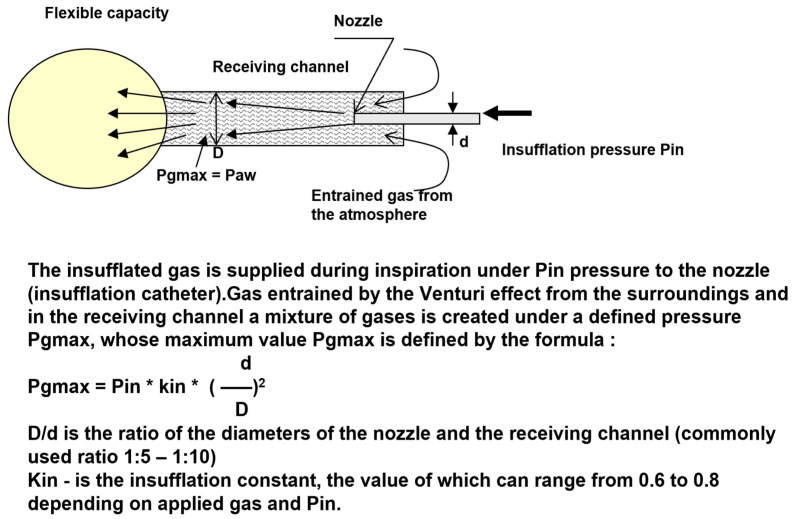 Figure 1: The jet cannula acts as a nozzle within the receiving channel formed by the endotracheal tube and trachea; the high-velocity jet creates a sub-atmospheric pressure at the nozzle that entrains surrounding gas by the Venturi effect, so total flow to the lung exceeds cannula flow. (Source: Musil P, Harsanyi S, Torok P, et al. Advances in Respiratory Medicine 2023;91(4):278-287. DOI: 10.3390/arm91040022).
Physical Principles of Jet Ventilation
The Jet, the Receiving Channel, and Entrainment
The ventilator generates a high-pressure pulse — the driving pressure, $P_{in}$ — ejected through an injector cannula of internal diameter $d$, typically well under $1\text{ mm}$ in neonatal adapters. Its tip lies inside the ETT, which together with the trachea forms the wider receiving channel of diameter $D$. As gas accelerates through the nozzle its lateral pressure falls, creating a sub-atmospheric region that draws in surrounding gas: entrainment. Bernoulli's principle describes the velocity–pressure trade-off:
$$P_{1} + \tfrac{1}{2}\rho v_{1}^{2} = P_{2} + \tfrac{1}{2}\rho v_{2}^{2}$$where $P$ is lateral pressure ($\text{cmH}_2\text{O}$), $\rho$ is gas density ($\text{kg/m}^{3}$), and $v$ is velocity ($\text{m/s}$); because $v_2 \gg v_1$ at the nozzle, $P_2$ falls sharply and ambient gas is entrained. The flow augmentation is approximated by:
$$\dot{V}_{\text{total}} = \dot{V}_{\text{jet}}\left(1 + k\left(\frac{D}{d} - 1\right)\right)$$where $\dot{V}_{\text{total}}$ is the total flow entering the airway ($\text{L/min}$), $\dot{V}_{\text{jet}}$ is the flow through the cannula ($\text{L/min}$), $D$ and $d$ are the receiving-channel and cannula diameters in the same units, and $k$ is a dimensionless entrainment coefficient less than unity. Transmitted pressure moves in the opposite direction:
$$P_{G,\max} \propto P_{in}\left(\frac{d}{D}\right)^{2}$$where $P_{G,\max}$ is the maximum pressure the generator transmits to the lung ($\text{cmH}_2\text{O}$). A narrow cannula in a wide trachea entrains much gas but transmits little pressure; a cannula that nearly fills the tube does the reverse. Cannula and tube size therefore both matter, and a partial tube obstruction alters delivered pressure markedly.
HFJV is not merely fast conventional ventilation. Gas is injected as a jet whose momentum, not a sealed pressure circuit, carries fresh gas into the lung; entrainment augments flow while the airway remains open to the atmosphere.
Active Insufflation and Passive Exhalation
Inspiration is driven wholly by the jet; expiration is passive and depends on elastic recoil as gas leaves around the jet and through the open circuit. This asymmetry is the essential mechanistic difference from HFOV, where the oscillator withdraws gas. Because exhalation must occur between jets, the expiratory interval — not inspiratory power alone — determines whether gas is cleared or retained, which is why HFJV traps gas more readily than HFOV.
The Tandem Conventional Ventilator
HFJV cannot generate PEEP or sighs itself. A conventional ventilator is connected in tandem through the jet adapter to deliver continuous PEEP (commonly $5-6\text{ cmH}_2\text{O}$), a low or zero backup rate, and one or two sighs a minute at higher pressure to recruit atelectatic lung. The tandem circuit is not optional: omitting it removes the end-expiratory pressure and periodic recruitment that keep the lung open.
Mechanisms of Gas Transport
Bulk Convection and Entrainment
Bulk convection through the jet and its entrained flow carries fresh gas to the proximal and mid airways, the jet's momentum penetrating the axial core of the bronchial tree further than a diffusive front could reach. Entrainment multiplies effective flow without a correspondingly large cannula, so a physically tiny jet can ventilate a comparatively large neonatal lung.
Taylor Dispersion, Pendelluft, and Molecular Diffusion
Taylor dispersion — augmented axial diffusion from the jet's parabolic velocity profile and turbulent mixing — enhances transport in the conducting airways. Pendelluft shuttles gas between units of differing time constants, mixing regions bulk flow bypasses, and is prominent in the heterogeneous preterm lung. Molecular diffusion completes exchange at the alveolar–capillary membrane; because carbon dioxide is far more soluble than oxygen, it is rarely rate-limiting, so clearance depends more on delivered volume and expiratory time.
HFJV Versus HFOV: Passive Versus Active Expiration
In HFOV the oscillator withdraws gas during expiration, so egress depends less on expiratory time; in HFJV egress depends wholly on elastic recoil and the interval between jets, so a prolonged time constant (secretions, tube obstruction, bronchospasm) or a shortened interval (high rate, long inspiratory time) promotes trapping.
Ventilator Settings and Their Physiological Meaning
Driving Pressure and Servo-Pressure
Driving pressure $P_{in}$ is applied to the injector; the resulting peak inspiratory pressure (PIP) at the airway is what the clinician targets. PIP sets jet momentum, entrained volume, and hence $\text{CO}_2$ clearance, while also determining peak distending pressure. Most neonatal jet ventilators use a servo-pressure feature: airway pressure measured at the distal ETT tip is used to adjust driving pressure breath by breath to hold the set PIP, compensating for changes in compliance, resistance, and leak. This makes PIP a controlled variable, but a leaking circuit or a misplaced pressure port can mislead the loop.
The Respiratory Time Constant and Air Trapping
Passive expiration follows the respiratory time constant:
$$\tau = R \times C$$where $\tau$ is the time constant ($\text{s}$), $R$ is airway resistance ($\text{cmH}_2\text{O}\cdot\text{s}\cdot\text{L}^{-1}$), and $C$ is compliance ($\text{mL}\cdot\text{cmH}_2\text{O}^{-1}$). Because the units are mixed, the product is multiplied by $10^{-3}$ (since $1\text{ L} = 1000\text{ mL}$) to yield seconds, or both terms are expressed in millilitre-consistent units. Exhalation is roughly complete after three time constants, so the expiratory interval must satisfy:
$$T_{e} = \frac{1}{f} - T_{i} \gtrsim 3\tau$$where $T_e$ is expiratory time ($\text{s}$), $f$ is the jet rate ($\text{Hz}$), and $T_i$ is the inspiratory (jet-on) time ($\text{s}$). If $T_e$ falls below about $3\tau$, gas is retained and hyperinflation follows. The stiff neonatal lung suits HFJV precisely because low compliance shortens $\tau$ — and a mucus-plugged tube or a shortened expiratory interval is correspondingly dangerous.
$\tau = R \times C$ is the time for the lung to exhale about $63\%$ of its volume; complete passive exhalation needs roughly $3\tau$. Any manoeuvre that lengthens $\tau$ or shortens $T_e$ — a higher rate, a longer inspiratory time, secretions, or tube obstruction — stacks gas and inflates the lung dangerously.
Rate, Inspiratory Time, PEEP, and Sighs
The jet rate is typically started at $240-420\text{/min}$ ($4-7\text{ Hz}$); lower rates lengthen the period and suit air leak, while higher rates aid clearance. Inspiratory time is classically $0.020\text{ s}$ (range $0.020-0.034\text{ s}$) and should be kept as short as achieves ventilation, because every jet-on millisecond is subtracted from expiratory time. PEEP and sighs are set on the tandem ventilator.
| Parameter | Typical initial setting | Physiological meaning | Titration goal |
|---|---|---|---|
| Jet rate | $240-420\text{/min}$ ($4-7\text{ Hz}$) | Jets per minute; sets the period $T = 1/f$ | Lower ($240-300\text{/min}$) in air leak; raise for $\text{CO}_2$ |
| Inspiratory time ($T_i$) | $0.020\text{ s}$ ($0.020-0.034\text{ s}$) | Duration of each jet pulse | Shortest value that ventilates, preserving expiratory time |
| Driving pressure / PIP | About $20-25\text{ cmH}_2\text{O}$, servo-controlled | Jet momentum, entrained volume, peak airway pressure | Lowest PIP that clears $\text{CO}_2$ |
| Tandem PEEP | $5-6\text{ cmH}_2\text{O}$ | Sustained lung inflation | Oxygenation and radiographic lung volume |
| Sighs | $1-2\text{/min}$ | Intermittent recruitment | Prevent atelectasis without over-inflation |
| $\text{FiO}_2$ | $1.0$ initially, then weaned | Oxygen delivery | $\text{SpO}_2$ $91-95\%$ |
Clinical Indications
Air Leak and Pulmonary Interstitial Emphysema
The clearest rationale is reduced proximal airway pressure. Because gas is carried by jet momentum and entrainment rather than a sealed circuit, ventilation can be sustained at lower proximal pressures and smaller tidal volumes, minimising the cyclic stretch that dissects air into the interstitium. HFJV is thus attractive in pulmonary interstitial emphysema (PIE), pneumothorax with bronchopleural fistula, and other air-leak syndromes, where HFOV may require a relatively high mean airway pressure that worsens the leak.
Congenital Diaphragmatic Hernia
In congenital diaphragmatic hernia (CDH) the hypoplastic lung is stiff and leak-prone, while the contralateral lung over-distends easily. HFJV has been used for initial management, stabilisation, and transport, on the reasoning that lower inspiratory pressures limit barotrauma and contralateral injury while the tandem ventilator sustains recruitment.
Severe Respiratory Distress Syndrome and Rescue Therapy
HFJV is used as rescue therapy in severe respiratory distress syndrome (RDS) and in refractory respiratory failure when conventional ventilation cannot achieve gas exchange at acceptable pressures, and has been studied as a first-intention mode in extremely low birth weight infants. The evidence demands caution: systematic reviews show no clear reduction in death or bronchopulmonary dysplasia from elective HFJV, and HFJV-versus-HFOV comparisons are inconclusive. HFJV is therefore best regarded as a targeted rescue rather than a routine first-line strategy.
Randomised evidence does not establish that elective HFJV improves survival or reduces bronchopulmonary dysplasia, and comparisons with HFOV are inconclusive. Its clearest role is as a rescue when conventional ventilation cannot achieve gas exchange at acceptable pressures, and in air-leak syndromes where lower proximal pressures are the specific objective.
Complications and Pitfalls
Necrotising Tracheobronchitis
The high-velocity jet can desiccate and mechanically injure the tracheal mucosa, producing necrotising tracheobronchitis — insidious and, in severe cases, fatal. Prevention rests on meticulous humidification with a dedicated heated jet humidifier and on ensuring the jet does not play directly against the mucosa.
A high-velocity, inadequately humidified jet can injure the tracheal wall. Confirm the jet-specific heated humidifier is functioning and that the cannula is not directed at the mucosa; blood-streaked secretions or unexplained deterioration should raise suspicion.
Mucus Plugging and Airway Obstruction
The narrow injector, open circuit, and lack of a large suction lumen make obstruction more likely than on conventional ventilation. A rising $\text{PaCO}_2$, a falling wiggle, or increased resistance to manual ventilation should prompt suctioning, humidification review, and assessment of tube patency.
Air Trapping and Hyperinflation
When $T_e < 3\tau$, gas accumulates, the lung hyperinflates, oxygenation falls as capillaries are compressed, and systemic hypotension follows. Over-inflation is recognised radiographically by a diaphragm at or beyond the tenth posterior rib, and clinically by worsening oxygenation and haemodynamics. The remedy is to lengthen expiration: reduce the rate, shorten the inspiratory time, and correct any cause of a prolonged time constant.
Endotracheal Tube Position and Disconnection
Because the jet is delivered at a fixed point, the ETT tip is functionally part of the ventilator setting. A tip too close to the carina lets the jet be directed asymmetrically into one main bronchus, causing unilateral hyperinflation and pneumothorax; the tip must be confirmed well above the carina on radiograph and re-checked after every repositioning or deterioration. The jet adapter's bulk, the open circuit, and frequent handling also increase the risk of kinking, disconnection, and accidental extubation, so secure the tube and handle the infant deliberately.
Monitoring, Troubleshooting, and Weaning
The Chest-Wall Wiggle
The "wiggle" — a fine visible fluttering of the chest wall synchronous with the jet — confirms that the jet reaches the lung, and should be present and symmetric. Its sudden loss is never normal and demands a search for the DOPES causes: Displacement of the tube, Obstruction, Pneumothorax, Equipment failure, and Stacked breaths.
A vanished or asymmetric chest-wall wiggle is an emergency. Exclude tube displacement or obstruction, circuit disconnection or leak, pneumothorax, and equipment failure before adjusting any ventilator setting.
Blood Gases and Serial Radiographs
Gas exchange is followed with arterial or capillary blood gases and, where available, transcutaneous $\text{CO}_2$, because the servo loop controls pressure rather than flow and ventilation can change without any change in displayed driving pressure. Serial chest radiographs track lung volume and tube-tip position; over-inflation (diaphragm at or below the tenth rib) and under-inflation (low volume with poor oxygenation) are both radiograph-first diagnoses.
A Set-Up and Troubleshooting Algorithm
flowchart TD
    Start["Neonate on HFJV: jet ventilator in tandem with a conventional ventilator"] --> Setup["Confirm ETT tip well above carina on CXR, secure the tube, and check humidification"]
    Setup --> Wiggle{"Chest-wall wiggle present and symmetric?"}
    Wiggle -->|"No"| Dopes["Search DOPES: Displacement, Obstruction, Pneumothorax, Equipment failure, Stacked breaths"]
    Dopes --> Fix["Reposition or replace the ETT, clear secretions, decompress air leak, reconnect the circuit"]
    Fix --> Wiggle
    Wiggle -->|"Yes"| Gas["Measure blood gas and transcutaneous CO2"]
    Gas --> Oxy{"Oxygenation adequate on FiO2 0.40 or less?"}
    Oxy -->|"No"| Peep["Increase tandem-ventilator PEEP or mean airway pressure in 1-2 cmH2O steps"]
    Peep --> Cxr["CXR: assess lung volume and tube tip position"]
    Cxr --> Gas
    Oxy -->|"Yes"| Vent{"Ventilation adequate, PaCO2 4.5-6.5 kPa?"}
    Vent -->|"No, hypercapnia"| Drive["Check for tube obstruction or air trapping, then increase jet driving pressure or lower the rate"]
    Drive --> Gas
    Vent -->|"Yes"| Wean["Wean FiO2, then jet driving pressure, then transition to conventional ventilation"]
    Wean --> Gas
Weaning and Transition
Weaning begins once oxygenation is stable on an $\text{FiO}_2 \le 0.40$ with acceptable gas exchange. Oxygen is reduced first, then jet driving pressure in small steps while tandem PEEP preserves lung volume, then the rate as $\text{PaCO}_2$ allows. Many units transition to a conventional mode before extubation, watching for atelectasis as the jet is withdrawn; confirm each reduction with a blood gas and a radiograph, not the ventilator numbers alone.
Key Takeaways
- HFJV injects high-velocity jets at $240-660\text{/min}$ ($\approx 4-11\text{ Hz}$) through a narrow cannula within or at the tip of the ETT; inspiration is active, exhalation passive and recoil-driven.
- The jet both ventilates and entrains: by Bernoulli's principle the low lateral pressure at the nozzle draws in surrounding gas, so total flow exceeds cannula flow, with $P_{G,\max} \propto P_{in}(d/D)^{2}$.
- HFJV must run in tandem with a conventional ventilator supplying PEEP and sighs; the jet alone cannot maintain lung volume.
- Transport rests on bulk convection, entrainment, Taylor dispersion, pendelluft, and molecular diffusion — as in HFOV, but with passive rather than active expiration.
- Expiration follows $\tau = R \times C$; when $T_e = 1/f - T_i$ falls below about $3\tau$, gas stacks and the lung hyperinflates.
- HFJV is a targeted rescue and air-leak mode — PIE, bronchopleural fistula, CDH, severe RDS — because it ventilates at lower proximal pressures; randomised evidence does not support elective use to improve survival or reduce bronchopulmonary dysplasia.
- Necrotising tracheobronchitis, mucus plugging, air trapping, and ETT tip position are the characteristic hazards; monitor the wiggle, blood gases, and radiographs, and treat loss of the wiggle as an emergency.