Traditional pressure-limited ventilation delivers every breath at a fixed inflating pressure, so the tidal volume ($V_T$) reaching the lung depends passively on respiratory-system compliance. When compliance changes — repeatedly in surfactant deficiency and evolving bronchopulmonary dysplasia (BPD) — a fixed peak inspiratory pressure (PIP) produces a drifting $V_T$: too large as compliance improves, too small as it worsens. Volume-targeted ventilation (VTV) inverts the relationship: the clinician sets the $V_T$, and the ventilator adjusts the inflation pressure to achieve it. Volume Guarantee (VG) is Dräger's implementation of VTV and, with PRVC and AutoFlow, among the most widely used hybrid modes in neonatal intensive care. It attacks two forms of ventilator-induced lung injury at once: capping volume limits volutrauma and biotrauma, while stabilising minute ventilation prevents the hypocarbia associated with cerebral white-matter injury.
Definition, Taxonomy and Platform Implementation
Volume-Targeted Ventilation as a Mode Family
VTV is a family of strategies with one defining feature: a tidal volume is set and pressure is the dependent variable. A VTV breath is a pressure-controlled breath with volume feedback, distinct from volume-controlled ventilation (VCV), in which a set flow delivers a guaranteed volume while pressure varies.
In volume-controlled ventilation the ventilator is a flow generator: it delivers a set volume over a set inspiratory time and airway pressure rises as required. In volume-guaranteed ventilation it remains a pressure generator, but the pressure target is recomputed each breath from the volume error. VG preserves the decelerating flow of a pressure-controlled breath; VCV produces a square, constant-flow inflation.
How Volume Guarantee Is Implemented on Dräger Devices
On the Dräger Babylog VN500 and Evita, VG is not a stand-alone mode but a targeting option layered onto a pressure-controlled or assisted mode such as synchronised intermittent mandatory ventilation (SIMV), assist/control (A/C) or pressure support (PSV). The clinician prescribes the target $V_T$, the mode and rate, and the pressure ceiling ($P_{\max}$), and the ventilator updates working PIP breath by breath. Two features are essential: the proximal Y-piece flow sensor, without which VG cannot operate, and a pressure ceiling, since VG may raise PIP only between the set floor and $P_{\max}$.
Equivalents on Other Platforms
PRVC (Siemens/Getinge Servo), AutoFlow (Getinge/Maquet) and volume-assured pressure support (Hamilton) share the architecture of a pressure-controlled breath with a proximal volume feedback loop, differing in measurement site and adjustment aggressiveness. Because VTV measures expired volume at the airway opening, cross-platform comparisons of set $V_T$ are meaningful only when measurement site and leak behaviour match.
The Servo-Control Mechanism
Breath-to-Breath Operation
Each VG breath is a feedback cycle. During inflation the proximal flow sensor integrates flow to measure inspired volume ($V_i$); during exhalation it measures expired volume ($V_{Te}$). The controller subtracts measured volume from the set target and adjusts the next inflation pressure proportionally, making VG a discrete, breath-to-breath servo. The pressure change per breath is deliberately limited — typically to about $\pm 3\text{ cmH}_2\text{O}$ — so the mode cannot chase noise with large swings. If the required pressure would exceed $P_{\max}$, it raises a "volume not reached" alarm.
Auto-Weaning as Compliance Changes
When compliance improves after surfactant or diuresis, the same PIP delivers a larger $V_T$; the controller detects the excess and lowers PIP on subsequent breaths. This is auto-weaning: support withdrawn in proportion to physiological improvement without a clinician turning a dial. When compliance falls — atelectasis, pneumothorax, mucus plugging — the controller raises PIP until the target is achieved or the ceiling is reached. Working PIP thus becomes a bedside read-out of lung mechanics — and its principal hazard: an unrecognised deterioration or large leak can drive PIP to the ceiling and cause the barotrauma the mode was chosen to avoid.
flowchart LR
    A["Set target V_T (4-6 mL/kg) and P_max"] --> B["Inflate at current working PIP"]
    B --> C["Y-piece sensor measures inspired (V_i) and expired (V_Te) volume"]
    C --> D{"Compare V_Te with set V_T"}
    D -->|"Below target"| E["Raise next PIP by up to +3 cmH2O"]
    D -->|"Above target"| F["Lower next PIP by up to -3 cmH2O"]
    E --> G{"Within P_max and PIP floor?"}
    F --> G
    G -->|"Yes"| B
    G -->|"Ceiling reached"| H["Alarm: volume not reached - reassess leak, mechanics, effort"]

    style A fill:#eff6ff,stroke:#3b82f6,stroke-width:2px;
    style D fill:#fefce8,stroke:#eab308,stroke-width:2px;
    style H fill:#fee2e2,stroke:#ef4444,stroke-width:2px;
Physiological Equations and Tidal Volume Targets
Compliance and Driving Pressure
Respiratory-system compliance links the volume delivered to the pressure used to deliver it:
$$C_{rs} = \frac{\Delta V}{\Delta P} = \frac{V_T}{PIP - PEEP}$$where $C_{rs}$ is compliance ($\text{mL}\cdot\text{cmH}_2\text{O}^{-1}$), $\Delta V$ is delivered volume ($\text{mL}$) and $\Delta P$ is driving pressure ($\text{cmH}_2\text{O}$), approximated as PIP minus PEEP. Rearranged, $V_T = C_{rs}\times(PIP - PEEP)$: at fixed PIP, doubling $C_{rs}$ doubles $V_T$ and risks volutrauma, while halving it risks hypoventilation.
Tidal Volume per Kilogram
The target is scaled to the infant's weight, conventionally as a dose in millilitres per kilogram:
$$V_{T,\text{set}}\ [\text{mL}] = d\ [\text{mL}\cdot\text{kg}^{-1}]\times W\ [\text{kg}]$$where $d$ is the dose, conventionally $4\text{–}6\ \text{mL}\cdot\text{kg}^{-1}$ of current weight, and $W$ is weight in kilograms. Because preterm infants gain weight daily, the millilitre target must be recalculated with every weight.
Leak Fraction
With an uncuffed endotracheal tube, a fraction of inspired volume escapes unmeasured. The leak fraction is:
$$L = \frac{V_i - V_e}{V_i}\times 100\%$$where $V_i$ is inspired and $V_e$ is expired tidal volume ($\text{mL}$). A leak up to about $30\%$ is usually tolerable; above $40\text{–}50\%$ the expired signal becomes unreliable and the controller may raise PIP to chase a volume being lost.
Alveolar Ventilation and Carbon Dioxide
Carbon dioxide removal depends on alveolar ventilation:
$$\dot V_A = f\,(V_T - V_D), \qquad PaCO_2 \approx \frac{0.863\times\dot V_{CO_2}}{f\,(V_T - V_D)}$$where $\dot V_A$ is alveolar ventilation ($\text{mL}\cdot\text{min}^{-1}$), $f$ is respiratory rate ($\text{min}^{-1}$), $V_D$ is anatomical plus instrumental dead space ($\text{mL}$), $PaCO_2$ is arterial carbon dioxide tension ($\text{mmHg}$), $\dot V_{CO_2}$ is carbon dioxide production ($\text{mL}\cdot\text{min}^{-1}$) and $0.863$ is a unit conversion constant. The relationship is inverse, $PaCO_2\propto 1/\dot V_A$, so an unintended rise in delivered $V_T$ produces hypocarbia directly. The Y-piece sensor adds instrumental dead space of the order of $1\text{ mL}$, not negligible in the smallest infants.
A $PaCO_2$ below about $35\text{ mmHg}$, and especially below $30\text{ mmHg}$, produces cerebral vasoconstriction with reduced cerebral blood flow and is a recognised antecedent of periventricular leukomalacia (PVL) and BPD in extremely preterm infants. Because a small absolute error in $V_T$ is a large relative error in a $500\text{ g}$ infant, an over-generous target can silently generate sustained hypocarbia. The Cochrane review showed VTV roughly halved hypocarbia, but that protection depends on a correctly chosen target.
The Evidence Base: Volume-Targeted versus Pressure-Limited Ventilation
The Cochrane Review
The reference synthesis is the Cochrane review by Klingenberg and colleagues (2017): twenty randomised trials in infants below 44 weeks' postmenstrual age, sixteen parallel-group (977 infants) and four crossover (88 infants). No trial was blinded, and GRADE certainty was moderate to low. Death or BPD at 36 weeks' postmenstrual age fell to $\text{RR }0.73$ ($95\%\text{ CI }0.59\text{–}0.89$; NNTB $8$, $95\%\text{ CI }5\text{–}20$), and mechanical ventilation shortened by $1.35\text{ days}$ ($95\%\text{ CI }-1.83\text{ to }-0.86$).
Secondary Outcomes
| Outcome | Typical RR (95% CI) | NNTB (95% CI) |
|---|---|---|
| Death before discharge | 0.75 (0.53–1.07) | — |
| Death or BPD at 36 weeks | 0.73 (0.59–0.89) | 8 (5–20) |
| Hypocarbia | 0.49 (0.33–0.72) | 3 (2–5) |
| Grade 3–4 IVH | 0.53 (0.37–0.77) | 11 (7–25) |
| PVL with or without grade 3–4 IVH | 0.47 (0.27–0.80) | 11 (7–33) |
| Pneumothorax | 0.52 (0.31–0.87) | 20 (11–100) |
Caveats
Three caveats matter. Death alone was not significantly reduced ($\text{RR }0.75$, $95\%\text{ CI }0.53\text{–}1.07$), so the composite benefit is driven largely by BPD. The trials were unblinded, so bias cannot be excluded. And the meta-analysis lacked power to show improved neurodevelopment, so volume targeting reduces short-term pulmonary and cranial morbidity rather than being a proven neurodevelopmental therapy.
Target Selection and Initial Settings
Choosing the Target Tidal Volume
For most preterm infants with respiratory distress syndrome (RDS) the target is $4\text{–}6\ \text{mL}\cdot\text{kg}^{-1}$ of current weight, stratified by physiology:
- Early RDS and acute hypoxaemic respiratory failure: $4\text{–}5\ \text{mL}\cdot\text{kg}^{-1}$. The sick lung has low, heterogeneous compliance, so the lower end limits volutrauma.
- Evolving BPD: $5\text{–}6\ \text{mL}\cdot\text{kg}^{-1}$. Regional overdistension raises the dead-space fraction, which a slightly larger target offsets.
- Permissive hypercapnia: $PaCO_2$ $45\text{–}55\ \text{mmHg}$ (to $60\text{ mmHg}$) with $pH > 7.20\text{–}7.25$. Mild hypercapnia permits a lower $V_T$ and PIP, never hypocarbia.
Recalculate the target in millilitres at every change in body weight. The dose is prescribed per kilogram but programmed in millilitres; a target that drifts out of range as the infant gains weight is a common, avoidable cause of under-ventilation.
Initial Settings and Titration
| Parameter | Typical initial setting | Titration target / safety limit |
|---|---|---|
| Target $V_T$ | $4\text{–}5\ \text{mL}\cdot\text{kg}^{-1}$ (RDS); $5\text{–}6\ \text{mL}\cdot\text{kg}^{-1}$ (BPD) | Confirm against $PaCO_2$; reserve $>6\text{ mL/kg}$ for hypercapnia |
| $P_{\max}$ (ceiling) | $5\text{–}10\ \text{cmH}_2\text{O}$ above the anticipated working PIP | Leave servo headroom; avoid very high ceilings |
| Backup rate | $40\text{–}60\ \text{min}^{-1}$ (higher in ELBW) | Titrate to $PaCO_2$; avoid tachypnoea-induced hypocarbia |
| Inspiratory time | $0.30\text{–}0.40\ \text{s}$ | Long enough to deliver, short enough to avoid air trapping |
| PEEP | $5\text{–}7\ \text{cmH}_2\text{O}$ in RDS; lower in BPD if hyperinflated | Optimise oxygenation and lung volume |
| Inspiratory flow | Above $6\text{–}10\ \text{L}\cdot\text{min}^{-1}$ | Match demand; avoid flow starvation |
Blood-Gas Targets
VG stabilises volume, not blood gases. Typical targets are $pH$ $7.25\text{–}7.35$, $PaCO_2$ $40\text{–}55\ \text{mmHg}$, $PaO_2$ $50\text{–}80\ \text{mmHg}$ and $SpO_2$ $90\text{–}95\%$. The critical constraint is the lower $PaCO_2$ limit: a falling $PaCO_2$ should prompt a reduction in set $V_T$ or rate.
The three numbers that tell you whether VG is working are the displayed $V_{Te}$, the leak percentage and the working PIP trend. A stable $V_{Te}$ at falling PIP means the lung is improving; a rising PIP toward $P_{\max}$ with falling $V_{Te}$ means worsening mechanics or a leak; a normal $V_{Te}$ with rising $PaCO_2$ means dead space or rate.
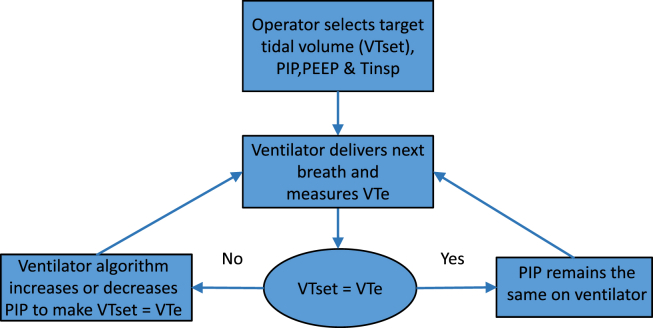 Figure 1: A published titration algorithm for tidal volume-targeted ventilation, comparing measured expired tidal volume with the set target to adjust peak inspiratory pressure (PIP) and PEEP within the pressure ceiling. (Source: Chakkarapani AA, Adappa R, Mohammad Ali SK, et al. International Journal of Pediatrics & Adolescent Medicine 2020. DOI: 10.1016/j.ijpam.2020.11.002).
Pitfalls, Troubleshooting and Alarms
Uncuffed-Tube Leak, False Readings and the Flow Sensor
When expired volume under-reads, the controller sees a deficit and raises PIP; if the leak is flow-dependent, the higher PIP worsens it, producing a positive-feedback spiral of rising pressure with unchanged measured volume. Treat it mechanically — reposition the tube, correct depth, reduce neck extension, suction, and upsize if the leak exceeds roughly $40\text{–}50\%$ — never by raising the target or ceiling. The proximal flow sensor compounds the problem: secretions, condensation and water on its wires distort the flow signal and produce false volume readings, spuriously low or spuriously high. Sensors should be drained, dried and replaced per manufacturer guidance, and an unexplained change in measured $V_T$ without a change in chest excursion should prompt sensor inspection first.
Over-Aggressive Auto-Weaning and Patient Effort
During assisted breaths the infant's own effort contributes to $V_T$; when effort increases, the ventilator reads a satisfactory volume and reduces PIP, potentially leaving an improving infant unsupported and at risk of fatigue. A deep spontaneous effort can likewise be misread and cause an inappropriate pressure reduction on later breaths. Poor synchrony makes both delivered and measured volume unreliable.
Alarms and Their Interpretation
"Volume not reached" means the target could not be achieved despite reaching $P_{\max}$ — a large leak, mechanical deterioration or an unrealistic target. Low tidal or minute volume indicates genuine under-delivery. A high-pressure alarm signals falling compliance or an approaching ceiling. Neither should be silenced without deciding which input — target, leak or mechanics — has changed.
flowchart TD
    A["On VG: review V_Te, leak percent and PIP trend"] --> B{"V_Te on target and leak under 30 percent?"}
    B -->|"Yes"| C["Maintain target; wean FiO2 and PEEP"]
    B -->|"No"| D{"Is V_Te persistently below target?"}
    D -->|"Yes, PIP at ceiling"| E["Volume not reached - check leak, sensor, mechanics"]
    D -->|"Yes, PIP below ceiling"| F["PIP rising as intended; confirm calibration"]
    D -->|"No, V_Te above target"| G{"Is PaCO2 below 35 mmHg?"}
    G -->|"Yes"| H["Reduce set V_T toward 4 mL/kg and rate - avoid hypocarbia"]
    G -->|"No"| I["Reduce set V_T by 0.5 mL/kg and reassess gas"]
    E --> J{"Leak above 40 percent or sensor fault?"}
    J -->|"Yes"| K["Reposition or upsize tube; drain or replace sensor"]
    J -->|"No"| L["Reassess PEEP, tube patency and effort"]

    style A fill:#eff6ff,stroke:#3b82f6,stroke-width:2px;
    style E fill:#fef2f2,stroke:#dc2626,stroke-width:2px;
    style H fill:#fee2e2,stroke:#ef4444,stroke-width:2px;
    style C fill:#f0fdf4,stroke:#16a34a,stroke-width:2px;
VG does exactly what it is told: if the set $V_T$ is too high it raises PIP until the volume is delivered or $P_{\max}$ is reached. A "volume not reached" alarm is therefore often a safety success; the correct response is to interrogate the target and the lung, not to raise the ceiling.
Comparative Matrix of Ventilator Control Strategies
| Feature | Pressure-Controlled (PC) | Volume-Controlled (VC) | Volume-Guaranteed (VG) |
|---|---|---|---|
| Primary set variable | PIP and inspiratory time | $V_T$ and inspiratory flow | Target $V_T$ with variable PIP |
| Improving compliance | $V_T$ rises; volutrauma and hypocarbia | Pressure falls; volume constant | PIP falls automatically (auto-weaning) |
| Worsening compliance | $V_T$ falls; hypoventilation | Pressure rises; volume constant | PIP rises to ceiling; alarm |
| Leak compensation | None | Partial (sensor dependent) | Active, via expired-volume feedback |
| Principal hazard | Volutrauma, hypocarbia, unstable $V_T$ | Barotrauma from uncontrolled pressure | Ceiling-driven pressure, false sensor readings |
Key Takeaways
- Volume Guarantee is a pressure-controlled breath with volume feedback. The clinician sets the tidal volume and pressure ceiling; the ventilator recomputes PIP each breath from measured expired volume.
- The servo is discrete and deliberately damped. Volume is measured at the Y-piece and the next PIP is adjusted within about $\pm 3\text{ cmH}_2\text{O}$, bounded by the ceiling and floor.
- Auto-weaning is the signature behaviour. As compliance improves PIP falls automatically; as compliance falls PIP rises until the ceiling triggers a "volume not reached" alarm.
- Target $4\text{–}6\ \text{mL}\cdot\text{kg}^{-1}$ of current weight, using $4\text{–}5$ in acute RDS and $5\text{–}6$ in evolving BPD, and recalculate the millilitre setting at every weight change.
- Hypocarbia is the neurotoxic end of the volume spectrum. Keep $PaCO_2$ above roughly $35\text{ mmHg}$; an over-generous target can cause PVL even while the mode prevents gross volutrauma.
- The Cochrane evidence is moderate-certainty and clinically meaningful. Volume targeting reduced death or BPD, hypocarbia, severe IVH, PVL and pneumothorax; death alone and neurodevelopment were not significantly improved.
- Troubleshoot the leak and the sensor before the numbers. A leak above $40\text{–}50\%$ and a contaminated flow sensor are the commonest causes of misleading volume readings and runaway pressure.