Volume-Controlled Continuous Mandatory Ventilation (VC-CMV) and Pressure-Controlled Continuous Mandatory Ventilation (PC-CMV)—traditionally designated as Volume Assist-Control (V-A/C) and Pressure Assist-Control (P-A/C)—represent the fundamental pillars of full-support invasive mechanical ventilation in the intensive care unit. Both modes guarantee a baseline machine-delivered minute ventilation for passive patients while providing full breath assistance whenever the patient initiates an effort. However, they diverge fundamentally in their mathematical control variables, airway pressure dynamics, flow delivery patterns, response to evolving respiratory mechanics, and vulnerabilities to patient-ventilator asynchrony.
Understanding these mechanical distinctions at a deep physiological level allows the intensivist to tailor mode selection to specific pathophysiological states—balancing tight control of arterial carbon dioxide tension ($PaCO_2$) in neurotrauma against stringent transpulmonary pressure limits in acute respiratory distress syndrome (ARDS).
The Chatburn Classification Taxonomy
Modern mechanical ventilation taxonomy, standardized by Robert L. Chatburn, classifies every breath according to three primary physical characteristics:
- Control Variable: The target variable governed by the ventilator's feedback loop during inspiration (Equation of Motion).
- Breath Sequence: The relationship between mandatory and spontaneous breaths (Continuous Mandatory Ventilation [CMV], Intermittent Mandatory Ventilation [IMV], or Continuous Spontaneous Ventilation [CSV]).
- Phase Variables: The specific physical conditions that govern breath initiation (Trigger), breath delivery (Target / Limit), and breath termination (Cycle).
========================================================================================
                              THE EQUATION OF MOTION
                    P_vent(t) + P_mus(t) = (V(t) / C_rs) + (R_aw * Flow(t)) + PEEP
========================================================================================
        |                                                           |
   VOLUME CONTROL                                             PRESSURE CONTROL
   Control Variable: Volume & Flow                            Control Variable: Pressure
   Independent: Flow(t), Volume(t)                            Independent: P_vent(t)
   Dependent:   P_vent(t) (varies with C_rs, R_aw)            Dependent:   Flow(t), Volume(t) (varies with C_rs, R_aw)
========================================================================================
Phase Variable Definitions
Every machine-delivered breath progresses through four distinct operational phases:
$$\text{Trigger} \longrightarrow \text{Limit / Target} \longrightarrow \text{Cycle} \longrightarrow \text{Baseline (PEEP)}$$- Trigger Variable: The signal that initiates inspiration.
- Time Triggering: Occurs at a preset cycle time determined by the backup respiratory rate ($T_{tot} = \frac{60}{RR}$).
- Patient Triggering: Occurs when patient inspiratory effort generates a change in airway pressure ($\Delta P$, typically $-0.5\text{ to }-2.0\text{ cmH}_2\text{O}$) or continuous bias flow ($\Delta \dot{V}$, typically $1.0\text{ to }3.0\text{ L/min}$) that meets the clinician-set threshold.
- Limit (Target) Variable: A parameter (pressure, flow, or volume) that cannot be exceeded during inspiration, but reaching this limit does not terminate the inspiratory phase.
- Cycle Variable: The primary physiological variable (volume, time, or flow) that terminates inspiration and transitions the ventilator into expiration.
- Baseline Variable: The parameter controlled during the expiratory phase, universally configured as Positive End-Expiratory Pressure (PEEP) or continuous positive airway pressure (CPAP).
Volume-Controlled Continuous Mandatory Ventilation (VC-CMV)
VC-CMV WAVEFORM SCHEMATIC (Constant / Square Flow Delivery)
----------------------------------------------------------------------------------------
Pressure    P_peak |            /|
(cmH2O)            |           / |
            P_plat |-----+    /  |
                   |     |   /   |
             PEEP  |-----+--+----+------------------------
                   +--------------------------------------
Flow        V_insp |+------------+
(L/min)          0 |-------------+------------------------
                   |             |  \
                   |             |   \_______ (Exp Flow)
                   +--------------------------------------
Volume             |            /|
(mL)          V_T  |           / |
                   |          /  |
                 0 +---------+---+------------------------
                     Trigger    Cycle
                     (Time/Pt)  (Volume)
----------------------------------------------------------------------------------------
Operational Mechanics and Phase Variables
In VC-CMV, the ventilator's microprocessor algorithm strictly governs tidal volume ($V_T$) and inspiratory flow delivery ($\dot{V}$). Airway pressure ($P_{aw}$) serves as the dependent variable, fluctuating continuously according to changes in total respiratory system compliance ($C_{rs}$), airway resistance ($R_{aw}$), and active patient muscular effort ($P_{mus}$).
- Trigger Variable: Time (mandatory rate) or Patient (flow/pressure threshold).
- Target / Limit Variable: Flow (constant square or clinician-selected decelerating ramp).
- Cycle Variable: Volume (or Inspiratory Time $T_I$ if an end-inspiratory pause is dialed in). Once the predetermined $V_T$ is metered, inspiratory flow abruptly ceases.
Mathematical Dynamics
Under constant (square) flow conditions during passive inflation ($P_{mus} = 0$), airway pressure rises linearly as alveolar volume accumulates:
$$P_{aw}(t) = \text{PEEP} + (\dot{V}_{set} \times R_{aw}) + \frac{\dot{V}_{set} \times t}{C_{rs}}$$At the immediate onset of flow, pressure steps up instantly by an amount equal to the resistive pressure drop across the endotracheal tube and conductive airways ($\Delta P_{res} = \dot{V}_{set} \times R_{aw}$). Thereafter, pressure climbs with a constant slope ($\frac{\dot{V}_{set}}{C_{rs}}$) until the target volume is delivered, culminating in the Peak Inspiratory Pressure ($P_{peak}$):
$$P_{peak} = \text{PEEP} + (\dot{V}_{set} \times R_{aw}) + \frac{V_T}{C_{rs}}$$Applying an end-inspiratory occlusion (inspiratory hold, typically $0.5\text{--}1.0\text{ s}$) brings gas flow to zero ($\dot{V} = 0$). The resistive component dissipates immediately, revealing the Plateau Pressure ($P_{plat}$):
$$P_{plat} = \text{PEEP} + \frac{V_T}{C_{rs}} = \text{PEEP} + \Delta P_{driving}$$Flow Waveforms: Square vs. Decelerating
Modern intensive care ventilators allow the clinician to select between two primary flow profiles in VC-CMV:
- Square (Constant) Flow Waveform: Flow is maintained at a fixed level ($\text{e.g.}, 60\text{ L/min}$) throughout the entirety of $T_I$. This yields the classic linear pressure rise. It produces a lower mean airway pressure ($mPaw$) for identical peak flows but generates a higher $P_{peak}$ due to sustained high end-inspiratory resistive pressure.
- Decelerating (Descending Ramp) Flow Waveform: Flow peaks immediately upon triggering and declines linearly to a preset end-flow percentage (typically $0\text{--}10\text{ L/min}$). For a given $V_T$ and $T_I$, a decelerating ramp delivers the majority of the volume early in the inspiratory phase when alveolar pressure is lowest. This results in:
- A lower $P_{peak}$ compared to square flow at equivalent peak rates.
- A higher $mPaw$, enhancing alveolar recruitment and oxygenation in inhomogeneous lung disease.
- More uniform gas distribution among lung units with heterogeneous regional time constants ($\tau = R \times C$).
Flow Starvation and Work of Breathing
The most severe physiological vulnerability of standard VC-CMV is flow starvation (flow dyssynchrony). Because the clinician locks both $V_T$ and $\dot{V}$, the ventilator cannot adapt if the patient's neurological respiratory drive ($P_{0.1}$) or metabolic demand surges.
When patient inspiratory effort ($P_{mus}$) exceeds the machine's fixed flow delivery, the patient attempts to suck gas out of the circuit faster than it is provided. This creates a dramatic drop in circuit pressure, manifesting as:
- Concave "Scalloping" of the Pressure-Time Waveform: Instead of the normal linear rise, the inspiratory pressure trace deflects downward toward or below the PEEP line.
- Increased Imposed Work of Breathing ($WOB_{imp}$): The patient performs vigorous physical work pulling against a rigid machine flow restriction, driving up oxygen consumption ($\dot{V}O_2$), generating diaphragmatic fatigue, and provoking severe patient agitation.
- Spurious Driving Pressure and Stress: Vigorous eccentric contractions during flow starvation can trigger severe transpulmonary pressure spikes ($\Delta P_L = P_{plat} - P_{es}$), predisposing the patient to patient-self-inflicted lung injury (P-SILI).
Pressure-Controlled Continuous Mandatory Ventilation (PC-CMV)
PC-CMV WAVEFORM SCHEMATIC (Decelerating Exponential Flow Delivery)
----------------------------------------------------------------------------------------
Pressure    P_peak |+------------+
(cmH2O)            |             |
            P_insp |             |
                   |             |
             PEEP  |-------------+------------------------
                   +--------------------------------------
Flow        Peak V | \
(L/min)            |  \  (Exponential Decay)
                 0 |---+---------+------------------------
                   |             |  \
                   |             |   \_______ (Exp Flow)
                   +--------------------------------------
Volume             |            /|
(mL)          V_T  |       _--'' | (Curvilinear Volume Rise)
                   |  _--''      |
                 0 +-+-----------+------------------------
                     Trigger      Cycle
                     (Time/Pt)    (Time)
----------------------------------------------------------------------------------------
Operational Mechanics and Phase Variables
In PC-CMV, the ventilator's servo-valve instantly modulates flow to establish and sustain a constant, clinician-set inspiratory pressure ($P_{insp}$ or $\Delta P$) above PEEP across the entire inspiratory time ($T_I$). Tidal volume ($V_T$) and inspiratory flow ($\dot{V}$) serve as dependent variables, dynamically determined by the respiratory system's mechanical impedance and the patient's effort.
- Trigger Variable: Time (backup rate) or Patient (flow/pressure threshold).
- Target / Limit Variable: Pressure ($P_{insp}$ or $\Delta P$).
- Cycle Variable: Time ($T_I$). The ventilator transitions to expiration strictly when the programmed inspiratory time elapses, regardless of whether gas flow has completed its natural decay.
Mathematical Dynamics and Exponential Flow Decay
At the instant of breath triggering, the ventilator rapidly pressurizes the proximal circuit to the target level ($P_{set} = \text{PEEP} + \Delta P$). This produces an immediate pressure gradient between the upper airway and the uninflated alveoli ($P_{alv} = \text{PEEP}$ at $t = 0$).
Initial peak inspiratory flow ($\dot{V}_{peak}$) is governed entirely by airway resistance:
$$\dot{V}_{peak} = \frac{\Delta P}{R_{aw}}$$As gas rapidly flows into the lungs, alveolar pressure ($P_{alv}(t)$) rises exponentially. Because the driving gradient ($\Delta P - P_{alv}(t)$) progressively diminishes, inspiratory flow decays exponentially as a function of the respiratory system time constant ($\tau_{rs} = R_{aw} \times C_{rs}$):
$$\dot{V}(t) = \dot{V}_{peak} \cdot e^{-\frac{t}{\tau_{rs}}} = \left(\frac{\Delta P}{R_{aw}}\right) e^{-\frac{t}{R_{aw} C_{rs}}}$$The volume accumulated in the lungs at any time $t$ during the breath is:
$$V(t) = \Delta P \cdot C_{rs} \left(1 - e^{-\frac{t}{R_{aw} C_{rs}}}\right)$$Time Constants and Volume Delivery
EXPONENTIAL FLOW DECAY & ALVEOLAR FILLING OVER INSPIRATORY TIME
----------------------------------------------------------------------------------------
Time Elapsed    % Alveolar Equilibrium    Remaining Flow (% of Peak)
----------------------------------------------------------------------------------------
1 x Tau (1τ)            63.2%                      36.8%
2 x Tau (2τ)            86.5%                      13.5%
3 x Tau (3τ)            95.0%                       5.0%
4 x Tau (4τ)            98.2%                       1.8%
5 x Tau (5τ)            99.3%                       0.7%
----------------------------------------------------------------------------------------
If the clinician sets an inspiratory time $T_I \ge 3\text{--}4 \times \tau_{rs}$, flow decays completely to zero before cycling. When flow reaches zero at end-inspiration, there is no resistive pressure drop across the airways ($R_{aw} \times \dot{V} = 0$). Consequently:
$$P_{peak} = P_{plat} = \text{PEEP} + \Delta P$$In a completely passive patient with zero end-inspiratory flow, delivered tidal volume simplifies directly to:
$$V_T = \Delta P \times C_{rs}$$Physiological Advantages of PC-CMV
- Decelerating Flow & Homogeneous Ventilation: High early flow rapidly inflates fast-filling alveoli (short $\tau$), after which sustained pressure allows collateral ventilation (pores of Kohn, canals of Lambert) to recruit slow-filling, diseased alveoli (long $\tau$).
- Rigid Airway Pressure Ceiling: By design, peak airway pressure cannot exceed the programmed $P_{insp}$ under passive conditions, guarding against barotrauma caused by sudden coughing or downstream circuit kinks.
- Variable Flow Adaptation: If the patient makes a strong spontaneous effort ($P_{mus} > 0$), the circuit pressure dips momentarily. The ventilator immediately increases flow delivery to maintain the target pressure, inherently abolishing flow starvation dyssynchrony.
Clinical Hazards and Pitfalls of PC-CMV
- Unstable Tidal and Minute Volume: Because $V_T = \Delta P \times C_{rs}$, any acute deterioration in compliance (e.g., tension pneumothorax, massive atelectasis, abdominal compartment syndrome, endobronchial intubation) or increase in airway resistance (bronchospasm, endotracheal tube biting, secretions) causes an immediate, catastrophic drop in delivered $V_T$ and $\dot{V}_E$, precipitating acute hypercapnic respiratory acidosis.
- Volutrauma During Compliance Improvement: Conversely, as pulmonary pathology resolves (e.g., following surfactant replacement, diuresis, pleural effusion drainage, or recruitment maneuvers), $C_{rs}$ rises. If $\Delta P$ is not promptly down-titrated, delivered $V_T$ will escalate rapidly ($> 10\text{--}12\text{ mL/kg PBW}$), inflicting insidious volutrauma and shearing stress.
- Variable $T_I$ vs. Flow Mismatch: If $T_I$ is configured too short ($T_I < 2\tau$), the breath cycles while substantial inspiratory flow is still entering the lung, truncating $V_T$. If $T_I$ is too long, the patient may attempt active exhalation against a closed machine valve during the terminal pressure plateau, triggering late cycling asynchrony.
Direct Physiological and Clinical Comparison
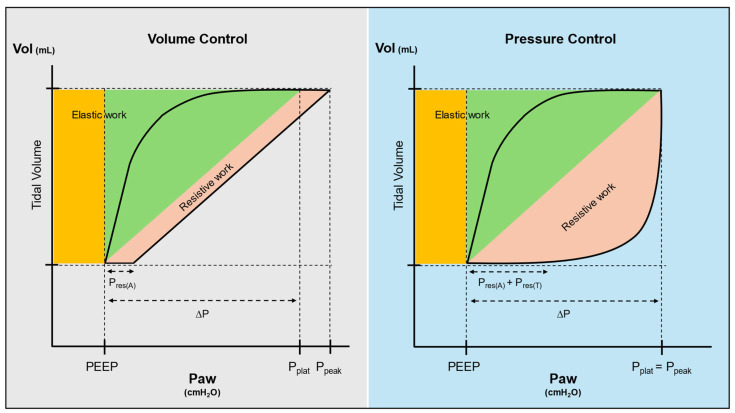 Figure 1: Comprehensive clinical waveform comparison of Volume-Controlled Ventilation (VCV) and Pressure-Controlled Ventilation (PCV). Under VCV with constant flow (left panel), airway pressure climbs progressively to a peak ($P_{peak}$), partitioning into an initial resistive step ($\Delta P_{res} = \dot{V} \times R_{aw}$) and an elastic ramp. Under PCV (right panel), pressure rises instantaneously to a flat plateau, generating a characteristic exponential decelerating flow pattern whose decay rate is dictated by the respiratory system time constant ($\tau = R_{aw} \times C_{rs}$). Dynamic pressure-volume loops demonstrate the differential distribution of resistive versus elastic mechanical work between the two modalities (Adapted under CC-BY 4.0 from Gattinoni et al., J Clin Med 2024; PMC11642134).
| Physiological Domain | Volume-Controlled CMV (VC-CMV) | Pressure-Controlled CMV (PC-CMV) | Clinical Implications & Winner |
|---|---|---|---|
| Primary Guarantee | Constant, locked Tidal Volume ($V_T$) and Minute Ventilation ($\dot{V}_E$). | Constant, locked Peak Inspiratory Pressure ($P_{peak} / P_{insp}$). | VC-CMV wins for strict $PaCO_2$ stability (Traumatic Brain Injury); PC-CMV wins for pressure safety. |
| Dependent Variable | Airway Pressures ($P_{peak}, P_{plat}$). | Tidal Volume ($V_T$) and Minute Ventilation ($\dot{V}_E$). | Must set tight high-pressure alarms in VC; tight low-volume alarms in PC. |
| Flow Waveform Profile | Constant square or linear decelerating ramp (fixed peak flow). | Exponential decelerating flow (variable, demand-responsive peak flow). | PC-CMV matches patient demand more naturally; VC-CMV carries high risk of flow starvation. |
| Mean Airway Pressure ($mPaw$) | Lower $mPaw$ with square flow; moderate $mPaw$ with decelerating flow. | Inherently higher $mPaw$ due to instantaneous square pressure profile. | PC-CMV improves alveolar recruitment and oxygenation at identical $P_{peak}$. |
| Gas Distribution Inhomogeneity | Sequential filling; may favor low-resistance, fast-filling lung compartments. | Improved laminar distribution; early high flow recruits fast units, late plateau fills slow units. | PC-CMV provides superior distribution in heterogeneous ARDS. |
| Hemodynamic Impact | Lower intrathoracic pressure early in inspiration; less preload reduction. | Rapid rise in intrathoracic pressure; higher mean pleural pressure impairs venous return. | VC-CMV causes less hemodynamic compromise in hypovolemic or preload-dependent shock. |
| Auto-PEEP (Dynamic Hyperinflation) Risk | Predictable expiratory time ($T_E = T_{tot} - T_I$); controlled minute volume. | High risk if $T_I$ is prolonged or decelerating flow extends into expiratory phase. | VC-CMV is standard in severe obstructive lung disease (Asthma / COPD exacerbation). |
| Work of Breathing ($WOB$) | Can be severely elevated during high neuro-ventilatory drive (flow starvation). | Markedly lower imposed $WOB$; ventilator increases flow to meet patient effort. | PC-CMV offers superior patient comfort and lower sedation requirements in active patients. |
| Asynchrony Predisposition | Flow starvation, premature cycling, double triggering from unquenched effort. | Variable tidal volume, terminal expiratory fighting if $T_I$ exceeds neural $T_I$. | VC-CMV prone to flow dyssynchrony; PC-CMV prone to cycling dyssynchrony. |
Detailed Clinical Indications
CLINICAL MODE SELECTION MATRIX
----------------------------------------------------------------------------------------
Pathophysiology                     Preferred Mode    Key Physiological Rationale
----------------------------------------------------------------------------------------
Severe ARDS / Heterogeneous ALI     PC-CMV            Decelerating flow; recruits slow units;
                                                      guarantees safe alveolar pressure ceiling.
----------------------------------------------------------------------------------------
Acute Severe Asthma / COPD          VC-CMV            Guarantees fixed minute volume; allows
                                                      prolonged T_E; precisely monitors auto-PEEP.
----------------------------------------------------------------------------------------
Traumatic Brain Injury (TBI / ICP)  VC-CMV            Guarantees strict, predictable V_E to
                                                      maintain tight PaCO2 target (35-38 mmHg).
----------------------------------------------------------------------------------------
Post-Operative General Anesthesia   VC-CMV            Stable ventilation during paralysis and
                                                      laparoscopic insufflation pressure shifts.
----------------------------------------------------------------------------------------
Bronchopleural Fistula / Large Leak PC-CMV            Constant pressure compensates for gas
                                                      loss; prevents cycle-fail hypoventilation.
----------------------------------------------------------------------------------------
Parameter Initialization & Step-by-Step Titration Algorithms
Step 1: Baseline Parameter Setup
                     INITIAL PARAMETER SELECTION FLOWCHART
                                       │
                  ┌────────────────────┴────────────────────┐
                  ▼                                         ▼
         VOLUME CONTROL (VC-CMV)                   PRESSURE CONTROL (PC-CMV)
  ┌───────────────────────────────┐         ┌───────────────────────────────┐
  │ 1. Mode: VC-CMV (A/C Volume)  │         │ 1. Mode: PC-CMV (A/C Pressure)│
  │ 2. V_T: 6-8 mL/kg PBW         │         │ 2. P_insp (ΔP): 10-15 cmH2O   │
  │    (4-6 mL/kg in ARDS)        │         │    (Titrate to 6 mL/kg PBW)   │
  │ 3. Flow: 60 L/min Decelerating│         │ 3. T_I: 0.8-1.0 sec (Adult)   │
  │ 4. RR: 12-16 breaths/min      │         │ 4. RR: 12-16 breaths/min      │
  │ 5. PEEP: 5 cmH2O (or ARDS Net)│         │ 5. PEEP: 5 cmH2O (or ARDS Net)│
  │ 6. FiO2: 1.0 (Titrate ≤0.60)  │         │ 6. FiO2: 1.0 (Titrate ≤0.60)  │
  │ 7. Trigger: Flow 2.0 L/min    │         │ 7. Trigger: Flow 2.0 L/min    │
  └───────────────────────────────┘         └───────────────────────────────┘
Predicted Body Weight (PBW) Calculations
Tidal volumes must always be calculated based on PBW (derived from height and biological sex), never actual body weight:
- Male PBW (kg): $50 + 0.91 \times (\text{Height in cm} - 152.4)$
- Female PBW (kg): $45.5 + 0.91 \times (\text{Height in cm} - 152.4)$
Step 2: Bedside Titration Protocol
========================================================================================
                         BEDSIDE TITRATION & MONITORING PROTOCOL
========================================================================================

1. TARGET OXYGENATION (All Modes):
   - Titrate FiO2 and PEEP in tandem using ARDSNet PEEP/FiO2 tables.
   - Primary Goal: SpO2 92-96% (88-92% in ARDS/COPD), PaO2 55-80 mmHg.
   - Wean FiO2 < 0.60 as rapidly as tolerated to prevent hyperoxic absorption atelectasis.

2. TARGET VENTILATION & ACID-BASE BALANCE:
   - Obtain baseline arterial blood gas (ABG) 20-30 minutes post-initiation.
   - Primary Goal: Arterial pH 7.35-7.45, PaCO2 35-45 mmHg.
   - In ARDS / Severe Asthma: Accept Permissive Hypercapnia (pH ≥ 7.20-7.25).
   - Adjust Minute Ventilation via Respiratory Rate formula:
     RR_new = RR_current * (PaCO2_current / PaCO2_desired)

3. LUNG-PROTECTIVE BIOMECHANICAL CONSTRAINTS:
   - Plateau Pressure: Maintain P_plat ≤ 30 cmH2O (perform inspiratory hold in VC-CMV).
   - Driving Pressure: Maintain ΔP = P_plat - PEEP ≤ 14-15 cmH2O.
   - In PC-CMV: Confirm that end-inspiratory flow reaches zero. If flow does not reach
     zero before cycling, P_plat cannot be accurately assumed to equal P_peak.

4. SAFETY ALARM INITIALIZATION:
   - High Peak Pressure Alarm: Set 10 cmH2O above operating P_peak (Max 35-40 cmH2O).
   - Low Expiratory Minute Ventilation Alarm: Set 20% below target V_E (Crucial in PC-CMV).
   - Low Tidal Volume Alarm: Set 20% below target V_T.
   - Apnea Interval: Set to 15-20 seconds with backup ventilation parameters.
========================================================================================
Advanced Troubleshooting & Pathophysiological Scenarios
Diagnostic Flowchart for High Pressure Alarms in VC-CMV
                           HIGH PEAK PRESSURE ALARM IN VC-CMV
                                           │
                           Perform End-Inspiratory Hold
                                           │
                 ┌─────────────────────────┴─────────────────────────┐
                 ▼                                                   ▼
       ELEVATED P_peak ONLY                               ELEVATED P_peak AND P_plat
     (P_plat Normal ≤ 30 cmH2O)                             (P_plat > 30 cmH2O)
     Transairway Pressure High                             Driving Pressure High
                 │                                                   │
                 ▼                                                   ▼
     AIRWAY RESISTANCE PROBLEM                           COMPLIANCE / ELASTIC PROBLEM
     (R_aw = [P_peak - P_plat] / Flow)                   (C_rs = V_T / [P_plat - PEEP])
     - Endotracheal tube kinked or bitten                - Tension pneumothorax (EMERGENCY)
     - Secretion encrustation / mucous plug              - Worsening ARDS / consolidation
     - Acute severe bronchospasm                         - Pulmonary edema
     - Water condensation in circuit                     - Massive pleural effusion
     - Excessive inspiratory flow rate                   - Abdominal compartment syndrome
     - Patient fighting against flow (starvation)        - Dynamic hyperinflation (Auto-PEEP)
Scenario-Specific Troubleshooting
1. The Obstructive Patient with Flow Dyssynchrony in VC-CMV
- Presentation: Patient with acute COPD exacerbation exhibits violent abdominal tensing, tachypnea, and prominent dip in the pressure waveform during early inspiration.
- Underlying Mechanism: High central drive ($P_{0.1} > 4\text{ cmH}_2\text{O}$) demands an initial flow rate of $80\text{--}90\text{ L/min}$, but ventilator is restricted to $50\text{ L/min}$.
- Corrective Action:
- Increase set inspiratory flow to $70\text{--}80\text{ L/min}$ or switch to a decelerating flow pattern.
- Alternatively, transition to PC-CMV with a short $T_I$ ($0.6\text{--}0.8\text{ s}$) to allow demand-responsive flow while maintaining adequate $T_E$ for complete exhalation.
2. Sudden Severe Hypoventilation in PC-CMV
- Presentation: Intubated trauma patient in PC-CMV exhibits a drop in delivered $V_T$ from $480\text{ mL}$ to $210\text{ mL}$ over 3 minutes, triggering the low minute volume alarm.
- Differential Diagnosis:
- Mainstem endobronchial intubation (effective lung compliance halved).
- Tension pneumothorax.
- Large mucous plug occluding a lobar or main bronchus.
- Massive chest wall rigidity following rapid fentanyl administration.
- Immediate Action: Disconnect patient from ventilator, initiate manual bag ventilation with $100\%\text{ O}_2$ to assess thoracic compliance, auscultate bilaterally, and perform urgent bedside thoracic ultrasonography / chest radiography.
Key Takeaways
- Fundamental Duality: VC-CMV guarantees volume and minute ventilation while leaving airway pressures dependent on mechanics; PC-CMV guarantees airway pressure and decelerating flow while leaving tidal volume dependent on compliance and resistance.
- Flow Synchronization: PC-CMV naturally matches patient inspiratory demand via variable decelerating flow, drastically reducing the risk of flow starvation compared to fixed-flow VC-CMV.
- Safety Monitoring: High-pressure alarms are paramount in VC-CMV to protect against barotrauma; low-minute-volume and low-tidal-volume alarms are mandatory in PC-CMV to prevent insidious asphyxiation from compliance loss.
- Clinical Tailoring: Choose VC-CMV when tight $PaCO_2$ regulation is imperative (severe neurotrauma, elevated ICP) or in severe obstructive airflow disease with auto-PEEP. Choose PC-CMV when lung protection, improved gas distribution, and high oxygenation demand predominate (severe ARDS).