Airway pressure release ventilation (APRV) is a time-cycled, pressure-limited mode in which the airway is held at a high continuous positive airway pressure ($P_{high}$, the CPAP phase) for a prolonged interval and then briefly released to a lower pressure ($P_{low}$) before being restored. There is no imposed tidal volume and no conventional mandatory breath: the operator sets two pressures and two times, the cycle repeats indefinitely, and the patient breathes spontaneously at any point in it. The tidal volume is not delivered by the ventilator — it is released, and is measured as the volume of gas that leaves the lung during the brief low-pressure interval. The mode was described by Downs and Stock in 1987 and remains the purest clinical expression of the "open lung" idea: keep the alveoli open continuously and let the patient's own respiratory muscles provide ventilation.
The commercial names confuse the bedside. Siemens Healthineers sells the mode as Bi-Vent; Medtronic as BiLevel; Dräger as BIPAP and DuoPAP; Hamilton as APRV. All are bilevel pressure modes with spontaneous breathing at both levels, and all become functionally identical to APRV when $T_{high}$ is long (4–6 s) and the release brief. The distinction is branding and default timing, not physiology.
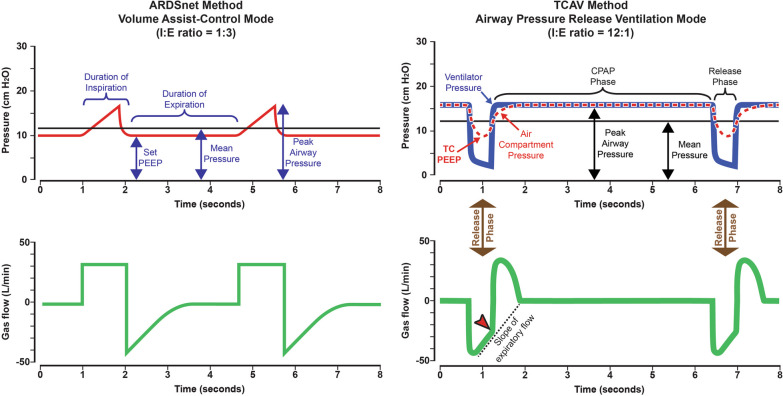 Figure 1: Pressure–time and flow–time curves contrasting ARDSNet volume assist-control with APRV/TCAV: in APRV the CPAP phase occupies about 90% of the cycle, the tidal volume is the gas released during the brief release phase, and the slope of the expiratory flow curve determines the appropriate release duration. (Source: Al-Khalisy H, Nieman GF, Kollisch-Singule M, et al. Respiratory Research 2024;25:41. DOI: 10.1186/s12931-023-02615-y).
Definition and Control Scheme
The Four Set Variables
APRV has an unusually small control panel. The physician sets $P_{high}$ (typically 20–35 $\text{cmH}_2\text{O}$), $P_{low}$ (0–5 $\text{cmH}_2\text{O}$), $T_{high}$ (4–6 s) and $T_{low}$ (0.4–0.8 s). Everything else follows from the patient's respiratory mechanics. The respiratory rate is not set but is the reciprocal of the cycle length,
$$RR = \frac{60}{T_{high} + T_{low}}$$where $RR$ is the release frequency ($\text{breaths/min}$) and the times are in seconds. With $T_{high} = 5.0\ \text{s}$ and $T_{low} = 0.5\ \text{s}$ the mandatory release rate is 10.9/min, and the fraction of the cycle spent at $P_{high}$ is
$$F_{high} = \frac{T_{high}}{T_{high} + T_{low}} \approx 0.91$$a dimensionless ratio that is the mode's defining feature and, at 85–90%, its therapeutic target.
APRV is CPAP interrupted by timed pressure releases. $P_{high}$ and $T_{high}$ are the recruitment phase; $P_{low}$ and $T_{low}$ are the ventilation phase. Spontaneous breathing is permitted and expected throughout both.
Spontaneous Breaths Within the Cycle
Spontaneous breaths are permitted at either pressure level and are the reason the mode is tolerated at light sedation. A breath taken during the CPAP phase is assisted only by the set pressure and the patient's own effort; on Bi-Vent and its equivalents an optional pressure-support component can be added. A breath that begins during the release continues into the next CPAP phase, and the ventilator must sense and support it without terminating the timed cycle. Minute ventilation is therefore the sum of the released volume and the spontaneous contribution, and the two cannot be separated at the bedside without a dedicated monitor.
The Release Phase
During the release, alveolar pressure falls toward $P_{low}$ and gas exits the lung along the expiratory flow–time curve. The volume released becomes the tidal volume. Because the release is time-limited rather than volume-limited, the delivered tidal volume is a dependent, not an independent, variable: it varies breath to breath with compliance, airway resistance, patient effort and the duration of the release. This inverts the logic of conventional ventilation and is the single most important practical consequence of the mode — the clinician titrates pressure and time and then reads the resulting volumes, rather than setting volumes directly.
Why "Bi-Vent" Is Not a Different Mode
In Bi-Vent and its equivalents the operator sets two pressures and a rise time, spontaneous breaths may be pressure-supported, and the mandatory rate follows from the cycle time. With $T_{high}$ at 4–6 s the mode reproduces APRV; with $T_{high}$ shortened to a conventional expiratory time it degenerates into inverse-ratio ventilation without the prolonged recruitment phase. The APRV evidence therefore applies to Bi-Vent only when $T_{high}$ is long.
Physiological Rationale
Sustained Recruitment with Spontaneous Effort
APRV combines the two interventions that most reliably improve oxygenation — a sustained high mean airway pressure and preserved diaphragmatic activity — without the mandatory hypercapnia of inverse-ratio ventilation or the disuse atrophy of deep sedation. The prolonged CPAP phase holds recruiting units open for seconds at a time, converting cyclic recruitment–derecruitment into stable inflation, while the contracting diaphragm distributes ventilation preferentially to the dependent dorsal lung that positive pressure alone tends to spare. Keeping the diaphragm active also counters ventilator-induced diaphragmatic dysfunction, which develops within days of controlled ventilation and contributes to difficult weaning.
Ventilation–Perfusion Matching
Spontaneous diaphragmatic contraction lowers regional pleural pressure, drawing gas and blood into the same dependent units, so ventilation–perfusion matching improves and shunt falls for any given $F_iO_2$. This is the mechanism behind the rise in $P_aO_2/F_iO_2$ seen in physiological studies and small trials, and it may be achieved at a lower cost in overdistension than a comparable increase in PEEP.
Sedation, Paralysis, and Haemodynamics
Because the patient must breathe, APRV is intrinsically a light-sedation strategy, and the sparing of sedatives and neuromuscular blockers is among its most reproducible clinical effects. Spontaneous negative intrathoracic pressure also preserves right-ventricular preload and venous return, so cardiac output is usually better maintained than during controlled ventilation at an equivalent mean airway pressure. The advantage is not unconditional: mean airway pressure is high, and a hypovolaemic or failing right ventricle may still be compromised.
APRV tends to preserve cardiac output by maintaining spontaneous venous return, but it does so at a mean airway pressure of roughly 85–90% of $P_{high}$. Hypovolaemia is unmasked, not treated, by the mode.
Setting the Release
The Expiratory Time Constant
The release must be long enough to allow carbon dioxide to clear and short enough that the lung never collapses. The physics is that of passive expiration from a single compartment, described by the expiratory time constant
$$\tau = R_{rs} \times C_{rs}$$where $\tau$ is the expiratory time constant ($\text{s}$), $R_{rs}$ is expiratory resistance ($\text{cmH}_2\text{O}\cdot\text{L}^{-1}\cdot\text{s}$) and $C_{rs}$ is static respiratory-system compliance ($\text{L}/\text{cmH}_2\text{O}$). Flow then decays exponentially,
$$\dot{V}(t) = \dot{V}_{peak} \times e^{-t/\tau}$$so that terminating the release when flow has fallen to a fraction $f$ of its peak value requires
$$T_{low} = \tau \times \ln\left(\frac{1}{f}\right)$$For $f = 0.75$ this gives $T_{low} \approx 0.29\,\tau$; for $f = 0.50$, $T_{low} \approx 0.69\,\tau$. A stiff injured lung has a short $\tau$ and demands a short release; an obstructive lung has a long $\tau$ and demands a longer one. The same nominal $T_{low}$ therefore transmits different volumes in different patients, which is why the mode is titrated against the flow curve, not a protocol number.
The 50–75% Flow-Termination Rule
The bedside rule is to terminate the release when expiratory flow has fallen to approximately 50–75% of the peak expiratory flow, which in practice yields a $T_{low}$ of 0.4–0.8 s and a release rate of 10–14/min. The aim is deliberately not to empty the lung: ending the release while flow is still substantial traps a small volume, generating intentional intrinsic PEEP that splints the alveoli open and preserves end-expiratory recruitment.
Display flow–time on the ventilator screen. Shorten $T_{low}$ until the release ends while expiratory flow is still 50–75% of its peak. Watch the release volume: too long a $T_{low}$ derecruits and wastes volume, too short a $T_{low}$ causes air trapping, CO₂ retention and rising end-expiratory lung volume.
Release Volume and Driving Pressure
The released volume follows from the pressure step and the fraction of the expiratory equilibrium achieved during $T_{low}$:
$$\Delta V_{release} = C_{rs} \times (P_{high} - P_{low}) \times \left(1 - e^{-T_{low}/\tau}\right)$$and the airway driving pressure of the release is therefore
$$\Delta P_{aw} = P_{high} - P_{low} = \frac{\Delta V_{release}}{C_{rs} \times \left(1 - e^{-T_{low}/\tau}\right)}$$where $\Delta V_{release}$ is in the same volume units as $C_{rs}$ (conventionally mL, with $C_{rs}$ in $\text{mL}/\text{cmH}_2\text{O}$) and the pressures are in $\text{cmH}_2\text{O}$. The clinically relevant distending pressure is the transpulmonary pressure,
$$P_{tp} = P_{aw} - P_{pl}$$with $P_{pl}$ the pleural pressure ($\text{cmH}_2\text{O}$). With $P_{low}$ near zero the full $P_{high}$ becomes the driving pressure of every release, and in a patient making vigorous spontaneous efforts $P_{tp}$ can far exceed the number on the screen.
A $P_{low}$ of 0 $\text{cmH}_2\text{O}$ maximises the driving pressure and the expiratory flow, which is convenient for monitoring and for CO₂ clearance — but it also maximises the shear stress and the rate of alveolar emptying. Set it deliberately, and reassess it in every patient with a stiff chest wall or high spontaneous effort.
T-high, Time at P-high, and Mean Airway Pressure
$T_{high}$ governs how long the recruitment pressure is applied. Alveolar opening is time-dependent, so a longer CPAP phase recruits progressively; 4–6 s is the usual compromise between recruitment time and an acceptable release rate. Lengthening $T_{high}$ raises the fraction of the cycle at $P_{high}$ and lowers the release frequency, reducing carbon dioxide clearance; shortening it does the reverse.
The resulting mean airway pressure is a useful summary of the haemodynamic and recruitment load:
$$P_{mean} = \frac{P_{high} \times T_{high} + P_{low} \times T_{low}}{T_{high} + T_{low}}$$With $P_{high} = 30\ \text{cmH}_2\text{O}$, $P_{low} = 0$, $T_{high} = 5.0\ \text{s}$ and $T_{low} = 0.5\ \text{s}$, $P_{mean} \approx 27\ \text{cmH}_2\text{O}$ — high, and higher still at the alveolar level because of the trapped volume. Interpret the equation as a warning: APRV recruits by holding a genuinely high mean airway pressure, and the haemodynamic price is paid continuously.
Aim to keep $T_{high}$ at roughly 85–90% of the cycle. If the release rate has to be above 14/min to control CO₂, the problem is usually insufficient release volume or excessive dead space, not "$T_{high}$ too long".
Pitfalls, Hazards, and Monitoring
Air Trapping and Unintentional Auto-PEEP
A $T_{low}$ that is too short relative to $\tau$ causes progressive gas trapping: end-expiratory lung volume climbs, the effective $P_{low}$ rises above the set value, release volume falls, and $CO_2$ clearance deteriorates. The signs are a release volume that stops rising, a rising end-expiratory flow curve, haemodynamic compromise and hypercapnia. Obstructive physiology — COPD, asthma, a high secretion load — carries the greatest risk, and severe obstruction is the principal relative contraindication.
Excessive Transpulmonary and Driving Pressures
A high $P_{high}$ against a $P_{low}$ near zero generates driving pressures that would be unacceptable in volume-controlled ventilation, and spontaneous effort superimposes further transpulmonary pressure. The paradox follows: a mode marketed as lung-protective can deliver volutrauma and patient self-inflicted lung injury unless the release volume and the patient's effort are measured. Vigorous spontaneous breathing is not automatically protective.
Patient Discomfort and Asynchrony
Releases are time-triggered and can interrupt the patient's own pattern, producing dyspnoea, air hunger and fighting. Discomfort usually means $T_{low}$ is too long — excessive emptying and derecruitment, so each release feels like a deflating breath — or that the release frequency is mismatched to demand. Sedation is titrated to comfort, not to abolish effort, but a patient who cannot tolerate the release pattern needs the mode reviewed rather than more opioid.
Interpreting Plateau Pressure and Tidal Volume
There is no meaningful end-inspiratory plateau: $P_{high}$ is not a static alveolar pressure and, in the breathing patient, underestimates the true transpulmonary pressure. The displayed tidal volume is the released volume and excludes gas moved by spontaneous breaths during the CPAP phase. Compliance and driving pressure must therefore be read cautiously; the release volume, the flow curve and the patient's work of breathing are the more trustworthy signals.
Ventilator Alarms, Monitoring and Liberation
Three practical problems recur. First, minute-ventilation and low-tidal-volume alarms fire continuously because the released volume is not registered as a tidal volume, and they are often disabled — which removes a safety net that should instead be re-set around the release volume. Second, the mode conceals hypoventilation: a falling release volume may reflect improving compliance or progressive air trapping, and only the flow curve distinguishes them. Third, liberation is a two-step process: wean $F_iO_2$ first, then lower $P_{high}$ in 2 $\text{cmH}_2\text{O}$ steps as oxygenation allows, and finally convert to pressure support or a conventional spontaneous mode once $P_{high}$ is at or below roughly 12–16 $\text{cmH}_2\text{O}$.
APRV removes the tidal-volume guarantee that defines conventional lung-protective ventilation. Without a monitored release volume, a visible flow curve and attention to spontaneous effort, a high $P_{high}$ against a near-zero $P_{low}$ can deliver exactly the regional overdistension the mode is supposed to avoid.
Practical Initiation and Titration
Initiation requires that the patient can breathe, that a significant air leak or untreated pneumothorax has been excluded, and that obstructive physiology has been considered. Typical starting settings and their titration targets are summarised below.
| Parameter | Typical initial value | Titration target |
|---|---|---|
| $P_{high}$ | 28–32 $\text{cmH}_2\text{O}$ (often the previous plateau pressure, capped) | Release volume $\leq$ 8 mL/kg predicted body weight |
| $P_{low}$ | 0 $\text{cmH}_2\text{O}$ (sometimes 5) | Expiratory flow terminated at 50–75% of peak |
| $T_{high}$ | 4–6 s | 85–90% of the cycle at $P_{high}$ |
| $T_{low}$ | 0.4–0.6 s, then adjusted to the flow curve | Release ends at 50–75% of peak expiratory flow |
| Release rate | 10–14/min (derived from $T_{high} + T_{low}$) | Sufficient CO₂ clearance without trapping |
| $F_iO_2$ | 0.3–1.0, then weaned | $S_pO_2$ 88–95% or $P_aO_2$ 55–80 mmHg |
| Sedation | Light; target RASS 0 to $-2$ | Preserve spontaneous effort; treat discomfort by adjusting the release |
flowchart TD
    A["Candidate for APRV: moderate to severe ARDS, refractory hypoxaemia, or failure to wean from high PEEP"] --> B["Exclude untreated air leak, pneumothorax and severe obstructive disease"]
    B --> C["Set P-high 28 to 32 cmH2O, or the last plateau pressure capped at 32"]
    C --> D["Set P-low 0 cmH2O"]
    D --> E["Set T-high 4 to 6 s, giving a release rate of 10 to 14 per minute"]
    E --> F["Set initial T-low 0.4 to 0.6 s, then adjust to terminate expiratory flow at 50 to 75 percent of peak"]
    F --> G{"Release volume at or below 8 mL/kg predicted body weight?"}
    G -->|"No"| H["Reduce P-high by 2 cmH2O, then shorten T-low"]
    H --> G
    G -->|"Yes"| I{"Oxygenation and CO2 acceptable?"}
    I -->|"Hypoxaemia"| J["Increase P-high by 2 cmH2O and lengthen T-high"]
    J --> I
    I -->|"Hypercapnia"| K["Check for air trapping first, then lengthen T-low slightly or increase the release rate"]
    K --> I
    I -->|"Yes"| L["Lighten sedation and monitor spontaneous effort, release volume and haemodynamics"]
    L --> M{"Air trapping, barotrauma or haemodynamic compromise?"}
    M -->|"Yes"| N["Reduce P-high or P-low, treat the cause, consider conversion to conventional ventilation"]
    M -->|"No"| O["Reassess daily; wean FiO2, then P-high, then transition to pressure support"]
The Evidence Base and Its Uncertainties
Physiological and Small Clinical Studies
The physiological case is coherent and largely reproduced: APRV raises end-expiratory lung volume, improves ventilation–perfusion matching and $P_aO_2/F_iO_2$, preserves diaphragm activity, and reduces sedative and neuromuscular-blocker requirements. In a single-centre randomised trial of 138 ARDS patients, Zhou and colleagues found that early APRV, compared with low-tidal-volume ventilation, increased ventilator-free days at day 28 (median 19, interquartile range 8–22, versus 2, interquartile range 0–15; $P < 0.001$) and shortened ICU stay, with a numerically lower ICU mortality (19.7% versus 34.3%; $P = 0.053$). These are encouraging but single-centre results in a selected population, with no demonstrated mortality benefit.
The mechanistic case for the mode rests largely on preclinical work. In porcine and rodent models of ARDS, the time-controlled adaptive ventilation protocol that underlies most modern APRV practice — a $T_{low}$ titrated to terminate at 75% of peak expiratory flow — reduces alveolar instability, atelectrauma and inflammatory mediator release compared with conventional low-tidal-volume ventilation. These are supporting data rather than clinical outcome evidence: they explain the physiological rationale without establishing a treatment effect.
The Meta-Analytic Signal
A PRISMA-compliant meta-analysis of 14 studies and 2,096 patients found that APRV produced a larger increase in $P_aO_2/F_iO_2$ than low-tidal-volume or synchronised intermittent mandatory ventilation, but no significant difference in mortality or ICU stay. The consistent finding is a physiological advantage without a proven survival advantage.
The PHARLAP Trial and the Open-Lung Hypothesis
PHARLAP was the phase II randomised trial that tested the open-lung hypothesis underlying APRV directly. It compared maximal lung recruitment with titrated PEEP and further tidal-volume limitation against conventional protective ventilation in moderate-to-severe ARDS. Enrolment was halted after publication of ART, when only 115 of a planned 340 patients had been randomised. The primary outcome — ventilator-free days at day 28 — was neutral (median 16, interquartile range 0–21, versus 14.5, interquartile range 0–21.5; $P = 0.95$), as were mortality (24.6% versus 26.8%; $P = 0.79$) and barotrauma. The intervention reduced the use of new hypoxaemic adjuvant therapies but increased new cardiac arrhythmia (29% versus 13%; $P = 0.03$).
PHARLAP tested a maximal-recruitment and high-PEEP strategy, not the APRV mode itself, and it was stopped early and therefore underpowered for mortality. Its value is as the cautionary counterweight to the physiological enthusiasm: the surrogate gains of aggressive recruitment did not translate into fewer ventilator days.
The Comparison with Conventional Modes
| Domain | APRV / Bi-Vent with long $T_{high}$ | Volume-controlled ventilation | Pressure-controlled ventilation |
|---|---|---|---|
| Variables set | $P_{high}$, $P_{low}$, $T_{high}$, $T_{low}$ | $V_T$, rate, PEEP, flow | Inspiratory pressure, rate, PEEP, $T_i$ |
| Tidal volume | Dependent (released volume) | Independent (guaranteed) | Dependent on compliance |
| Mean airway pressure | High (85–90% of $P_{high}$) | Set by PEEP and inspiratory pressure | Intermediate to high |
| Spontaneous breathing | Expected throughout the cycle | Usually suppressed | Possible, but unsupported between breaths |
| Sedation and paralysis | Lower requirement | Higher requirement | Intermediate |
| Haemodynamics | Preserved spontaneous venous return; high mean pressure still impedes it | Impaired by positive pressure and sedation | Intermediate |
| Air-trapping risk | High if $T_{low}$ is too short for $\tau$ | Low to moderate | Moderate |
| Lung-protection monitoring | Oblique: release volume, flow curve, effort | Direct: $V_T$, plateau, driving pressure | Direct for pressure, indirect for $V_T$ |
| Evidence for mortality benefit | None demonstrated | Established standard of care | No advantage over volume control |
APRV is best framed as a rescue or alternative mode for refractory hypoxaemia, failure to wean from high PEEP, or patients in whom deep sedation is undesirable. It has physiological appeal, a fragile evidence base, and continuing uncertainty; it should be chosen deliberately, monitored closely, and abandoned readily if it does not deliver.
Key Takeaways
- APRV holds the airway at $P_{high}$ for a prolonged $T_{high}$ and briefly releases to $P_{low}$; the practitioner sets four variables ($P_{high}$, $P_{low}$, $T_{high}$, $T_{low}$), and the patient breathes spontaneously throughout.
- Bi-Vent, BiLevel, BIPAP/DuoPAP and APRV are one bilevel family, functionally identical when $T_{high}$ is 4–6 s; the evidence applies across the naming.
- The tidal volume is released, not delivered: it is a dependent variable determined by $C_{rs}$, the pressure step and $T_{low}$, and must be measured rather than assumed.
- Set $T_{low}$ by terminating the release at 50–75% of peak expiratory flow, giving roughly 0.4–0.8 s and a release rate of 10–14/min; $\tau = R_{rs} \times C_{rs}$ predicts the flow decay and explains why a stiff lung needs a shorter release.
- Terminating the release early is deliberate: the retained volume generates intentional intrinsic PEEP that splints alveoli open, whereas an over-long $T_{low}$ derecruits and an over-short $T_{low}$ traps gas.
- Mean airway pressure is high — approximately 85–90% of $P_{high}$ — so recruitment and haemodynamic cost are paid simultaneously and continuously.
- Advantages: preserved diaphragm activity, better ventilation–perfusion matching, less sedation and paralysis, better-maintained cardiac output. Hazards: air trapping, high transpulmonary and driving pressures, discomfort during releases, and no readable plateau pressure.
- The evidence shows improved oxygenation and shorter ventilation in small studies, no confirmed mortality benefit in meta-analysis, and a neutral primary outcome in PHARLAP: APRV remains a rescue or alternative strategy, not a default.