Positive end-expiratory pressure (PEEP) recruits collapsed alveoli, holds them open across expiration, reduces shunt, and lowers the cyclic shear that tears alveolar-capillary membranes. The same pressure overdistends open units, compresses the capillary bed, and raises right ventricular afterload and dead space. Titration balances two simultaneous injuries — atelectrauma below and overdistension above — rather than finding a single correct number.
The ARDS lung is heterogeneous: oedema, surfactant dysfunction, and the pleural pressure gradient leave a small aerated compartment — the "baby lung" — while dependent regions are flooded or collapsed. A pressure applied at the airway reaches every region at once, overdistending aerated units and recruiting collapsed ones. Because recruitable tissue varies between patients and shifts with position, secretions, and fluid balance, no single optimal PEEP fits a population — or one patient across a day.
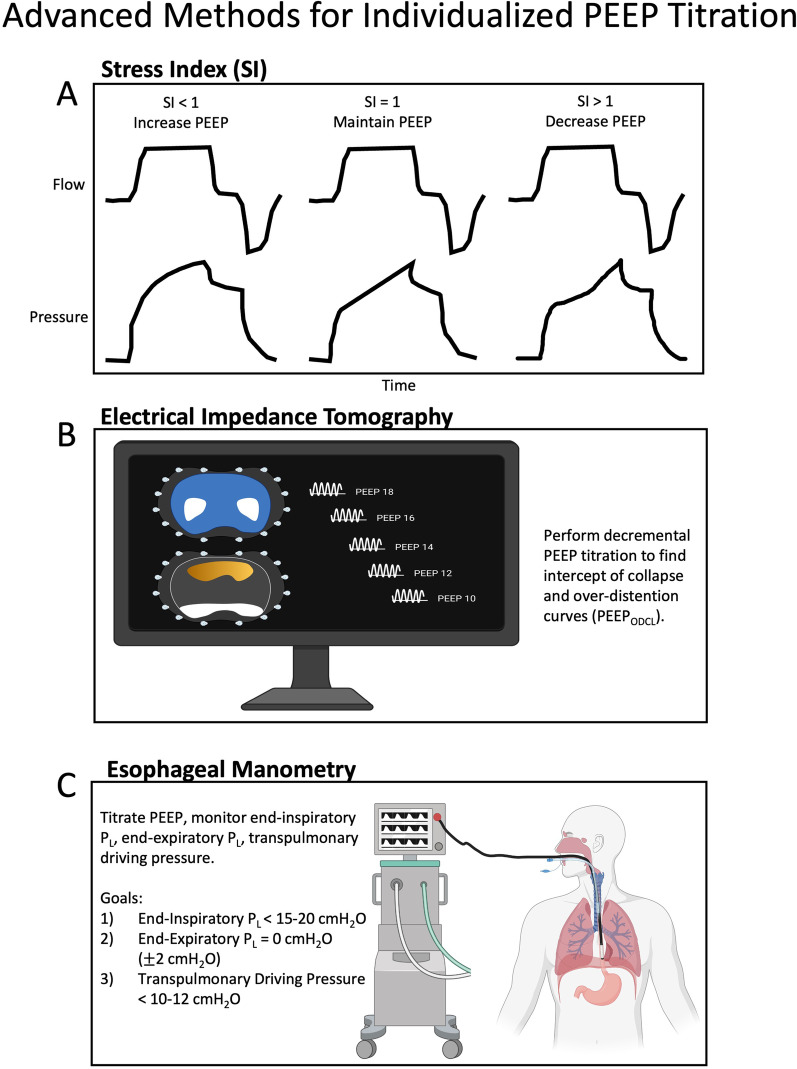 Figure 1: Three bedside methods of PEEP titration: the stress index from the pressure–time curve, electrical impedance tomography with decremental PEEP titration, and oesophageal manometry targeting transpulmonary pressure. (Source: Grotberg JC, Reynolds D, Kraft BD. Crit Care 2023. DOI: 10.1186/s13054-023-04572-w).
Physiological Foundations of Recruitment and Derecruitment
The Mechanics of Alveolar Opening and Closing
In the injured lung, surfactant dysfunction and flooding raise elastic recoil and lung weight, so dependent units are compressed and end-expiratory volume falls below closing capacity. PEEP raises the end-expiratory distending pressure above the airway opening pressure (AOP) of collapsed units. Recruitment is a threshold phenomenon, not a linear dose–response: below its AOP a unit stays closed; above it, it opens abruptly. The governing variable is transpulmonary pressure,
$$P_{tp} = P_{aw} - P_{pl}$$where $P_{tp}$ is transpulmonary pressure, $P_{aw}$ airway opening pressure, and $P_{pl}$ pleural pressure (all $\text{cmH}_2\text{O}$), the last estimated by oesophageal pressure. Recruitable lung ranges from almost none in focal ARDS to more than half the lung in severe diffuse disease.
The true distending pressure of the alveolus is $P_{tp} = P_{aw} - P_{pl}$, not the airway pressure read on the ventilator; plateau pressure alone cannot distinguish a stiff lung from a stiff chest wall.
Atelectrauma and the Competing Risk of Overdistension
Cyclic closing and reopening shears the interface between open and collapsed units — atelectrauma — and releases mediators that injure distant lung. PEEP abolishes atelectrauma, but each increment distends open units, raising alveolar strain, compressing the capillary bed, increasing dead space, raising pulmonary vascular resistance, and imposing a right-ventricular afterload that may precipitate acute cor pulmonale. The two injuries coexist, so at any PEEP some units are protected and others harmed.
Why No Single Optimal PEEP Can Exist
PEEP transmission to the pleural space depends on chest-wall elastance:
$$\Delta P_{pl} = \Delta P_{aw} \times \frac{E_{cw}}{E_{rs}}$$where the pressures are in $\text{cmH}_2\text{O}$ and $E_{cw}$ and $E_{rs}$ are chest-wall and respiratory-system elastance ($\text{cmH}_2\text{O}/\text{L}$). With a stiff oedematous lung and a normal chest wall only 20–30% of airway pressure reaches the pleural space; with obesity, abdominal hypertension, or a rigid chest wall the fraction may exceed 50–80%. Identical PEEP thus produces different transpulmonary and haemodynamic effects, and the balance shifts with position, secretion load, fluid balance, and disease stage.
Bedside Titration Methods
Oxygenation Targets and the ARDSNet PEEP/FiO₂ Tables
The commonest approach pairs PEEP to the FiO₂ needed for a target (PaO₂ 55–80 mmHg or SpO₂ 88–95%), using the ARDSNet lower-PEEP/higher-FiO₂ and higher-PEEP/lower-FiO₂ tables.
| FiO₂ | Lower PEEP table (PEEP, cmH₂O) | Higher PEEP table (PEEP, cmH₂O) |
|---|---|---|
| 0.30 | 5 | 12 |
| 0.40 | 5 | 14 |
| 0.50 | 8 | 16 |
| 0.60 | 8 | 18 |
| 0.70 | 10 | 18 |
| 0.80 | 10 | 20 |
| 0.90 | 12 | 22 |
| 1.00 | 12 | 22 |
The advantage is simplicity, and pairing prevents escalating FiO₂ while leaving PEEP untouched. The limitation is fundamental: oxygenation depends on shunt fraction, mixed venous oxygen content, and cardiac output, not recruitability. PaO₂ may rise with overdistension and flow diversion, and fall when PEEP recruits but reduces cardiac output.
Oesophageal Manometry and Transpulmonary Pressure
Because the distending pressure is $P_{tp}$, oesophageal manometry separates lung from chest wall and lets PEEP be set against a physiological target: end-expiratory $P_{tp}$ between $0$ and $+2\ \text{cmH}_2\text{O}$ keeps alveoli open, while end-inspiratory $P_{tp}$ below $15\text{–}20\ \text{cmH}_2\text{O}$ limits overdistension. The balloon measures regional, not global, pleural pressure, is affected by cardiac artefact, and needs validated placement. EPVent-2 found no improvement in death or ventilator-free days with $P_{eso}$-guided versus empirical high-PEEP–FiO₂ strategies.
The Stress Index and the Shape of the Pressure–Time Curve
During constant-flow volume-controlled ventilation the pressure–time curve reflects changing compliance as the lung fills. Fitting the inspiratory curve gives
$$P_{aw}(t) = a \times t^{b} + c, \qquad SI = b$$where $t$ is time ($\text{s}$), $a$ and $c$ are constants ($\text{cmH}_2\text{O}$), and the dimensionless exponent $b$ is the stress index. A linear rise ($SI = 1$) means constant compliance; a downward-concave curve ($SI < 1$) means compliance improves during the breath — tidal recruitment — and argues for more PEEP, while an upward-concave curve ($SI > 1$) means compliance falls — overdistension — and argues for less. It requires a passive patient, square-wave flow, and no auto-PEEP.
Static Pressure–Volume Curve Inflection Points
The static P–V curve, built by stepwise occlusion or supersyringe, carries two inflection points: the lower (LIP), where collapsed units begin to open, and the upper (UIP), where aerated units begin to overdistend. Setting PEEP above the LIP and plateau pressure below the UIP is the classic open-lung prescription, but the LIP is often absent, hysteresis separates the limbs, the curve ignores regional heterogeneity, and the measurement needs paralysis and time.
The Decremental PEEP Trial: Best Compliance and Driving-Pressure Minimisation
Because driving pressure and compliance are inversely related at a fixed tidal volume, the PEEP that maximises compliance minimises driving pressure. After recruitment, PEEP is reduced in 2 cmH₂O steps every 2–3 minutes, recomputing compliance:
$$C_{rs} = \frac{V_T}{P_{plat} - PEEP}$$where $C_{rs}$ is respiratory-system compliance ($\text{mL}/\text{cmH}_2\text{O}$), $V_T$ is tidal volume ($\text{mL}$), and the pressures are in $\text{cmH}_2\text{O}$. Equivalently,
$$\Delta P = P_{plat} - PEEP = \frac{V_T}{C_{rs}}$$with $\Delta P$ the driving pressure ($\text{cmH}_2\text{O}$). Compliance rises as units open, plateaus, then falls with derecruitment; PEEP is set 2 cmH₂O above the best-compliance step. The method needs only a plateau measurement and includes the chest wall, but compliance is a global average, so simultaneous recruitment and overdistension can hide regional harm.
Electrical Impedance Tomography
EIT resolves ventilation regionally. Thoracic impedance varies with aeration, and tidal impedance images identify collapse and overdistension as PEEP falls, allowing selection of the PEEP at which both are least (the ODCL PEEP). It shows regional heterogeneity that global methods miss and tracks position and suctioning in real time, but needs a dedicated device and operator and has no outcome-data support.
| Method | Target or signal | How performed | Key limitations |
|---|---|---|---|
| ARDSNet PEEP/FiO₂ tables | PaO₂ 55–80 mmHg or SpO₂ 88–95% | Pair FiO₂ with table PEEP | Ignores recruitability and chest-wall mechanics |
| Oesophageal manometry | End-expiratory $P_{tp}$ 0 to $+2\ \text{cmH}_2\text{O}$ | Balloon catheter; $P_{aw} - P_{eso}$ | Regional; artefact; EPVent-2 neutral |
| Stress index | $SI = 1$, a linear pressure–time curve | Constant-flow VC; fit $a \times t^{b} + c$ | Needs passive, constant-flow, no auto-PEEP |
| Static P–V curve | PEEP above the LIP; $P_{plat}$ below the UIP | Stepwise occlusion or supersyringe | Slow; needs paralysis; LIP often absent |
| Decremental PEEP trial and driving-pressure minimisation | Highest $C_{rs}$ and lowest $\Delta P \leq 15\ \text{cmH}_2\text{O}$ | Reduce PEEP 2 cmH₂O every 2–3 min | Global average hides regional overdistension; needs passivity |
| Electrical impedance tomography | Least collapse with least overdistension | Electrode belt; regional tidal impedance | Device-dependent; no outcome data |
Recruitment Maneuvers: Techniques and Costs
Sustained Inflation
A sustained inflation holds airway pressure at 30–40 cmH₂O for 20–40 seconds — the circuit clamped in volume mode, or in pressure mode — then PEEP is raised immediately. The aim is to exceed the opening pressure of many collapsed units at once; the usual response is a transient rise in PaO₂ and end-expiratory lung volume. Hypotension is common as venous return falls, and the gain is lost within minutes unless PEEP holds the units open.
Stepwise (Staircase) Recruitment with Decremental PEEP
PEEP is raised progressively — often 5 cmH₂O every few breaths or 30–60 seconds — to 30–40 cmH₂O, with inspiratory pressure held 15 cmH₂O above PEEP in pressure-controlled ventilation, then titrated downward. Spread over minutes, the load is better tolerated and can be interrupted if blood pressure falls, and it suits concurrent compliance, driving-pressure, and EIT monitoring. Its drawback is cumulative time at high airway pressure; escalation to high absolute pressures is not benign.
Pressure-Controlled Recruitment
Pressure-controlled recruitment achieves the same end-inspiratory distension with decelerating flow, distributing gas more evenly and avoiding the abrupt peak of a square pressure wave. Some protocols use a continuous positive airway pressure of 40 cmH₂O for 40 seconds; others stage the pressure. The intent and the risks match sustained inflation.
Rationale, Haemodynamic Cost, and Barotrauma Risk
Recruitment converts non-aerated units to tidal ventilation, reduces shunt and cyclic shear, and lowers driving pressure. Its haemodynamic cost is immediate: raised intrathoracic pressure reduces right-ventricular preload while coexisting overdistension raises pulmonary vascular resistance, so a transient fall in cardiac output and blood pressure is the rule. Barotrauma is the structural cost — pneumothorax, pneumomediastinum, subcutaneous emphysema — and its risk rises with absolute pressure, emphysema, and undrained pleural air.
Untreated pneumothorax, bronchopleural fistula, emphysema with bullae, vasopressor-dependent shock, and raised intracranial pressure. In focal, non-recruitable ARDS the pressure reaches almost only normal lung.
The Evidence Base and Its Cautionary Lessons
Higher-PEEP Strategies Were Neutral
ALVEOLI (2004), LOVS (2008), and EXPRESS (2008) all achieved their physiological objectives — higher PEEP improved oxygenation and sometimes compliance — but none showed a mortality benefit. A surrogate that improves is not necessarily one that matters.
The ART Trial: A Harm Signal
The Alveolar Recruitment for ARDS Trial (ART) randomised 1,010 patients with moderate-to-severe ARDS to a staircase recruitment manoeuvre escalating to high airway pressures plus decremental PEEP titration to best compliance, or to conventional low PEEP. Twenty-eight-day mortality was 55.3% versus 49.3% (hazard ratio 1.20, 95% CI 1.01–1.42; P = 0.041); six-month mortality and ventilator-free days were also worse, and pneumothorax requiring drainage (3.2% vs 1.2%) and barotrauma (5.6% vs 1.6%) increased — a signal that ended routine high-pressure recruitment in unselected ARDS.
High-pressure staircase recruitment plus PEEP titrated to best compliance increased 28-day and 6-month mortality and doubled barotrauma in unselected ARDS. Recruitment is a rescue therapy, not a default.
Where Recruitment Maneuvers Remain Reasonable
Recruitment remains a rescue therapy in documented recruitable disease with life-threatening hypoxaemia and after a derecruitment event (suctioning, disconnection, transport, bronchoscopy). Use the lowest pressure that recruits, for the shortest time, with haemodynamic monitoring, followed by a decremental PEEP trial. A Cochrane review found low-quality evidence that open-lung strategies including recruitment may reduce intensive-care mortality without increasing barotrauma, but co-interventions preclude isolating the manoeuvre's effect.
Practical Bedside Guidance
Monitoring Driving Pressure and Mechanical Power
Driving pressure should be recorded at every PEEP step: in a passive patient $\Delta P = P_{plat} - PEEP$, and values at or below $15\ \text{cmH}_2\text{O}$ are associated with improved survival. Because $\Delta P = V_T / C_{rs}$, it expresses the strain on the baby lung. Mechanical power integrates pressure, volume, and rate:
$$MP \approx 0.098 \times RR \times V_T \times \left(P_{peak} - \frac{1}{2}\Delta P\right)$$where $MP$ is mechanical power ($\text{J/min}$), $RR$ respiratory rate ($\text{breaths/min}$), $V_T$ tidal volume ($\text{L}$), and $P_{peak}$ and $\Delta P$ are in $\text{cmH}_2\text{O}$; the constant $0.098$ converts $\text{cmH}_2\text{O}\cdot\text{L}$ to joules. Values above roughly 17 J/min are associated with injury; PEEP can lower or raise both depending on whether it recruits or overdistends.
Recognising Haemodynamic Compromise
Every PEEP increment and recruitment manoeuvre is a haemodynamic intervention, so continuous arterial monitoring is mandatory. A mean arterial pressure below 65 mmHg, a sustained fall over 20% from baseline, a new tachyarrhythmia, a rising lactate, or falling urine output means the pressure has passed beyond the useful part of the recruitment curve. Stop, reduce PEEP, and restore preload and perfusion pressure with fluid and noradrenaline rather than persevering for an oxygenation target. Rising central venous pressure with falling cardiac output suggests right-ventricular failure.
Watch the arterial waveform, not only the number. A narrowing pulse pressure and rising heart rate during a PEEP step often precede the fall in mean arterial pressure by 30–60 seconds.
Decremental Titration and the Lowest Effective PEEP
PEEP is a drug with a dose, an effect, and a toxicity, and should be de-escalated whenever it is not earning its keep. After recruitment, titrate downward and select the lowest PEEP that preserves recruitment, judged by compliance and driving pressure, reassessing daily and after any change in position, sedation, or fluid balance. If PEEP cannot be reduced without derecruitment and hypoxaemia persists, escalate along a different axis — prone positioning, neuromuscular blockade, or extracorporeal support — rather than adding pressure to a lung with no recruitable units left.
A PEEP Titration and Recruitment Algorithm
flowchart TD
    A["Moderate to severe ARDS on invasive ventilation"] --> B["Optimise: tidal volume 6 mL/kg predicted body weight, plateau pressure at most 30 cmH2O"]
    B --> C{"Recruitable lung?"}
    C -->|"Focal, non-recruitable"| D["Use the ARDSNet lower PEEP table"]
    C -->|"Diffuse, recruitable"| E["Recruit: sustained inflation 30 to 40 cmH2O for 20 to 30 seconds"]
    E --> F["Decremental PEEP trial: start at 20 to 24 cmH2O, reduce by 2 cmH2O every 2 to 3 minutes"]
    F --> G{"Best compliance or lowest driving pressure?"}
    G -->|"No"| F
    G -->|"Yes"| H["Set PEEP 2 cmH2O above the best-compliance step"]
    H --> I{"Haemodynamic compromise?"}
    I -->|"Yes"| J["Stop, lower PEEP, give fluid and vasopressor"]
    I -->|"No"| K["Reassess PEEP daily; if hypoxaemia persists, consider prone positioning or ECMO"]
Key Takeaways
- PEEP recruits collapsed lung while overdistending open lung; titration minimises the sum of atelectrauma and overdistension rather than seeking a universal optimum.
- Recruitability, chest-wall elastance, position, and disease stage all shift the balance, so no single PEEP fits every patient and PEEP must be re-titrated.
- The ARDSNet PEEP/FiO₂ tables are reproducible but oxygenation-based; oxygenation is a poor surrogate for recruitment and overdistension.
- Oesophageal manometry, the stress index, static P–V curves, decremental best-compliance trials, driving-pressure minimisation, and EIT each interrogate a different surrogate, with blind spots.
- Monitor driving pressure ($\Delta P = P_{plat} - PEEP = V_T / C_{rs}$) and mechanical power at every PEEP step; best compliance normally coincides with lowest driving pressure.
- Recruitment improves oxygenation transiently but carries haemodynamic and barotrauma costs; ART showed increased mortality with high-pressure staircase recruitment plus titrated high PEEP.
- Use recruitment only as rescue in documented recruitable disease or after derecruitment, at the lowest effective pressure and shortest duration with haemodynamic monitoring.
- Titrate PEEP downward after recruitment to the lowest value that maintains recruitment; if that fails, escalate another way.